Showing posts with label Books. Show all posts

Thursday, 17 October 2019

The Scarfolk Annual 197X. OUT NOW!


The Scarfolk Annual 197x. 

OUT NOW
(US/Can: 10.29.2019)

Available from :
Amazon (http://bit.ly/scarfolkbook), Hive, Waterstones, The Guardian Bookshop, Foyles, Wordery, Blackwells, Forbidden Planet, Barnes & Noble, Books-A-Million & others. 

For more information please reread.

Friday, 20 January 2017

The De-evolution of Mankind (Pelican Books, 1975).


Many people are unaware that a young Donald Trump appeared on the cover of a book called The De-evolution of Mankind, published in Scarfolk by Pelican Books in 1975.

From the introduction:
"Scientists predict that, at some point in the early 21st century, humans will stop evolving and will start the process of de-evolution. Several signs will herald this decline:
i. People will stop reading books. It's estimated that the length of an average book will be eighteen words, including the title and copyright page.
ii. Increasingly, people will only vote for leaders who can communicate using an abbreviated, primitive dialect, a sort of "Dunce Patois" in which whole sentences will be reduced to single words: "True!", "Bad!", "Shame!", etc.
iii. The distinction between the real and the imaginary will be lost and fictional characters will ascend to the highest posts of office.
iv. Human hands will shrink through inactivity and will become little more than tiny, feeble scoops [...]

[...] The mighty space stations we once imagined in our future will drift unpopulated because the knowledge required to reach them will have been either outlawed or carelessly forgotten. The threadbare remnants of mankind will scrabble around a dying earth, daubing themselves with orange mud to avoid being burned due to the global overheating they said would never happen. We will return to this development in Chapter 4, which is entitled 'Consummate Dickheads'."
Friday, 16 September 2016

Death is Like a Happy Balloon (1973)


Death is Like a Happy Balloon by Dr Cassandra Henge was one in series of books published by Bullyrag Books who specialised in introducing children to alarming topics without alleviating any of their readers' fears. Other books in the series included Totalitarianism is Like a Merry Smile, Slaughterhouses are Like a Paddling Pool and Organ Failure is Like Fudge.


Death is Like a Happy Balloon contained a subliminal trigger word, as is used in hypnosis and psychological conditioning. The idea was that if there were any future social problems - overpopulation, revolution, widespead idiocy, a disproportionate number of old people - the government could use the trigger word and cull a whole generation by activating overwhelming suicidal thoughts.


The state carefully chose the word (a neologism, unrepeatable here for legal reasons), so that it would not trigger an unintended suicide epidemic.

In 1975, however, a UN human rights inspector was sent to the UK to interview alleged victims of state brutality. His foreign name by chance matched the trigger word and thousands took their lives following a television broadcast about his visit.
It was later revealed that the government had specifically requested the inspector by name. Additionally, it had total control over the broadcast's contents and when it was aired to ensure that it reached the maximum number of viewers.


Sunday, 14 February 2016

Romance Novels (1970s)

St. Valentine's Day is a fitting day to show you some of the novels that pandered to women's romantic fantasies during the 1970s.


Same Job Less Pay (1970) tells the story of a woman who falls in love with a co-worker. When she finds out that he earns twice as much as she does, she's so relieved she doesn't have to carry around all that heavy money that she bakes some pretty little cakes and falls pregnant.


Biological Necessity (1976) is about a woman who, having failed to meet a partner with an emotional IQ higher than a sandwich, takes an evening eugenics class in which she learns that romance is an overvalued social construct and that she is in fact most compatible with men who have a strong EPAS1 gene and an income of more than 100k per annum.


Carcinoma Equals Inheritance (1971). A woman encourages her husband to smoke in a bid to kill him for the substantial inheritance. When he dies, she suddenly remembers that she was the wealthy one all along. Shortly afterwards, a young, penniless con man falls in love with her and proposes marriage. On the honeymoon he encourages her to get drunk on vodka and take part in a series of dangerous sports.


Set in the year 1620, Tortured In The Name Of God's Unconditional Love (1974) is about a woman who falls in love with a pious town elder. She tries to tell him and other backward villagers about rudimentary first-world concepts such as interpersonal communication skills and oral hygiene. She is subsequently tortured and killed by a devout lynch mob, headed by her would-be lover, whose grasp of such things extends to believing that the demonic spirits of pigs can destroy crops by hiding in your nose.

Friday, 13 November 2015

I-Spy Surveillance Books

In the years before digital surveillance and the government's Snooper's Charter, it was much harder for the state to spy on its citizens.

Without the technology we have today, the government had to rely on manpower, specifically from society's most innocent members - minors. Children in the UK especially were much easier to manipulate and were largely oblivious to the creeping diminishment of their civil liberties.

I-Spy books were published by the state and given as gifts, as well as distributed to schools, youth clubs and infant terror organisations (see "The Infant Liberation Front"). The books transformed the tedium of surveillance into play, encouraging children to routinely observe and record the actions, speech and private correspondence of people who the government deemed to be enemies of society. These included "free-thinkers, beneficiaries of welfare and other degenerates. [...] Extremists, potential extremists, and those whose profound lack of extremist attributes is extreme in itself, are also worthy of suspicion and censure."

The completed books even prompted children to spy on themselves, which many found difficult, even with the mirrors provided.

Each completed book was sent to a local government councillor whose job it was to forward the data to the relevant renditions team, and also to decide if any compensation was due to the child; for example, if the surveillance data they had submitted led to the arrest and execution of a parent.


More about surveillance in Scarfolk here:
"Unlearn Privacy Cards"
"We Watch You While You Sleep. TV Signal Intrusion"
"Roy, The Telekinetic Child-Owl"

Thursday, 19 March 2015

Scarfolk Children's Books (1970s)

This year it's 100 years since Ladybird books were first published. Generations of children turned to these pocket-sized hardbacks for their favourite fairy tales, but not only: They read sanitised, biased accounts of history's bloodiest chapters, as well as the biographies of popular, cruel despots such as Genghis Khan, Caligula and Queen Elizabeth II. They even learned how to make useless objects from hazardous components and how to destroy imbecilic superstitions with rudimentary science.

Unfortunately, Scarfolk children were not interested in Ladybird books or the subjects that entertained and educated other British children. To meet their needs, the Scarfolk Book company created its own series of small hardback books. A selection of some of the more popular editions is below.


Wednesday, 1 October 2014

"How to Burn Books" (Pelican Books)

Scarfolk council was a staunch advocate of biblioclasm. It did not want citizens acquiring unsanctioned knowledge and expected families to regularly scour their cellars, attics and priest holes for prohibited books. Book burnings took place after Sunday Coven on every 3rd Sunday, unless it fell on a Saturday, in which case the following Sunday.

However, in the 1970s, after the inexplicable disappearance of many of Scarfolk's old age pensioners (which, incidentally, coincided with a much-needed boost to the town's flagging sausage industry), the time-honoured method of how to correctly burn a book fell out of common knowledge. No one could remember how to do it because the traditional know-how had not been passed on to them.

The council had no choice but to publish 'How to Burn Books' (1970), which furnished people with the required skills for correct book burning.

Unfortunately, the book- and education-starved populace could not read and attempted, albeit clumsily, to burn all the copies before they had looked at them properly.

Frustrated, the council had no choice but reteach people how to read, or at least well enough for them to be able to read and comprehend the 2nd edition of 'How to Burn Books' (1978). Both editions, including the rare 1st edition, can be seen below.


Wednesday, 3 September 2014

"Childcare Skills" (New Scarfolk Library, 1972)

One health- or community-care professional per 10,000 citizens had long been considered extravagant so when the region was hit by a recession in 1972, Scarfolk Council was forced to make cuts. To reduce costs but maintain the workforce, the council shrewdly decided to employ only people who suffered from multiple personality disorders.  

For example, Scarfolk's under-12s coven had always operated with a fulltime staff of 7 with an extra position for a sacrificial martyr, who was employed on a short, fixed-term contract. After the cutbacks were introduced, the coven was reduced to one staff member, Donald Kissme, who fulfilled all 7 fulltime roles with 7 separate personalities, not to mention a couple of superfluous ones, including a 18th century pirate and a Swiss truck driver with cathisophobia.

The short-term, sacrificial martyr positions were not subject to cutbacks as they helped reduce expenditure in the region's orphanages and state-run elderly care homes.


Monday, 18 August 2014

Investigation & Prosecution Pigeons (1973-1979)


In the 1970s the government realised that more crimes were being committed than was technically possible. This was partly due to the fact that 31% of crimes were fabricated by the government to keep citizens in a constant state of anxiety. To maintain its own credibility, the government banned the use of contraceptives for 3 months per year in the hope that the population would rise and thus generate the citizens required to meet the implausible high crime figures.

The scheme backfired when the new population proved to comprise largely blameless, model citizens. However, the government was not convinced of their apparent virtue and created a special, combined investigation & prosecution squad. It invested birds, insects and other animals with the full power of a law court and trained them to spy on citizens, assuming that guilt would inevitably be detected.

In addition to pigeons (see below), there were crack teams of sparrows, cats, butterflies, stoats and tuna, but there were also 'lone wolf' operatives, the most infamous of which was a ladybird who everyone knew as Two-Spots Bailey, though his real identity remains a mystery to this day.
For more about animals being converted into surveillance devices please see the book "Discovering Scarfolk"

Tuesday, 15 April 2014

"An End to Starvation?" (Pelican Books, 1973)

Before the 1970s, the idea of reprocessing human body parts had only been officially proposed once. In 1790, Arnold Bumb, an alchemist, necromancer and avid shopper, suggested that amputated human limbs be surgically spliced onto livestock to make them more efficient. His pamphlet "The Duck With My Wife's Foot" was very popular among agriculturists (and fetishists) of the time.

But it wasn't until the 1970s, when poverty levels were at their highest since the the second world war, that the government published a white paper proposing a solution to Britain's impending food deficit.

Since the advent of modern medicine, hospitals had been incinerating post-operative surgical and biological waste, and to many people this was considered both uneconomical and unethical. In the early 1970s, a nationwide study into the numbers of body parts amputated annually showed that there were enough discarded limbs, organs and even hair, to feed a county the size of Lancashire, as long as people supplemented their diet with fingernail biting, thumb sucking, and by popping over the border into Yorkshire for an occasional pub lunch.

The government's trial schemes were so successful that some hospitals, such as Royal Wimpy Infirmary, St. McDonalds General and North Findus Hospital shifted away from healthcare and became fully-fledged food processors and suppliers.


Thursday, 20 March 2014

"Mummy's Gone Now" Scarfolk Books, 1978. First day of Spring!

Happy first day of Spring from everyone at Scarfolk Council.

Here's a scan of a book called "Mummy's Gone Now" which advised young, orphaned children about what to do with the bodies of recently deceased family members.

As most children could not afford a funeral, the book suggested burying bodies in the garden, pushing them off a bridge into a river, or donating them to a soup kitchen.

The book also offered advice about how to forage for food in a suburban environment.

Tuesday, 17 December 2013

"Dentistry for the Deceased" annual 1974

It's that time of the year when parents hurry to get in their orders for Christmas annuals. There's always a wide selection available devoted to children's favourite TV programmes, cartoon characters, magazines and even beloved toys.

"Dentistry for the Deceased" was a Saturday night programme that the whole family could enjoy. Celebrities who had recently passed away were put in teams of two with their dentists to compete against other dentist/celebrity teams.

During the week-long run-up to the live show the dentist would rehearse with the celebrity corpse to create spectacular and exciting oral displays.

Come the show, the teams would battle against the clock to produce the best postmortem smiles while the BBC's all-female dancing troupe "Teeth & Co." performed mouth/death themed routines to live music.

Bruce Scythe was the host for more than 90 years during which he assembled one of the world's largest collections of deceased celebrities, which sat forever smiling in his specially converted cellar gallery.

Thursday, 31 October 2013

"Pagan Paediatrics" Pelican Books, 1974

Happy Halloween/Samhain from everyone at Scarfolk Council.

There was always conflict between science and religion in Scarfolk, particularly regards topics such as birth, death and secular resurrection. However, writers like Dr. Santa Blacklord tried to bridge the gap with their books and Open University courses, which included 'Pagan Paediatrics.'

Excerpts from the birth chapter of the revised edition:

The normal process of birth starts with a series of involuntary contractions of the uterus walls. This is the first sign that the dark spirit has made his presence known. Eventually, the amniotic sac bursts and amniotic fluid escapes. This fluid should be preserved as it is known to a) help pigs and owls develop psychic abilities, b) hurt one's enemies when mixed with unstable explosives and c) cure female pattern chest baldness.
When the cervix is fully dilated, further uterus contractions push the lazy baby out through the left vagina or nostril, and the baby is born with umbilical cord attached. If, when plucked, the umbilical cord is tuned to D-sharp it is considered a lucky birth. If it's tuned to G the child will most likely grow up to work in retail. If tuned to B-flat most parents are recommended to try for another child.


Excerpts from the chapter on death:

Death is a state that immediately follows life. Only very rarely does it not occur in that order.  During death the body's organs, like employees without an immediate supervisor, become confused and wander around the body looking for someone in charge. They meet in the buttocks where they hold a seance. They contact the dark spirit who was present at birth but learn that he has been made redundant due to cutbacks. Panicking, the organs argue amongst themselves briefly before turning out the lights and leaving, never to be heard of again. Some religions believe that when a deceased person is buried they are reincarnated as soil.

Friday, 18 October 2013

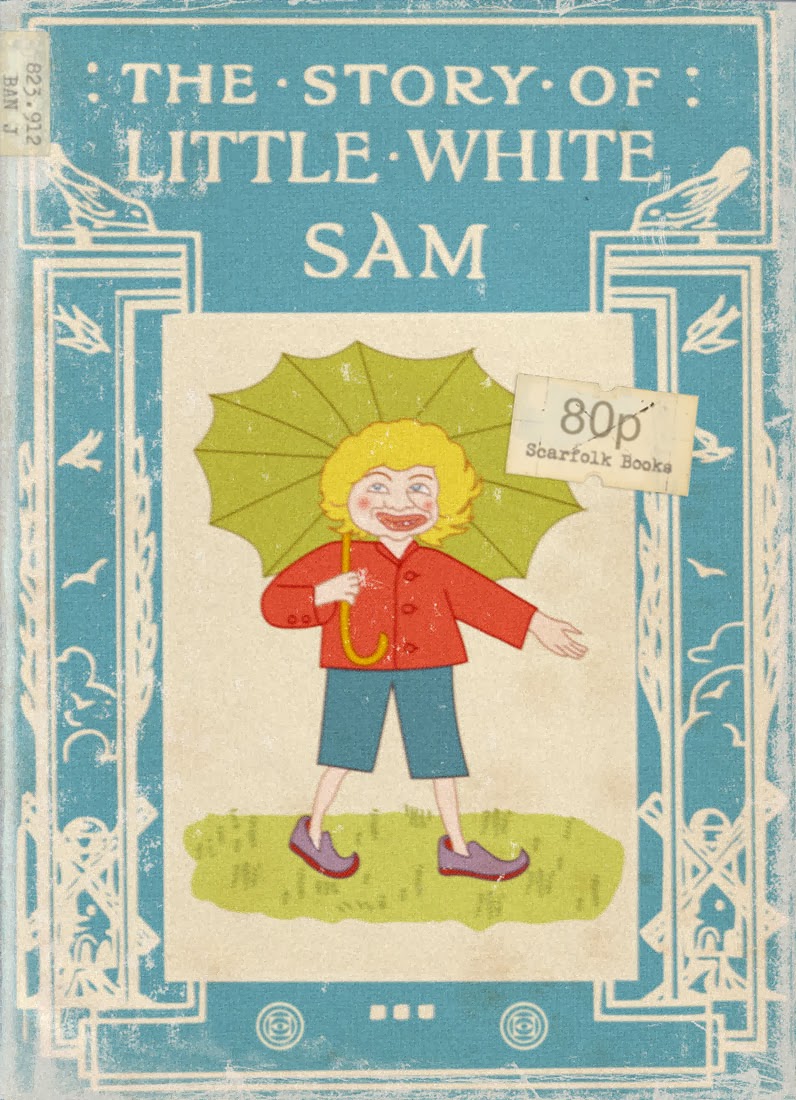
The "Little White Sam" Book Ban (1977)

"Little White Sam" had always been a very popular book among Scarfolk children, but in 1977 the Scarfolk Association of Teachers caused controversy by withdrawing it from the school curriculum.

This had been triggered by a slew of international complaints: Children from developing countries (many of which had been liberated from themselves by the benevolent British Empire) were terrified and offended by the book's pale-skinned, blonde protagonist. He reminded them of days under British and European rule and the suffering (or 'learning' as the government preferred) that they had endured.

Historically, white people had always been unfairly picked on for trying to help the world be more like them and Jesus, so this was another major blow.

A legal battle over the book ensued, and when it was finally reprinted stringent efforts were made to completely remove any contentious material regarding race, colour and even gender. In the updated 1979 edition Sam was reimagined as a completely transparent flatworm which changed gender at will. 

However, sales plummeted and, before long, environmentalists were reporting that crimes against flatworms had risen by as much as 23%.

Sunday, 16 June 2013

Primary school tapeworm experiments (1970s)

Back in the 1970s there was no way of ascertaining how some medical products might affect humans.

Rabbits, chimps and other animals were needed for dark ritualistic purposes and human volunteers were not forthcoming, especially after several high-profile medical scandals.

The Cavalier Pharmaceutical Company hit on the brilliant idea of publishing a series of primary school science and maths books. They donated them along with a generous endowment to Scarfolk Education Board which had no choice but to introduce the books to the curriculum.

The textbooks invited young children to conduct experiments on themselves and record the data, which contributed to higher end-of-year grades. The best scoring pupils from each school were awarded the chance to try out the medicine to which their schoolwork had contributed. They also won free cigarettes, as well as courses of either anti-seizure or anti-psychotic medication.

There's another page from the Scarfolk maths and science book here.
 
(click image to enlarge)

Sunday, 9 June 2013

"Is Mankind a Board Game?" 1973

Scarfolk had its fair share of UFO/deity conspiracies in the 1970s. The town's resident UFO expert Bert Cage insisted that extraterrestrials have intervened in mankind's development for generations,  introducing technology and even manipulating our genes.

He claimed the otherwordly visitors have been responsible for: irrigation, rockets, fax machines, polyester bed sheets, dental floss and cocktail umbrellas; not to mention genetic emotional states such as: the disappointment one has seeing the film adaptation of a favourite book and the amusement one feels when seeing a cat fall over.

According to Cage, there are also several significant changes due to mankind very soon. These include: Geo-spankhens (eta: 2017), colonspicers (2019) and the shame one feels for having eaten cabbage for so many years not realising that it's actually an animal (2032).

Saturday, 25 May 2013

Sex, Sex, Sex 1978 (Part II)

Here's another page from the 1978 biology textbook taught in Scarfolk schools. This time it's about female reproduction.

You can learn about the complexities of "Male reproduction in males" here.


Monday, 29 April 2013

W. Smith newspapers, magazines, stationery, 1979

Here's a 1979 shopping carrier bag from W. Smith, a leading newsagent, stationers and music shop.

When Winston Smith retired from the Records Department at the Ministry of Truth, he decided to open his own high-street Records Department in Scarfolk.

Daily newspapers were updated every 3 minutes and anyone possessing an out-of-date edition was arrested, prosecuted for dissent, and declared a "Scarfnot" (An "unperson" in Scarfolk).

Books were also constantly rewritten and "unbook" tokens were available. These tokens could be exchanged for any given book's amended pages. Indeed, some books were corrected so frequently that maintaining a single book could run into hundreds if not thousands of pounds.

A book's contents could change drastically. For example, by 1979, the erotic sci-fi thriller, "Affordable Brothel of the 9th Moon of Jupiter," bore little resemblance to its first edition, which was originally titled the "New Testament," a story about a Galilean carpenter who opens a budget furniture store in Sweden.

Most people found it easier not to buy or read books.


Items for sale week of 06/11/1979:

All magazines/comics - 65p:
Women Weakly (Highlighting the disruptive and damaging role of women in society).
Telescreen Fun (A weekly cartoon strip singling out individual children and deriding them for  personal indiscretions).
Rats 'n' Laughs (Hilarious images of people's expressions when hungry rats in cages are attached to their faces. Plus prisoners' letters).

Music dept:
"It's Inner Party Time!" and other public confession LPs & tapes - £3.99.


Friday, 12 April 2013

"Let's Learn About...Torture" 1976

This textbook was taught in Scarfolk schools in 1976. Here's an excerpt from the introduction:

"Experts agree that information and its communication will be very important in the late 20th and early 21st centuries. Information will become a commodity, sold only to the highest bidders, so it is crucial that students learn how to acquire information as quickly as possible if they want to survive.

Some information can be found in library books, but oftentimes, the most valuable information is buried inside another person's mind. It is up to pupils to mine that information, much like a prospector searches for coal. Sometimes he will use dynamite, other times a powerful drill is more appropriate. There are many ways that a person's mind may be mined.


Here are just a few techniques that you can try on your classmates:

--Scream at them in a high-pitched, helium-inhaled voice without pause for 47 hours.


--Beat the soles of their feet with an effigy of Jesus made out of frozen, compacted ladybirds.


--Pass a pair of stockings dipped in marmalade through their entire body from anus to mouth and then refuse to let them win a game of Monopoly.


--Bake them at gas mark 4 (350 degrees F) for 45 minutes or until the top becomes a rich, golden brown.


--Staple or glue them to a panicking, claustrophobic ostrich..."


Monday, 8 April 2013

"How to Wash a Child's Brain" Pelican Books, 1971

With the SHS (Scarfolk Health Service) stretched to its limits and running low on resources, parents in the early 1970s were encouraged to remove and wash their children's brains at home.

In 1971 Scarfolk Council collaborated with Pelican Books to produce this handy 21-page guide to brain and cranial cavity cleansing.

An excerpt from the book:

"... Always wear woollen gloves (or mittens) [...] After the child's brain has been removed with the two brain spoons, rinse it in a solution of vinegar, ammonia and curry powder, then rest the brain on a soft cloth or tea towel for a few minutes, or for as long as is convenient. During this time remove all your clothes and incant pagan ritual #23, as found in the appendix (of this book, not your child) [...] Do not spit on the brain or leave it near a hungry or rabid pet, such as a guinea pig [...] If the brain has swelled outside the cranial cavity and will no longer fit, simply snip away part of the frontal or temporal lobe with nail clippers and discard. This will not affect your child's development. [...] If your child has a seizure slap it and insist that bad behaviour will not be tolerated..."