
Scarfolk is a town in North West England that did not progress beyond 1979. Instead, the entire decade of the 1970s loops ad infinitum. Here in Scarfolk, pagan rituals blend seamlessly with science; hauntology is a compulsory subject at school, and everyone must be in bed by 8pm because they are perpetually running a slight fever. "Visit Scarfolk today. Our number one priority is keeping rabies at bay." For more information please reread.
Showing posts with label foreigners. Show all posts
Showing posts with label foreigners. Show all posts
Wednesday, 27 January 2021

Thursday, 6 October 2016
Foreigner Identification Badges (1974)

From 1974, all foreigners (as well as citizens friendly to foreigners) were required by law to wear identification badges. The image above is just one page from a hefty, six volume guide distributed to local councils and border officials. The glossy guide and badges were so expensive to produce that they were manufactured abroad because the dwindling UK print industry no longer had adequate resources.
Additionally, the first print run of the guide had to be recalled after a typo was discovered: A foreign typesetter had accidently rendered every instance of the word 'British' as 'Brutish'.
Friday, 15 July 2016
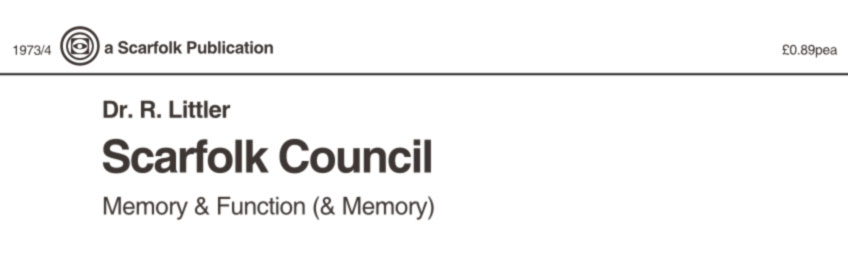
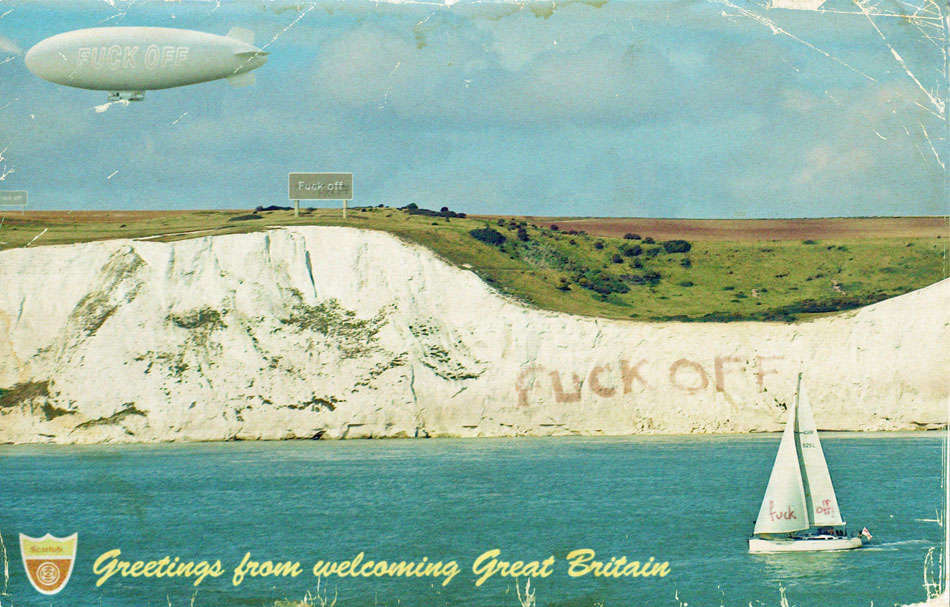
Xenophobic Postcards

In 1972 the University of Scarfolk trialled a new drug that affects the part of the brain that produces racist attitudes.
Researchers observed that the subjects lost control of their bodily functions and had to wear clinical incontinence products. Additionally, many subjects found it difficult to form coherent thoughts, much less verbalise them, and their mental ages registered as those of infants.
The experiment was discontinued, not on ethical grounds, but because the researchers concluded that there were no discernible behavioural and psychological differences between the racists who had taken the drug, and the control group of racists that hadn't.
When the Foreign Secretary read the study's findings, he decided that xenophobia should be extolled as one of Britain's defining virtues and he immediately set out to promote this idea abroad.

Thursday, 3 September 2015
"Welcome Refugees" Poster (1970)
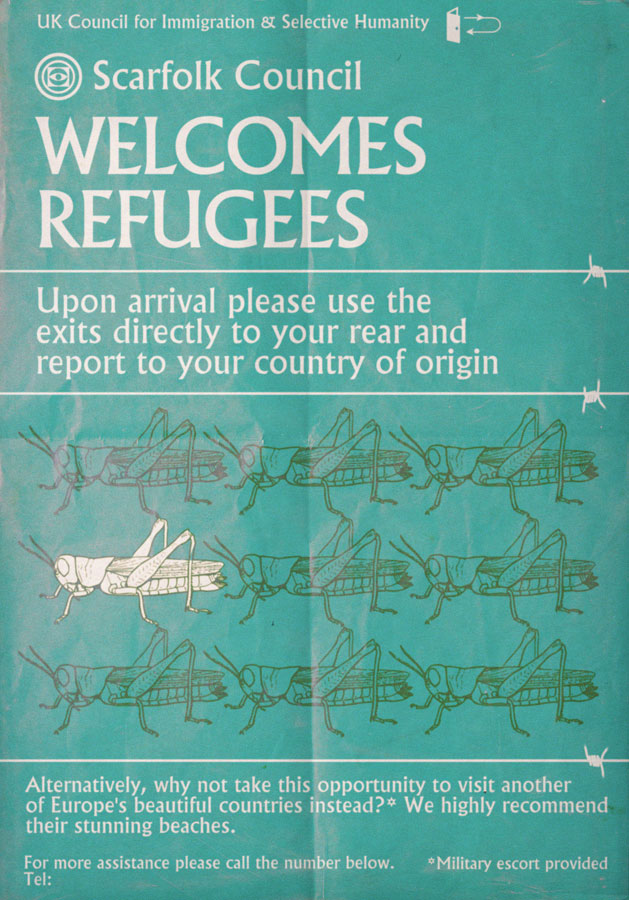
In 1970 Scarfolk Council faced a humanitarian crisis and was asked to take in refugees. Councillors warned that an influx of too many migrants could make Scarfolk susceptible to earthquakes, foreign food and other natural disasters, and that the town may even "become unbalanced, tip over and crash into a neighbouring town".
The mayor in particular expressed concern that a sudden population increase could affect the chances of him getting his favourite parking spot at Scarfolk Visitors' Welcome Centre and that the building of new housing to accommodate refugees may seriously impact the schedule of his builder who had already delayed the building of his kitchen extension twice that year.
Councillors also argued that Scarfolk didn't have the space for refugees and quickly redesignated vast regions of post-industrial wasteland as 'protected areas of outstanding natural beauty'. Despite this, the council was forced take in 1.3 refugees for every 20 citizens. The council promised to observe these requirements to the letter and even hired surgeons to ensure a precise quota.
When refugees finally arrived in Scarfolk, they were met by the poster above, which was clearly intended to deter them even before they passed through customs and immigration.
Friday, 5 June 2015
"Sense a Presence?" Public Information (1970)

In 1970 a council public information campaign warned citizens that they should be afraid, though it didn't clarify exactly what it was they were supposed to be afraid of. Inevitably, this lead to widespread panic. Police, council and coven telephone helplines were inundated with calls by distressed citizens of Scarfolk who had been previously unaware of the danger they were in.
In an attempt to define what the campaign's 'presence' might refer to, the Daily Ail newspaper printed what it believed everyone should fear. What began as a ten-point list quickly grew into a publication as thick as a telephone directory and included: Foreigners; magic gypsies; diseases with a foreign origin or name, e.g, Asian Squid Flu; asylum-seeking succubi and other demons that haunt Britain without the appropriate paperwork; 'other foreigners' not included in the first mention of foreigners; and the threat of rabies from migrating continental bats which refuse to make any attempt to learn the English language.
By the mid-70s Scarfolk was in a frenzy and adults and children alike were accusing all and sundry of being invisible, malevolent presences. Eventually, to allay the fear of its citizens, the council allocated a handful of social workers to each household. Every evening, these workers (actually, mentally-ill criminals sentenced to community service) would conceal themselves beneath beds, in wardrobes, in cellars and attics to ensure that sinister entities had no place to lurk.
Wednesday, 25 February 2015
Pedestrian 'Bastard Lanes' (1970s)
'Bastard Lanes', as they came to be known, were devised for unwed mothers and their unclean offspring. The narrow pedestrian footpaths were identifiable by their double black lines and electrified fences which ran in the gutters of most town streets.
In these two posters, nearly a decade apart, we can see how social policy evolved in Scarfolk. In 1970, the local church authority proposed the lanes as part of its 'campaign for moral decency', but the council banned the campaign, claiming that the church's principles were 'in contravention not only of human rights, but also the rights of foreigners'.

However, it became apparent that the council had only condemned the church as part of a strategy to coax citizens away from traditional religion and toward the state-funded, shadowy cult of Officism (see Discovering Scarfolk).
As the later poster from 1979 shows, despite the council's declared opposition to the church's ethics, the unwed mother lanes were still very much in operation and the alleged injustices of the original religious campaign had simply been rerendered in secular terms.

By the late-1970s, 'Bastard Lanes' had become sites of intense paranormal activity. They were littered with ectoplasm and all over town malevolent pagan spirits wreaked havoc as they brazenly flouted the Green Cross Code.
In these two posters, nearly a decade apart, we can see how social policy evolved in Scarfolk. In 1970, the local church authority proposed the lanes as part of its 'campaign for moral decency', but the council banned the campaign, claiming that the church's principles were 'in contravention not only of human rights, but also the rights of foreigners'.
However, it became apparent that the council had only condemned the church as part of a strategy to coax citizens away from traditional religion and toward the state-funded, shadowy cult of Officism (see Discovering Scarfolk).
As the later poster from 1979 shows, despite the council's declared opposition to the church's ethics, the unwed mother lanes were still very much in operation and the alleged injustices of the original religious campaign had simply been rerendered in secular terms.
By the late-1970s, 'Bastard Lanes' had become sites of intense paranormal activity. They were littered with ectoplasm and all over town malevolent pagan spirits wreaked havoc as they brazenly flouted the Green Cross Code.
Wednesday, 17 September 2014
North Scarfolk Independence & the "Unity Wall" (1974)
Back in 1973, residents of sparsely-populated North Scarfolk wrote to Father Christmas and asked if they could have independence. The North Scarfolkians had long felt that South Scarfolk had taken advantage of their natural resources - seashells - which they painted with pretty colours and glued together to make funny little characters and animals. These novelty items were valued as far afield as Wales.
Scarfolk Council eventually acquiesced. It granted North Scarfolk its independence and made it a gift of an unassailable, wall-shaped monument to celebrate its new-found sovereignty. The 'Unity Wall', as the south preferred to call it, also provided protection and comfort: The council was worried that North Scarfolkians might inadvertently fall off cliffs into the sea, so it made sure that the wall completely surrounded North Scarfolk. Positioned along its length were armed 'monument curators and attendants' who protected the wall for the North Scarfolkians and made sure they didn't accidentally wander out.
Occasionally, a few bad-mannered people from the North, who did not appreciate this artistic symbol of harmony, tried to spoil it for everyone else by attacking the wall, and the curators were forced to benevolently shoot these people for the sake of peace and brotherly understanding.
But on the whole, Scarfolk Council found North Scarfolk to be both amicable and manageable, so much so that it sent all its criminals to live there, presumably so that they could learn from their virtuous neighbours.

Scarfolk Council eventually acquiesced. It granted North Scarfolk its independence and made it a gift of an unassailable, wall-shaped monument to celebrate its new-found sovereignty. The 'Unity Wall', as the south preferred to call it, also provided protection and comfort: The council was worried that North Scarfolkians might inadvertently fall off cliffs into the sea, so it made sure that the wall completely surrounded North Scarfolk. Positioned along its length were armed 'monument curators and attendants' who protected the wall for the North Scarfolkians and made sure they didn't accidentally wander out.
Occasionally, a few bad-mannered people from the North, who did not appreciate this artistic symbol of harmony, tried to spoil it for everyone else by attacking the wall, and the curators were forced to benevolently shoot these people for the sake of peace and brotherly understanding.
But on the whole, Scarfolk Council found North Scarfolk to be both amicable and manageable, so much so that it sent all its criminals to live there, presumably so that they could learn from their virtuous neighbours.
Sunday, 15 June 2014
"Ethnic Cleansing Playset" (Scartoys, 1972)
Scarfolk parents thought it was crucial that their children play with educational toys. This was to help familiarise youngsters with the everyday items that would be indispensable to their adult lives: Vacuum cleaners and kitchenware for girls, for example, and for boys the M1941 Johnson Light Machine Gun, or the M4 Sherman Tank with the 75mm M3/40 cannon.
Toys like the 'Ethnic Cleansing Playset' from Scartoys also taught children invaluable life-lesson skills, such as how to defend oneself against marauding foreigners whose homeland you have decimated for either selfish economic gain, or for parochial, sanctimonious, religious reasons.
Most importantly, over time, such toys inculcated in the child the belief that though the righteousness of their actions was self-evident, they needn't be mundane; they could also be fun.

Toys like the 'Ethnic Cleansing Playset' from Scartoys also taught children invaluable life-lesson skills, such as how to defend oneself against marauding foreigners whose homeland you have decimated for either selfish economic gain, or for parochial, sanctimonious, religious reasons.
Most importantly, over time, such toys inculcated in the child the belief that though the righteousness of their actions was self-evident, they needn't be mundane; they could also be fun.
Click to enlarge
Friday, 18 October 2013
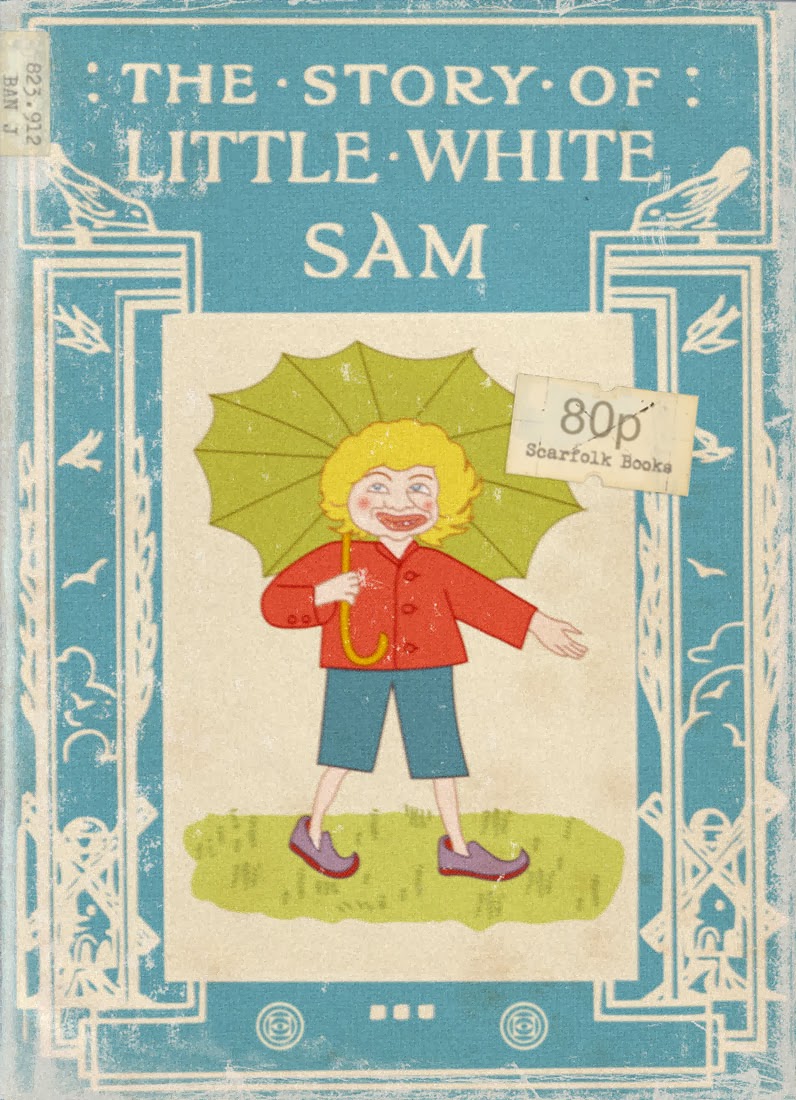
The "Little White Sam" Book Ban (1977)
"Little White Sam" had always been a very popular book among Scarfolk children, but in 1977 the Scarfolk Association of Teachers caused controversy by withdrawing it from the school curriculum.
This had been triggered by a slew of international complaints: Children from developing countries (many of which had been liberated from themselves by the benevolent British Empire) were terrified and offended by the book's pale-skinned, blonde protagonist. He reminded them of days under British and European rule and the suffering (or 'learning' as the government preferred) that they had endured.
Historically, white people had always been unfairly picked on for trying to help the world be more like them and Jesus, so this was another major blow.
A legal battle over the book ensued, and when it was finally reprinted stringent efforts were made to completely remove any contentious material regarding race, colour and even gender. In the updated 1979 edition Sam was reimagined as a completely transparent flatworm which changed gender at will.
However, sales plummeted and, before long, environmentalists were reporting that crimes against flatworms had risen by as much as 23%.

This had been triggered by a slew of international complaints: Children from developing countries (many of which had been liberated from themselves by the benevolent British Empire) were terrified and offended by the book's pale-skinned, blonde protagonist. He reminded them of days under British and European rule and the suffering (or 'learning' as the government preferred) that they had endured.
Historically, white people had always been unfairly picked on for trying to help the world be more like them and Jesus, so this was another major blow.
A legal battle over the book ensued, and when it was finally reprinted stringent efforts were made to completely remove any contentious material regarding race, colour and even gender. In the updated 1979 edition Sam was reimagined as a completely transparent flatworm which changed gender at will.
However, sales plummeted and, before long, environmentalists were reporting that crimes against flatworms had risen by as much as 23%.
Monday, 15 July 2013
"Twice Tasty" Secondhand food schemes (1970s)
Tolerating poor people has always been a challenge to more civilised, useful members of society.
Because of a historical legal statute the poor, unemployed and homeless were not formally recognised as homo sapiens until 1971. Before then they were officially categorised as a class of 'fruit or vegetable' below melon but slightly higher than turnip. Technically, this meant that they could be traded, thrown at petty criminals and fed to pigs, though this rarely occurred.
The government always endeavoured to strike a balance between eliminating the poor (and thus the strain on society) and needing them to fulfill menial, demeaning work: cleaner, road sweep, theologian, etc. It was Dr. Max Gongfarmer, professor of Socially Debased Ethics, who had the idea of feeding secondhand food to the poor after reading an amateur historian's account of Marie-Antoinette's life. According to the typo-ridden book, she uttered "Let them eat cak."
Unsurprisingly, the poor, who have no sense of aesthetics or cleanliness, welcomed the idea and it thrived in 1970s Scarfolk, as can be seen from this newspaper advertisement for the COUP supermarket chain.

Because of a historical legal statute the poor, unemployed and homeless were not formally recognised as homo sapiens until 1971. Before then they were officially categorised as a class of 'fruit or vegetable' below melon but slightly higher than turnip. Technically, this meant that they could be traded, thrown at petty criminals and fed to pigs, though this rarely occurred.
The government always endeavoured to strike a balance between eliminating the poor (and thus the strain on society) and needing them to fulfill menial, demeaning work: cleaner, road sweep, theologian, etc. It was Dr. Max Gongfarmer, professor of Socially Debased Ethics, who had the idea of feeding secondhand food to the poor after reading an amateur historian's account of Marie-Antoinette's life. According to the typo-ridden book, she uttered "Let them eat cak."
Unsurprisingly, the poor, who have no sense of aesthetics or cleanliness, welcomed the idea and it thrived in 1970s Scarfolk, as can be seen from this newspaper advertisement for the COUP supermarket chain.

Monday, 24 June 2013
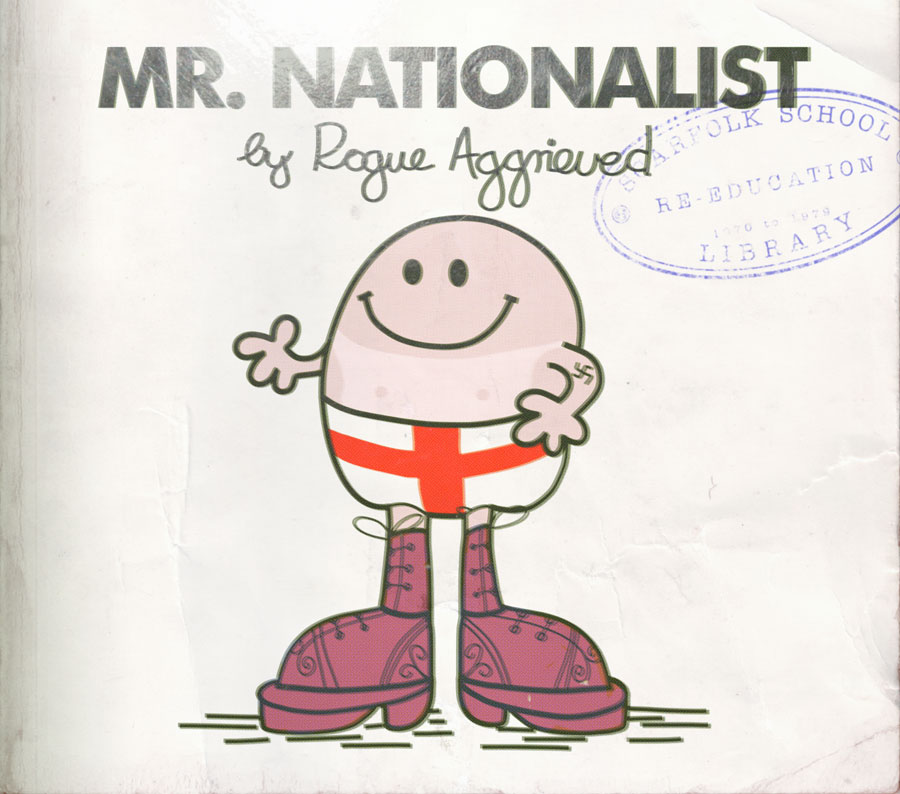
"Mr. Nationalist"
Until 1978 foreigners were officially classified by the government as livestock and were subcategorised by odour.
Defining who was and wasn't English became complicated. By the end of the decade, right-wing nationalists had drawn up a list that demanded the deportation of everyone apart from 9 people, all of who claimed to be the only true English. They even insisted on the deportation of all foreign foods (which they later amended, granting visas to pizza, kebab and curry sauce).
Their spokesperson, Colin Head, said at a 1976 rally:
"We reject foreign influences in England. That is our weltanschauung. Multiculturalism is our bête noire and we strongly believe that English culture is destined to become kaput if the current zeitgeist continues to be de rigueur. But it doesn't have to be a fait accompli and that's why we will continue to be the enfant terrible of modern politics. It's time to act: Carpe diem!"

Defining who was and wasn't English became complicated. By the end of the decade, right-wing nationalists had drawn up a list that demanded the deportation of everyone apart from 9 people, all of who claimed to be the only true English. They even insisted on the deportation of all foreign foods (which they later amended, granting visas to pizza, kebab and curry sauce).
Their spokesperson, Colin Head, said at a 1976 rally:
"We reject foreign influences in England. That is our weltanschauung. Multiculturalism is our bête noire and we strongly believe that English culture is destined to become kaput if the current zeitgeist continues to be de rigueur. But it doesn't have to be a fait accompli and that's why we will continue to be the enfant terrible of modern politics. It's time to act: Carpe diem!"
Friday, 31 May 2013
"Scarfolk Drop" Tourism poster. 1970
Decades before 'assisted suicide' was offered by organisations such as Switzerland's Dignitas, Scarfolk Council had its own kind of 'suicide tourism.'
The mayor and his councillors were always torn between the economic benefits of the tourist industry and not particularly liking outsiders. To balance the dichotomy, advertising man and stand-up arsonist Taylor Church suggested that the tourism board considerably exaggerate how exciting Scarfolk's tourist attractions were and then advertise them to depressives, the terminally ill, etc.
The plan was to raise the hopes of despairing tourists, so that when they arrived at an attraction it was an extreme disappointment - just the nudge they needed to 'take a plunge into the ocean'.
Cleverly, Church also recommended that tourists be guided through gift-shops before visiting the attractions, before disillusionment took too strong a hold.
After the tourist season ended, Scarfolk children would comb the beaches for washed-up snow globes, key-rings, tea towels and other items which were then resold in the shop.

The mayor and his councillors were always torn between the economic benefits of the tourist industry and not particularly liking outsiders. To balance the dichotomy, advertising man and stand-up arsonist Taylor Church suggested that the tourism board considerably exaggerate how exciting Scarfolk's tourist attractions were and then advertise them to depressives, the terminally ill, etc.
The plan was to raise the hopes of despairing tourists, so that when they arrived at an attraction it was an extreme disappointment - just the nudge they needed to 'take a plunge into the ocean'.
Cleverly, Church also recommended that tourists be guided through gift-shops before visiting the attractions, before disillusionment took too strong a hold.
After the tourist season ended, Scarfolk children would comb the beaches for washed-up snow globes, key-rings, tea towels and other items which were then resold in the shop.

Saturday, 18 May 2013
"Pick off your litter" & Mobile Termination Units (1977)
After the case of James Sprout (go here for more detail) the government realised that parents desired more control over their offspring, so, in 1977, laws pertaining to pregnancy and termination were revised and widely expanded.
Adverts, such as the one posted below, were printed in newspapers, magazines and church newsletters.

Many parents either couldn't find the time to drop off their unwanted children at a termination facility, or they just couldn't be bothered, so the MTU (Mobile Termination Unit) was introduced.
The MTU was a fully-equipped bus which travelled to schools, playgrounds, junior covens and prisons for the under 5s. In an attempt to calm children, sounds of laughter were played through tannoys.
Children dreaded being called out of the classroom by uniformed MTU doctors and desperately feigned undiminished magical abilities, but to no avail: The MTU doctors knew all the ruses and highly-trained government psychics tested each child individually before termination.
By 1979 the numbers of children in Scarfolk (in particular red-haired, bespectacled, and those who never wiped their noses) were drastically reduced, which prompted parent-teacher associations to hold a town fête.
Adverts, such as the one posted below, were printed in newspapers, magazines and church newsletters.

Many parents either couldn't find the time to drop off their unwanted children at a termination facility, or they just couldn't be bothered, so the MTU (Mobile Termination Unit) was introduced.
The MTU was a fully-equipped bus which travelled to schools, playgrounds, junior covens and prisons for the under 5s. In an attempt to calm children, sounds of laughter were played through tannoys.
Children dreaded being called out of the classroom by uniformed MTU doctors and desperately feigned undiminished magical abilities, but to no avail: The MTU doctors knew all the ruses and highly-trained government psychics tested each child individually before termination.
By 1979 the numbers of children in Scarfolk (in particular red-haired, bespectacled, and those who never wiped their noses) were drastically reduced, which prompted parent-teacher associations to hold a town fête.
Wednesday, 1 May 2013
1970s greetings cards
On the subject on stationers (see previous post), here's a greetings card sold during the mid-70s. This one was recently found behind a radiator in the Scarfolk police department of homicide and light entertainment.
Back in 1976 James Sprout was found dead in a Scarfolk canal. He was in a sack weighed down by his favourite toys (Action Man 'plague doctor', Fisher-Price 'death row' and concrete Play-doh)
A murder investigation was soon underway but the police ultimately found no evidence of foul play. They concluded that James had somehow inflicted upon himself a severe head injury from behind then, delirious, climbed into the sack. A forensics expert postulated that while James snoozed, the sack was then dragged four miles by either a vast litter of feral kittens, or the ghosts of unvaccinated foreigners, to the canal bridge where James fell to his watery grave.
When James' grief-stricken parents learned of their son's tragic fate they entered a lengthy period of mourning, consoling themselves by opening a beach-front bar in Barbados where they moved the day after James' funeral.

Back in 1976 James Sprout was found dead in a Scarfolk canal. He was in a sack weighed down by his favourite toys (Action Man 'plague doctor', Fisher-Price 'death row' and concrete Play-doh)
A murder investigation was soon underway but the police ultimately found no evidence of foul play. They concluded that James had somehow inflicted upon himself a severe head injury from behind then, delirious, climbed into the sack. A forensics expert postulated that while James snoozed, the sack was then dragged four miles by either a vast litter of feral kittens, or the ghosts of unvaccinated foreigners, to the canal bridge where James fell to his watery grave.
When James' grief-stricken parents learned of their son's tragic fate they entered a lengthy period of mourning, consoling themselves by opening a beach-front bar in Barbados where they moved the day after James' funeral.

Monday, 22 April 2013
"Never Go With Strange Children" public information poster, 1977

This public information poster was ubiquitous during the mid-1970s when
there was a spate of cases involving adults being abducted from leisure
centres, building sites and nudist beaches.
The police launched a public manhunt hoping that the perpetrator would be swiftly apprehended, but the crimes went unsolved for nearly two years. Terrified grownups would only go outside in groups of four or five and many pubs refused to open.
It was only when a police medium read the entrails of a recently sacrificed tramp that clues were finally unearthed, leading to the arrest of eight year old Steven Benson who had fed his victims to his tortoise, Admiral Twinkles.
When Steven was taken into state care and Admiral Twinkles escaped, it was suggested that the tortoise, which was an illegal immigrant, had used 'Manchurian Candidate' style psychological techniques to manipulate young Steven into subconsciously carrying out his instructions.
Sunday, 24 February 2013
Scarfolk tourism poster 1972
Despite the letter spacing typo on the poster, Scarfolk's 1972 tourism campaign was as successful as the mayor had hoped. Seven tourists visited that summer. Oddly, they were all called Timothy, wore identical clothes and appeared to communicate with each other telepathically. Everyone in Scarfolk called them 'The Tim Seven'.
Three days after they arrived in Scarfolk all the birds disappeared and for months after the Tims left whenever Scarfolk residents tried to use their telephones all they could hear on the other end was distant, frantic backward birdsong.
'The Tim Seven' also claimed they could psychically channel a long-dead Scarfolk resident - a fifteenth century plague doctor called Ranlyn Spangles - but they could only pick up his thoughts that referred to wigs or soup spoons.

Three days after they arrived in Scarfolk all the birds disappeared and for months after the Tims left whenever Scarfolk residents tried to use their telephones all they could hear on the other end was distant, frantic backward birdsong.
'The Tim Seven' also claimed they could psychically channel a long-dead Scarfolk resident - a fifteenth century plague doctor called Ranlyn Spangles - but they could only pick up his thoughts that referred to wigs or soup spoons.

Wednesday, 20 February 2013
Scarfolk Ice-Cream range, 1979
In Scarfolk the ice-cream van man comes between 3 & 4am. You can hear him blaring the haunting Swedish Rhapsody numbers station* from over a mile away.
The ice-cream van man wears a clown mask to disguise the horrific burns on his face because he doesn't want to frighten the children. He uses clothes pegs to hold the mask on because he is missing an ear.
He lives in a nondescript building in an electrical substation and no one knows his name.

*Here's a recording of Scarfolk's ice-cream van playing the Swedish Rhapsody Numbers Station.
http://www.youtube.com/watch?v=GUQUD3IMbb4
The ice-cream van man wears a clown mask to disguise the horrific burns on his face because he doesn't want to frighten the children. He uses clothes pegs to hold the mask on because he is missing an ear.
He lives in a nondescript building in an electrical substation and no one knows his name.

*Here's a recording of Scarfolk's ice-cream van playing the Swedish Rhapsody Numbers Station.
http://www.youtube.com/watch?v=GUQUD3IMbb4
Monday, 4 February 2013
Foreigners & How to Spot Them

Foreigners & How to Spot Them: Safe Methods of Approach, Penguin, 1973.
Subscribe to:
Posts (Atom)