Showing posts with label punishment. Show all posts

Thursday, 4 January 2018

'Loose Tongues' Public Information (1977)


When this poster was distributed by Scarfolk Council in 1977, many people were concerned that they did not understand the poster's message correctly and were thus at risk of unintentionally breaking the law by either talking or not talking about it.

Worried citizens gathered in secret to discuss the poster campaign. Knowing that most homes contained surveillance devices, they debated the poster non-verbally, using hand gestures. Unbeknownst to the clandestine groups, however, specially-trained police mime experts had infiltrated the meetings and reported everything they saw to Scarfolk's police commissioner who, keen to outdo his predecessor's record, had created the public information campaign to boost arrest numbers.

Telephone helplines were set up to provide legal aid to the many who were accused of talking (and not talking) and faced punitive tongue removal. Although the legal experts who manned the lines were not permitted to speak, they were authorised to offer advice via the medium of mime.

Thursday, 14 December 2017

Corporal (& Capital) Punishment


The Scarfolk Education Board was very keen on administering corporal punishment from the moment an infant entered the school system. Punishment was meted out for a wide range of misdemeanours including: 'being less than 5ft tall', 'not being able to clearly elucidate the works of Ludwig Wittgenstein via the medium of mime' and 'poor attendance due to injuries sustained as a result of corporal punishment'.

The reason for the early introduction of corporal discipline was to familiarise children with the idea of capital, or 'grown up', punishment and the fact that it was very expensive. Convicts were expected to meet the exorbitant costs personally, so children likely to commit capital offences were advised to start saving their pocket money from a young age. 'Execution gift tokens' were given at birthdays and Christmas by well-meaning grandparents, as well as given as prizes by schools for spying and reporting on classmates.

Friday, 1 December 2017

The 'Fingers On Lips' Campaign (1978)


Crime in Scarfolk did not rise substantially between 1976 and 1977, largely due to the latest in thought detection techniques* and random public executions. The government, however, did announce that there had been a significant increase in naughtiness.

Many citizens criticised the state for treating them like children. The council denied this but in January 1979, thousands received orders to put 'fingers on lips' while in public. Scarfolk fell silent.

Specially trained police officers patrolled streets, public and private buildings, and handed out on-the-spot fines for various misdemeanours such as not standing up straight, running in corridors and not paying attention. At the officer's discretion, the fines could be substituted for corporal punishment with a slipper, belt, cane or rabid Alsatian.

By the summer of 1979, the scheme was in chaos: So many people had been sent to 'stand in the corner' that a new, much larger corner had to be built - at a cost of £2 million - to accommodate the cramped detainees. In August alone, 94 people died after they raised their hands to go to the toilet but were not given permission. They had simply been forgotten.

At the end of the decade, the council decided that because of a small handful of troublemakers, the whole town would have to be punished: Everyone would have to resit the 1970s.

* See thought-detector vans and thought policy leaflets.

Friday, 1 September 2017

Play Safe Public Information Campaign (1979)


While the state frequently warned children about the dangers of playing on icy ponds, near electrical substations and in open-air, biological weapons laboratories, it failed to take into consideration the decade's plethora of science fiction films and TV programmes, which inspired space-themed games up and down the country.

Scarfolk children, who were known to take greater risks during play, initiated an unfortunate trend that started claiming lives. In 1977, two schoolboys from Scarfolk’s Junior Indoctrination Facility dared each other to endure the harsh extremities of space. Their corpses were eventually located drifting a few hundred miles from earth by tracking the surveillance devices that had been implanted in their frontal lobes at birth.

Concerned parents demanded that the state act immediately. Two years later, (and only after the government realised its child labour factories were losing a steady flow of under-10s), a public information campaign was launched which warned minors about leaving the earth's atmosphere (see poster above). Scarfolk Council also laid many miles of high-altitude, electrified fencing to repel innocent children who might unwittingly stray into outer space.

Thursday, 18 May 2017

"Children: The Cause of All Crime"


In 1970 the Scarfolk Crime Commission embarked on the largest study into crime to date. After two years of intense investigation it found a startling correlation between the types of people who commit crime and their early life experiences.

The findings were unequivocal: 100% of criminals had also once been children.

The council immediately put into effect acts intended to reduce, if not entirely eradicate this insidious cause of crime. Thousands of children were rounded up in camps. Toys were burnt in massive pyres. Adults were sterilised. Anyone who had been in regular contact with children, or had ever been a child, was quarantined in vast bunkers specially built several storeys below the council building.

Though Scarfolk was reduced to a ghost town, the scheme proved a success. During the first month that these stringent measures had been implemented not one crime had been committed. Consequently, at the 1972 Conference of Sham Utopias, a local conservative MP predicted that the most successful towns, and even countries, of the future will be those that eradicate all citizens who have any connection to, or dealings with, children or the adults they grow into.

For more about bad children, see: Brood parasites, Serious Infant Dental Assault, the Never Go with Strange Children campaign and the Infant Liberation Front terror group.

Thursday, 27 August 2015

"No" (1973-1975)


In 1973 Scarfolk Council released the above poster all over town. On the same day it also stopped responding to applications for welfare benefits, in fact it stopped responding to all enquiries from the public.

Those who called the council telephone number were answered by a distant, echoing voice which relentlessly repeated the word 'No'. It wasn't a recorded message and callers could sometimes hear faint whimpering in the background.

Some families received letters from the council which contained a single instance of the word, while others received multi-page letters with 'No' printed many hundreds of times. The longest 'No' letter received by a citizen contained 178,121 pages and was delivered by an articulated lorry, whose number plate also simply read 'No'.

Hoping for a 'No' answer, numerous residents tried to take advantage of the council by asking if they were required to pay their taxes or respect the law. Such people were visited by an impeccably dressed man called Mr. Custard who had rows of paper clips and occult symbols tattooed on his face. He would whisper briefly in the residents' ears before leaving. All were found dead within days of Mr Custard's visit, having slit their own wrists and daubed the word 'No' in their own blood on the walls of their homes.

In 1975 the 'No' era suddenly stopped. The council apologised and claimed that it had simply been the result of a clerical error.


For the 'Stop!' campaign see "Discovering Scarfolk" (page 154). For the 'Don't' campaign go HERE.

Thursday, 30 July 2015

Roy, The Telekinetic Child-Owl (1973-1979)

Scarfolk Council was no stranger to invading the privacy of ordinary families. Back in December we introduced you to the council Christmas Boy (see HERE) who strictly monitored the contentment of families during the festive season. We've since received letters asking how the council kept households in check during the rest of the year.


In 1973 the council engineered a genetically modified creature called Roy. He was the result of cross-breeding barn owls with surplus human infants raised by prying, judgemental, lower-middle-class parents. Roy was cloned and delivered to every family in Scarfolk. His job was to oversee domestic affairs, and, if any family member deviated from officially sanctioned activity, Roy was to berate them by tutting and shaking his head.

Unfortunately, there had been a clinical oversight. Volatile poltergeist DNA had accidentally contaminated Roy's genes when a careless scientist left open a lab window which looked out onto a supernatural-energy processing plant. Instead of the envisioned tutting and head-shaking, Roy flew into violent rages, triggering major telekinetic events. There were reports of Roys decimating entire families and, in one case, allegedly annihilating an entire housing estate.

The council was under pressure to recall the defective owls, but because there had been a sudden drop in the numbers of families claiming benefits, it announced instead that Roy was a resounding success and millions more of the human-owl hybrid were commissioned by the police and social services.

Thursday, 14 May 2015

"Lung Puppy" Sentient Toy (1975)


This magazine scan is of an advert for 'Lung Puppy', one of the many so-called "sentient toys" on the market in the 1970s. Not only did it follow your child anywhere (as long as your child was breathing), it also contained a device in the tongue that tested the child's galvanic skin response. If it detected inappropriate sweating, it assumed guilt and administered a Taser-like shock (see also: electrified Bibles, 'Discovering Scarfolk' p.149). The toy was not recommended for asthmatics or those being regularly waterboarded.

A more sophisticated version of the Lung Puppy - the Lung Alpaca - was used by the prison service to patrol cell blocks in Scarfolk Gaol. However, Lung Alpacas were withdrawn from service when 12 prisoners harvested the Alpaca's wool, knitted tunnelling equipment and escaped. By chance the gang was recaptured when a Lung Puppy which was previously owned by one of the criminals as a child detected his owner's breathing and lead police to the hideout.

Monday, 22 December 2014

Council Christmas Boy

Over the Christmas period, families in 1970s Scarfolk were plunged into a state of fear. They desperately tried to appear happy - or at least meet the minimum contentment levels - in case a council Christmas Boy turned up at their door to inspect them. Though many families were visited, seemingly concurrently, the council claimed there was ever only one boy. Nobody knew his real name.

Family members would often take turns standing in the front windows of their homes where they mimed laughter in the desperate hope that the Christmas Boy would pass them by. He rarely did. Once inside a home, he would sniff or lick the occupants for signs of stress or unhappiness.The Christmas Boy rarely found what he would deem a legally cheerful family and harsh punishments, which varied, were often meted out on the spot.

Families did not usually realise that they had been visited by the Christmas Boy until an hour or two after he had left because his flute was designed to have soporific effects. When these effects wore off, families might find that one or more members had been removed or that broad grins had been fixed on their faces following minor surgery.


A lawfully merry Christmas from Scarfolk Council. Be content...

Wednesday, 10 September 2014

'Hand Amnesty' (1972)

You may recall that we recently touched on crime in Scarfolk. One ubiquitous problem was 'subconscious crime', which was so prevalent in the 1970s that the council was forced to take drastic measures. Although it had complete faith in the integrity and innocence of it citizens, the council did not trust their hands. What were the town's approx. 80,000 hands doing and who were they talking to? There was no way of effectively monitoring or policing the situation.

That's why in 1972 the council offered its first Hand Amnesty and announced that no legal action would be taken against citizens if they turned in their hands to the police. A week before the amnesty date, each home received through the post a parcel containing a local anaesthetic, a miniature hacksaw (or sharp spoon, for working class families) and a raspberry lolly (as an incentive to carry out the necessary procedure).

However, many citizens were confused. If their hands had committed crimes without them being aware of it, how would they know if they were guilty or not? The average person had neither the time nor the resources to systematically surveil their own hands.

Council guidelines suggested the following:

1. If you are already conscious of your subconscious crime please take advantage of the amnesty and surrender your hands to the police. 

2. If you do not recall committing a crime, it is likely that your conscious mind is suppressing the memory of committing a crime. Please take advantage of the amnesty and surrender your hands to the police.

If you fail to comply with either 1. or 2. you will be visited by council surgeons. 

They are on hand 24 hours a day to give you a hand handing in your hands.

Thursday, 29 May 2014

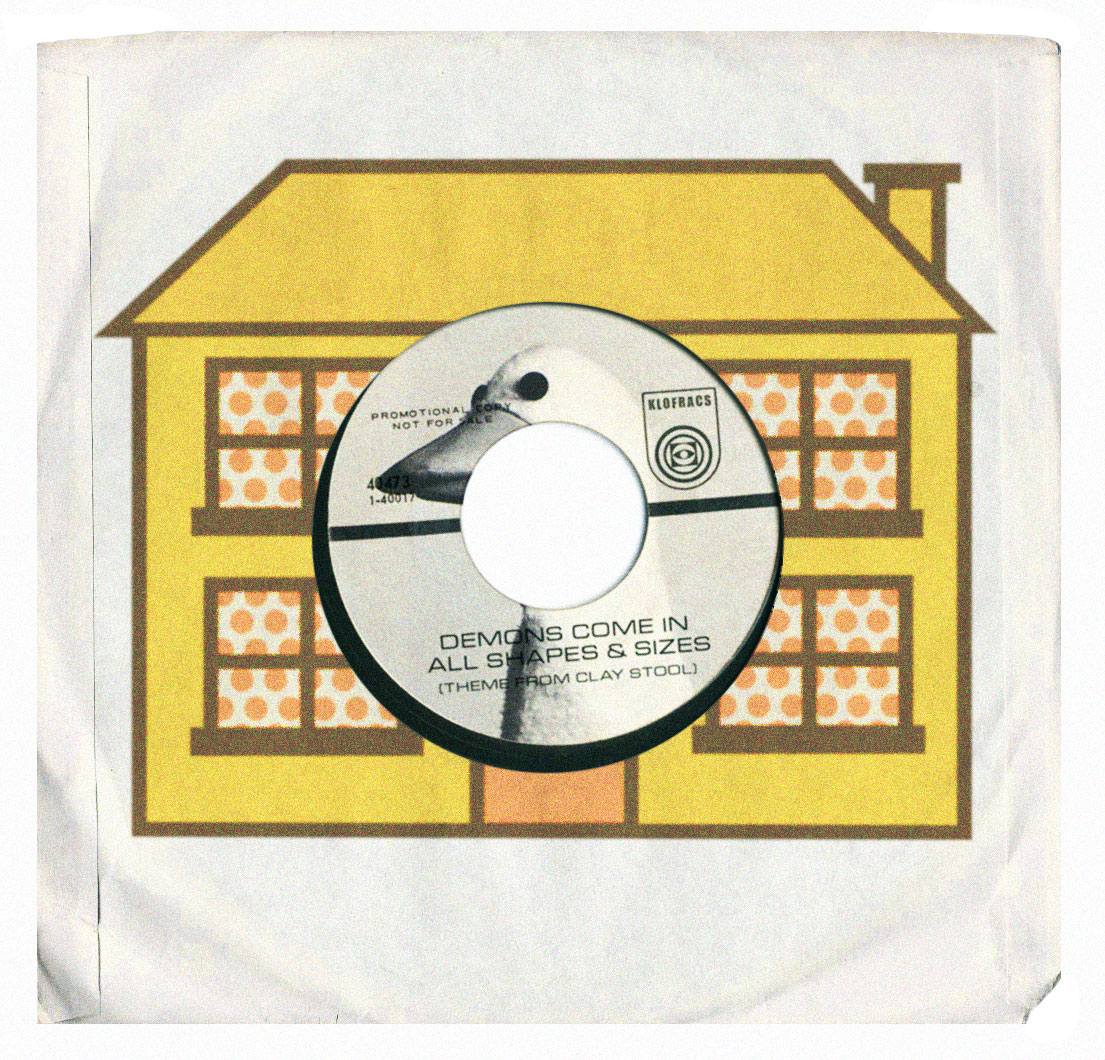
"Clay Stool" TV theme tune (Klofracs Records, 1973)

The theme tune from "Clay Stool," a popular 1970s children's daytime TV programme for 4 to 7 year olds, was released as a single in 1973 under the title "Demons Come In All Shapes & Sizes."


"Clay Stool" acquired its name from a form of medieval punishment for witchcraft. Originally, alleged witches were strapped to a wooden chair - a ducking stool - then plunged into a river. If they sank they were innocent, if they floated they were in league with the devil and summarily executed.

Samuel Revile, a local priest and freelance misogynist, wondered if ducking stools, which were traditionally festooned with dozens of inflated pigs' bladders, colourful helium balloons, and tethered albatrosses had something to do with the high numbers of people being found guilty.

Revile set about inventing the heavier "clay stool." A year after its introduction 100% of accused witches, mostly women, had plummeted to the riverbed where they drowned, proving their innocence.

Revile's work also alerted communities to the dangers of balloons. It was they, he maintained, not the women, that floated and were therefore in league with Satan. To this day, people who make balloon animals are considered unholy and are barred from church jumble sales.

Though Revile revolutionalised the justice system by inventing compassionate torture, he inadvertently caused widespread redundancies in the execution sector.


Listen to the single here:


Or watch the video here:

Thursday, 1 May 2014

"Ask a Policeman" poster (1979)

Crime was always one aspect of policing that hindered the police force from doing its job. That's why, in 1975, the department of justice proposed the radical idea of cutting back on the numbers of crimes that would be tolerated during any given year.

The 1975 crime figures were as high as 100,000, but by 1977 the total number had been reduced to 65,000. This was largely due to a polite but firm public information campaign which targeted offenders, informing them of the new, official crime ration, and explaining just how much pressure the average police officer was under.

Many lawbreakers were sensitive to the needs of the police and either stopped committing crimes completely or only committed those that were legal. Many helped out by leaving incriminating evidence at the scenes of crimes and in 1979 a consortium of gangland bosses even held a charity knee-capping event, the proceeds of which went to the police pedicure fund.


Wednesday, 19 February 2014

"We Watch You While You Sleep" TV signal intrusion 1975

Below is a rare video from the Scarfolk archives.

In 1975 there was a series of anonymous signal intrusions on the Scarfnada TV network. Many believed that the council itself was directly responsible for the illegal broadcasts, though this was never confirmed.

However, in 1976 a BBC TV documentary revealed that the council had surreptitiously introduced tranquillisers to the water supply and employed council mediums to sing lullabies outside the bedroom windows of suspect citizens.

Once a suspect had fallen asleep, the medium would break into their bedroom and secrete themselves in a wardrobe or beneath the bed. From these vantage points the medium could record the suspect's dreams and nocturnal mumblings into a specially designed device called a 'Night Mary', named after the woman who invented it.

The data would then be assessed by a local judge who could meter out the appropriate punishments. Many subconscious criminals were caught this way and the numbers of dream crimes plummeted. Literally overnight.

In addition to the video below, a poster, which can be viewed here, accompanied the scheme.

Monday, 9 December 2013

The "Rem-Exec 1" remote execution system

In the 1970s children were encouraged to take part in and experience all areas of civic life. In addition to compulsory youth clubs, which taught children surveillance skills and how to use them on neighbours and family members, older children were expected to take part in judicial proceedings.

Once a judge had sentenced a criminal in one of Scarfolk's many impromptu mobile courts, local children were expected to help carry out the sentence. They might assist by testing a noose's integrity, filling a hypodermic needle for a lethal injection or polishing the instruments of a masked council 'punisher.' Child executioners were chosen from school reports, much like jury duty.

Later in the decade, parents complained that such activities were too time consuming and got in the way of more important activities such as watching television, which is why Microharsh, a budding computer company, invented the REM-EXEC 1 (The Remote Executioner), a computer system that enabled children to carry out a death penalty from the comfort of their own homes.

The REM-EXEC 1 became so popular that children even began coding their own basic punishment programmes. One well-known one called 'Insert: Explosive Suppository Frog' made 10 year old Stephen Steel a household name.


Monday, 7 October 2013

"Charley says...[obey or die]" (1973)


Bad behaviour was rampant in 1970s Scarfolk and disciplining children was a major concern.

The so-called 'degenerate generation' of children, often from worthless-class backgrounds, was known to actively defy rules and social norms and frequently committed the following appalling offences:

- Stay awake after allotted bedtimes.
- Peel marzipan decorations from cakes.
- Laugh loudly while having fun.
- Read books more advanced than their official reading age.
- Question adults' belief in Father Christmas.
- Cry after having nightmares.
- Refuse to join in educational/life-skills games such as 'lie about a friend,' 'slap-the-immigrant',  'wet someone else's bed.'

In a desperate attempt to curb this destructive, nihilistic behaviour, Scarfolk Health Service launched a treatment regime employing the newly developed 'great flooding' psychological technique*, which exposes the subject to such long durations of relentless and exaggerated cruelty that any desire to be undisciplined is quashed.

*The technique largely comprised of repeated readings of a book called the bible which was written many hundreds of years ago by people who had never heard of knives and forks, washing machines, coat hangers, toilet seats, aluminium kitchen foil or shampoo.

Saturday, 20 July 2013

"Vulnerable Sam: Inflatable Child Substitute" (1972)


This educational product went on the market in late 1972 and was targeted at prospective parents, nursery school teachers and church staff. It afforded them the opportunity to practice their corporal punishment techniques before inflicting them on an actual child.

From the product description:
"'Vulnerable Sam' wants you to hit him (or her). Yes, that's right: Give him a good old whack! (wooden spoon provided). 'Vulnerable Sam' deserves everything you can throw at him. Hone your skills like a pro so when it comes to the real thing you can achieve the perfect balance of injury and compliance. Our research shows that correctly administered physical punishment will produce long-term psychological effects. Guaranteed. Now, that's what we call value for money!

'Vulnerable Sam' requires no medical attention and can't report you to the police or welfare services. So what are waiting for? Pick up that wooden spoon, cricket bat, or red hot poker and strike while the iron's hot!

'Vulnerable Sam's' body can be filled to simulate child body density at different ages:
- Inflate with air (0-2yrs)
- Fill with jam or marmalade (2-3yrs)
- Pack with cooked ham or black pudding (3-4yrs)
- Pack with raw lamb, beef or giraffe (4-6yrs)


Sample admonitions that you might like to try out:
"Sam! Stop it! Only filthy animals defecate where they sleep!"
" Jesus hates you, Sam. It's your fault that he was killed by Italians."
"Why must you constantly remind me of my first child who died?"
"You are irretrievably unaesthetic. I'm ashamed and sense the scorn of my peers."
"Your father is foreign."

Monday, 15 July 2013

"Twice Tasty" Secondhand food schemes (1970s)

Tolerating poor people has always been a challenge to more civilised, useful members of society.
Because of a historical legal statute the poor, unemployed and homeless were not formally recognised as homo sapiens until 1971. Before then they were officially categorised as a class of 'fruit or vegetable' below melon but slightly higher than turnip. Technically, this meant that they could be traded, thrown at petty criminals and fed to pigs, though this rarely occurred.

The government always endeavoured to strike a balance between eliminating the poor (and thus the strain on society) and needing them to fulfill menial, demeaning work:  cleaner, road sweep, theologian, etc. It was Dr. Max Gongfarmer, professor of Socially Debased Ethics, who had the idea of feeding secondhand food to the poor after reading an amateur historian's account of Marie-Antoinette's life. According to the typo-ridden book, she uttered "Let them eat cak."

Unsurprisingly, the poor, who have no sense of aesthetics or cleanliness, welcomed the idea and it thrived in 1970s Scarfolk, as can be seen from this newspaper advertisement for the COUP supermarket chain. 

Monday, 29 April 2013

W. Smith newspapers, magazines, stationery, 1979

Here's a 1979 shopping carrier bag from W. Smith, a leading newsagent, stationers and music shop.

When Winston Smith retired from the Records Department at the Ministry of Truth, he decided to open his own high-street Records Department in Scarfolk.

Daily newspapers were updated every 3 minutes and anyone possessing an out-of-date edition was arrested, prosecuted for dissent, and declared a "Scarfnot" (An "unperson" in Scarfolk).

Books were also constantly rewritten and "unbook" tokens were available. These tokens could be exchanged for any given book's amended pages. Indeed, some books were corrected so frequently that maintaining a single book could run into hundreds if not thousands of pounds.

A book's contents could change drastically. For example, by 1979, the erotic sci-fi thriller, "Affordable Brothel of the 9th Moon of Jupiter," bore little resemblance to its first edition, which was originally titled the "New Testament," a story about a Galilean carpenter who opens a budget furniture store in Sweden.

Most people found it easier not to buy or read books.


Items for sale week of 06/11/1979:

All magazines/comics - 65p:
Women Weakly (Highlighting the disruptive and damaging role of women in society).
Telescreen Fun (A weekly cartoon strip singling out individual children and deriding them for  personal indiscretions).
Rats 'n' Laughs (Hilarious images of people's expressions when hungry rats in cages are attached to their faces. Plus prisoners' letters).

Music dept:
"It's Inner Party Time!" and other public confession LPs & tapes - £3.99.


Saturday, 6 April 2013

"Black Spot" public discretion cards, 1978

Scarfolk Council had a few problems with outsiders, or "Scarfnots" as they were known, interfering in town affairs throughout the 1970s, so it developed a scheme to encourage civic discretion.

The severity of punishment for a "loose tongue" more or less guaranteed obedience, though a few Black Spot cards were issued.

For example, four year old Jeremy Chapped inadvertently discussed with his "Scarfnot" trepanning teacher the sudden, inexplicable appearances of ancient megaliths in schools and community centres, and found himself facing capital punishment.

In lieu of this penalty he pushed an unloved aunt in the path of a speeding hovercraft for which he received not only a cub scout badge, but also a £5 book token from the mayor.