Scarfolk Council did not approve of popular music unless it could be utilised as an indoctrination tool. In fact, most music was banned unless it contained subliminal messages which had been approved by the council's department of social education.
Scarfolk's first music festival in 1973 was only given the go ahead with the stipulation that all bands play songs which contain backmasked content. Additionally, they had to perform the songs backwards so that the subliminal messages could clearly be heard and understood by the audience.
Infamously, local prog-group Beige's* performance of their 3-hour epic song-cycle about a school gym teacher with missing-personality disorder contained subliminal elements that triggered mass hysteria. Many audience members hallucinated seeing in the sky the shape of satan with a trident, though others argued that it looked more like an intercontinental travel plug.
*For more information about Beige go here.
Scarfolk is a town in North West England that did not progress beyond 1979. Instead, the entire decade of the 1970s loops ad infinitum. Here in Scarfolk, pagan rituals blend seamlessly with science; hauntology is a compulsory subject at school, and everyone must be in bed by 8pm because they are perpetually running a slight fever. "Visit Scarfolk today. Our number one priority is keeping rabies at bay." For more information please reread.
Saturday, 28 June 2014
Wednesday, 25 June 2014
"Get Angled. Not Mangled" Public Information (1973-1979)
By the mid-1970s, the list of officially recognised hazards far outnumbered the list of non-hazardous. In fact, the only situation that the council approved as being completely risk free was the state of being deceased*.
Because each of the myriad hazards had its own detailed safety guidelines, citizens became easily confused, and the council was under pressure to create one safety procedure that could be adopted in any given scenario.
Experts eventually developed 'kneeling at an angle' which they determined could protect a person from the following dangers: an attack by a rabid animal, falling out of a seventh storey window, a chip pan fire or nuclear attack, being electrocuted by a feral robot, being thrown by a professional wrestler.
The slogan 'Get angled. Not mangled' was drummed into school children, who were submitted to regular angle drills.
* However, the council did acknowledge that a dead person might be in danger of post-mortem perdition. For this eventuality the council published a separate, non-denominational pamphlet which prepared the reader for an eternity of discomfort in the hell or hell-like place of his or her choice. Advice included taking a change of clothing, doing regular exercise and eating Kiwi fruit.
Because each of the myriad hazards had its own detailed safety guidelines, citizens became easily confused, and the council was under pressure to create one safety procedure that could be adopted in any given scenario.
Experts eventually developed 'kneeling at an angle' which they determined could protect a person from the following dangers: an attack by a rabid animal, falling out of a seventh storey window, a chip pan fire or nuclear attack, being electrocuted by a feral robot, being thrown by a professional wrestler.
The slogan 'Get angled. Not mangled' was drummed into school children, who were submitted to regular angle drills.
* However, the council did acknowledge that a dead person might be in danger of post-mortem perdition. For this eventuality the council published a separate, non-denominational pamphlet which prepared the reader for an eternity of discomfort in the hell or hell-like place of his or her choice. Advice included taking a change of clothing, doing regular exercise and eating Kiwi fruit.
Labels:
1970s,
children,
death,
family,
Hauntology,
health & safety,
PIF,
poster,
PSA,
Public Information,
religion,
Scarfolk,
school
Sunday, 15 June 2014
"Ethnic Cleansing Playset" (Scartoys, 1972)
Scarfolk parents thought it was crucial that their children play with educational toys. This was to help familiarise youngsters with the everyday items that would be indispensable to their adult lives: Vacuum cleaners and kitchenware for girls, for example, and for boys the M1941 Johnson Light Machine Gun, or the M4 Sherman Tank with the 75mm M3/40 cannon.
Toys like the 'Ethnic Cleansing Playset' from Scartoys also taught children invaluable life-lesson skills, such as how to defend oneself against marauding foreigners whose homeland you have decimated for either selfish economic gain, or for parochial, sanctimonious, religious reasons.
Most importantly, over time, such toys inculcated in the child the belief that though the righteousness of their actions was self-evident, they needn't be mundane; they could also be fun.
Toys like the 'Ethnic Cleansing Playset' from Scartoys also taught children invaluable life-lesson skills, such as how to defend oneself against marauding foreigners whose homeland you have decimated for either selfish economic gain, or for parochial, sanctimonious, religious reasons.
Most importantly, over time, such toys inculcated in the child the belief that though the righteousness of their actions was self-evident, they needn't be mundane; they could also be fun.
Click to enlarge
Thursday, 5 June 2014
Organ Tax & live organ postal services (1971-1978)
If a Scarfolk citizen failed to pay his annual Organ Tax, the organ in question could be turned off by the council, and if further warning letters were ignored the organ might be completely uninstalled by council workers, known as Offalbailiffs.
Many old people, as well as unemployed single parents, couldn't afford to pay the usurious Organ Tax, and frequently made ends meet by selling their innards to pay off outstanding debts.
This mounting problem was eventually brought to the public's attention when 82 year old pensioner Marjorie Pierce was discovered to have sold 17 human kidneys and 5 lungs, all of which she alleged were her own. However, the two spleens she traded were revealed to be two frozen, oven-ready lasagnes.
Charity organisations, such as The Insides Foundation, collected internal organs from wealthier citizens, which school children personally delivered in buckets to those less fortunate. However, when children began turning up in hospital emergency rooms suffering from the effects of purloined kidneys and pilfered spleens the practice stopped.
Organ donors instead turned to Scarfolk Royal Mail who quickly started offering special postal services, as can be seen from the advertisement below.
Many old people, as well as unemployed single parents, couldn't afford to pay the usurious Organ Tax, and frequently made ends meet by selling their innards to pay off outstanding debts.
This mounting problem was eventually brought to the public's attention when 82 year old pensioner Marjorie Pierce was discovered to have sold 17 human kidneys and 5 lungs, all of which she alleged were her own. However, the two spleens she traded were revealed to be two frozen, oven-ready lasagnes.
Charity organisations, such as The Insides Foundation, collected internal organs from wealthier citizens, which school children personally delivered in buckets to those less fortunate. However, when children began turning up in hospital emergency rooms suffering from the effects of purloined kidneys and pilfered spleens the practice stopped.
Organ donors instead turned to Scarfolk Royal Mail who quickly started offering special postal services, as can be seen from the advertisement below.
Labels:
1970s,
advertising,
charity,
Hauntology,
innards,
oap,
organs,
pensioners,
post office,
royal mail,
Scarfolk,
surgery,
tax
Thursday, 29 May 2014
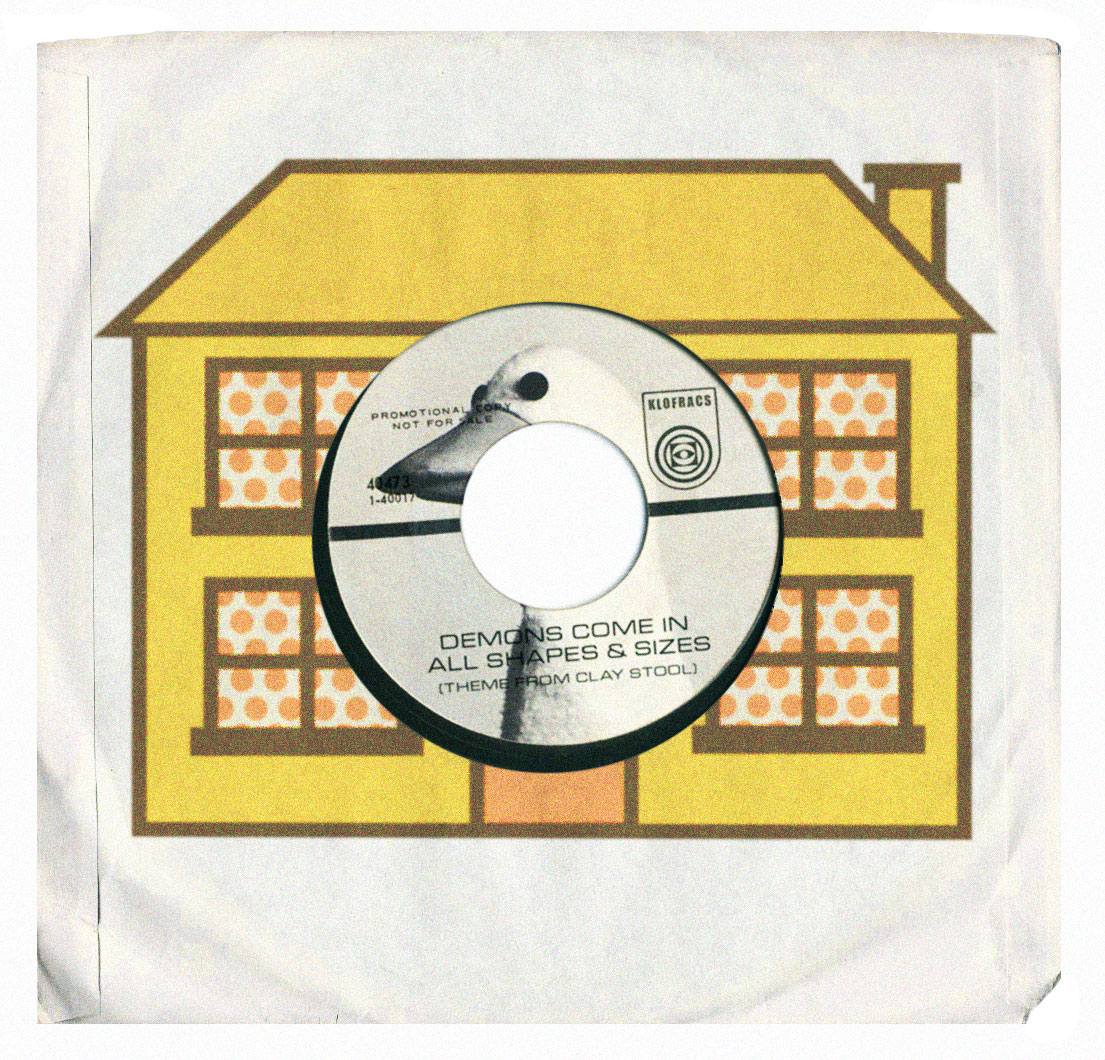
"Clay Stool" TV theme tune (Klofracs Records, 1973)
The theme tune from "Clay Stool," a popular 1970s children's daytime TV programme for 4 to 7 year olds, was released as a single in 1973 under the title "Demons Come In All Shapes & Sizes."
"Clay Stool" acquired its name from a form of medieval punishment for witchcraft. Originally, alleged witches were strapped to a wooden chair - a ducking stool - then plunged into a river. If they sank they were innocent, if they floated they were in league with the devil and summarily executed.
Samuel Revile, a local priest and freelance misogynist, wondered if ducking stools, which were traditionally festooned with dozens of inflated pigs' bladders, colourful helium balloons, and tethered albatrosses had something to do with the high numbers of people being found guilty.
Revile set about inventing the heavier "clay stool." A year after its introduction 100% of accused witches, mostly women, had plummeted to the riverbed where they drowned, proving their innocence.
Revile's work also alerted communities to the dangers of balloons. It was they, he maintained, not the women, that floated and were therefore in league with Satan. To this day, people who make balloon animals are considered unholy and are barred from church jumble sales.
Though Revile revolutionalised the justice system by inventing compassionate torture, he inadvertently caused widespread redundancies in the execution sector.
Listen to the single here:
Or watch the video here:
"Clay Stool" acquired its name from a form of medieval punishment for witchcraft. Originally, alleged witches were strapped to a wooden chair - a ducking stool - then plunged into a river. If they sank they were innocent, if they floated they were in league with the devil and summarily executed.
Samuel Revile, a local priest and freelance misogynist, wondered if ducking stools, which were traditionally festooned with dozens of inflated pigs' bladders, colourful helium balloons, and tethered albatrosses had something to do with the high numbers of people being found guilty.
Revile set about inventing the heavier "clay stool." A year after its introduction 100% of accused witches, mostly women, had plummeted to the riverbed where they drowned, proving their innocence.
Revile's work also alerted communities to the dangers of balloons. It was they, he maintained, not the women, that floated and were therefore in league with Satan. To this day, people who make balloon animals are considered unholy and are barred from church jumble sales.
Though Revile revolutionalised the justice system by inventing compassionate torture, he inadvertently caused widespread redundancies in the execution sector.
Listen to the single here:
Or watch the video here:
Labels:
1970s,
children,
crime,
cult,
law,
library music,
misogyny,
music,
pagan,
punishment,
thought crime,
torture,
TV,
witchcraft,
women
Friday, 23 May 2014
"Martyr Maid" Ice Cream (1970s)
In the 1970s, arcane cults and religious orders secretly funded multinational corporations with the goal of illicitly proselytising or brainwashing. Though the cults often targeted children via products such as toys and confectionery, including ice cream, as can be seen from the image below, adult virgins were also in great demand.
The aim was to subliminally indoctrinate a person over many years, so that by the time they came of age and were ready to be recruited, a cult's beliefs and rituals would not appear inappropriate, dangerous or even fatal.
This was especially true for people who were designated to become sacrifices to spirit deities, of which there were many in Scarfolk. One particularly insatiable deity was Rupert, a Robot Penguin Lord, who consumed so many sacrifices between 1970 and 1975 that he developed diabetes and put on so much weight that he had to completely replace his wardrobe.
The aim was to subliminally indoctrinate a person over many years, so that by the time they came of age and were ready to be recruited, a cult's beliefs and rituals would not appear inappropriate, dangerous or even fatal.
This was especially true for people who were designated to become sacrifices to spirit deities, of which there were many in Scarfolk. One particularly insatiable deity was Rupert, a Robot Penguin Lord, who consumed so many sacrifices between 1970 and 1975 that he developed diabetes and put on so much weight that he had to completely replace his wardrobe.
Monday, 12 May 2014
"Old Coffins are Death Traps" Public Information Poster (1975)
The recession of the 1970s gave Scarfolk Council no choice but to raise the age of retirement to 95 for men and 92 years, 36 months for women. This meant that when some people died they had not, in the eyes of the state, completed paying their dues to society.
All across Scarfolkshire coffins were exhumed and the cadavers put to work in the community. Fresher examples were dissected by children in biology classes or used in experiments by pharmaceutical and cosmetic firms. Less fresh cadavers served as scarecrows, supply teachers or junior ministers.
All this meant that hundreds of discarded coffins littered Britain's conurbations and countryside. Before long, Scarfolk's runaway children gathered the coffins in their thousands to make shanty-town-styled coffin 'cities' on the outskirts of urban areas. These settlements, which were given names such as 'Gravesend' and 'Bury', were pronounced death traps and a special branch of the police, called the Necropolice, were called in to dismantle the sites. Riots broke out and many police and children alike accidentally died after receiving nasty splinters. Despite this loss of life, thousands of pounds in funeral costs were saved as no new coffins were needed.
All across Scarfolkshire coffins were exhumed and the cadavers put to work in the community. Fresher examples were dissected by children in biology classes or used in experiments by pharmaceutical and cosmetic firms. Less fresh cadavers served as scarecrows, supply teachers or junior ministers.
All this meant that hundreds of discarded coffins littered Britain's conurbations and countryside. Before long, Scarfolk's runaway children gathered the coffins in their thousands to make shanty-town-styled coffin 'cities' on the outskirts of urban areas. These settlements, which were given names such as 'Gravesend' and 'Bury', were pronounced death traps and a special branch of the police, called the Necropolice, were called in to dismantle the sites. Riots broke out and many police and children alike accidentally died after receiving nasty splinters. Despite this loss of life, thousands of pounds in funeral costs were saved as no new coffins were needed.
Labels:
1970s,
children,
Council,
crime,
death,
ghetto,
Hauntology,
pensioners,
police,
politics,
poster,
Public Information,
runaways,
Scarfolk
Thursday, 1 May 2014
"Ask a Policeman" poster (1979)
Crime was always one aspect of policing that hindered the police force from doing its job. That's why, in 1975, the department of justice proposed the radical idea of cutting back on the numbers of crimes that would be tolerated during any given year.
The 1975 crime figures were as high as 100,000, but by 1977 the total number had been reduced to 65,000. This was largely due to a polite but firm public information campaign which targeted offenders, informing them of the new, official crime ration, and explaining just how much pressure the average police officer was under.
Many lawbreakers were sensitive to the needs of the police and either stopped committing crimes completely or only committed those that were legal. Many helped out by leaving incriminating evidence at the scenes of crimes and in 1979 a consortium of gangland bosses even held a charity knee-capping event, the proceeds of which went to the police pedicure fund.
The 1975 crime figures were as high as 100,000, but by 1977 the total number had been reduced to 65,000. This was largely due to a polite but firm public information campaign which targeted offenders, informing them of the new, official crime ration, and explaining just how much pressure the average police officer was under.
Many lawbreakers were sensitive to the needs of the police and either stopped committing crimes completely or only committed those that were legal. Many helped out by leaving incriminating evidence at the scenes of crimes and in 1979 a consortium of gangland bosses even held a charity knee-capping event, the proceeds of which went to the police pedicure fund.
Labels:
1970s,
charity,
crime,
justice,
law,
legal system,
police,
punishment,
Scarfolk
Friday, 18 April 2014
Jellied Babies (late 1970s)
This week's theme of human consumption continues with this popular Jellied Babies confectionery packaging from the late 1970s.
It's that time of the year when people tear unborn offspring away from incarcerated, drugged, distraught adults, paint them lurid colours, as if to mock them, then devour the helpless, would-be babies in front of the tormented parents. It's a bit like an annual jolly pogrom.
However, in the spirit of fairness, people in Scarfolk believed that chickens should not be the only creatures to lose their young during the festive spring period. Rabbit and otter eggs were also frequently consumed in Scarfolk, and human orphans in aspic were a particular favourite. Jellied Babies went into production after the council realised that the cost of foster care was prohibitive, especially because funds were needed for more beneficial things, such as quality garden furniture for the second homes of politicians.
In general, child donation can actually be financially lucrative. For example, when God sacrificed his own child for the good of society, he made sure he got a cut of the publishing and merchandising rights.
Happy Ēostre from Scarfolk Council.
If you have any unwanted children please write to: KiddyKomestibles Ltd, Scarfolk Industrial Park, SC1 6FG to arrange for a FREE pick up.
It's that time of the year when people tear unborn offspring away from incarcerated, drugged, distraught adults, paint them lurid colours, as if to mock them, then devour the helpless, would-be babies in front of the tormented parents. It's a bit like an annual jolly pogrom.
However, in the spirit of fairness, people in Scarfolk believed that chickens should not be the only creatures to lose their young during the festive spring period. Rabbit and otter eggs were also frequently consumed in Scarfolk, and human orphans in aspic were a particular favourite. Jellied Babies went into production after the council realised that the cost of foster care was prohibitive, especially because funds were needed for more beneficial things, such as quality garden furniture for the second homes of politicians.
In general, child donation can actually be financially lucrative. For example, when God sacrificed his own child for the good of society, he made sure he got a cut of the publishing and merchandising rights.
Happy Ēostre from Scarfolk Council.
Click to enlarge
Tuesday, 15 April 2014
"An End to Starvation?" (Pelican Books, 1973)
Before the 1970s, the idea of reprocessing human body parts had only been officially proposed once. In 1790, Arnold Bumb, an alchemist, necromancer and avid shopper, suggested that amputated human limbs be surgically spliced onto livestock to make them more efficient. His pamphlet "The Duck With My Wife's Foot" was very popular among agriculturists (and fetishists) of the time.
But it wasn't until the 1970s, when poverty levels were at their highest since the the second world war, that the government published a white paper proposing a solution to Britain's impending food deficit.
Since the advent of modern medicine, hospitals had been incinerating post-operative surgical and biological waste, and to many people this was considered both uneconomical and unethical. In the early 1970s, a nationwide study into the numbers of body parts amputated annually showed that there were enough discarded limbs, organs and even hair, to feed a county the size of Lancashire, as long as people supplemented their diet with fingernail biting, thumb sucking, and by popping over the border into Yorkshire for an occasional pub lunch.
The government's trial schemes were so successful that some hospitals, such as Royal Wimpy Infirmary, St. McDonalds General and North Findus Hospital shifted away from healthcare and became fully-fledged food processors and suppliers.
But it wasn't until the 1970s, when poverty levels were at their highest since the the second world war, that the government published a white paper proposing a solution to Britain's impending food deficit.
Since the advent of modern medicine, hospitals had been incinerating post-operative surgical and biological waste, and to many people this was considered both uneconomical and unethical. In the early 1970s, a nationwide study into the numbers of body parts amputated annually showed that there were enough discarded limbs, organs and even hair, to feed a county the size of Lancashire, as long as people supplemented their diet with fingernail biting, thumb sucking, and by popping over the border into Yorkshire for an occasional pub lunch.
The government's trial schemes were so successful that some hospitals, such as Royal Wimpy Infirmary, St. McDonalds General and North Findus Hospital shifted away from healthcare and became fully-fledged food processors and suppliers.
Labels:
1970s,
Books,
death,
disease,
euthanasia,
fast food,
food,
Hauntology,
healthcare,
hospitals,
NHS,
Pelican,
recycling,
science,
starvation,
surgery
Tuesday, 1 April 2014
Follow the Country Code (1979)
Scarfolk's farmers, like its firemen and policemen, are very delicate but have demanding jobs. Farmers wake up very early, often before lunchtime, to sing ballads to wheat fields, counsel anxious potatoes and smear themselves with shit.
They must also be able to communicate telepathically with livestock destined for ritual sacrifice. Pagan rites are complex and it's crucial that animals learn their lines and do exactly as they are instructed. Even the slightest deviation from standard procedure can lead to a faulty communion with the Nameless Lord of No Known Name, whom locals call Mr. Johnson for the sake of brevity.
Most sacrificial animals are fully aware of their fates and tend to mumble or mime their lines to delay the inevitable. It's not death that bothers them so much as being reincarnated as motorway service station employees.
They must also be able to communicate telepathically with livestock destined for ritual sacrifice. Pagan rites are complex and it's crucial that animals learn their lines and do exactly as they are instructed. Even the slightest deviation from standard procedure can lead to a faulty communion with the Nameless Lord of No Known Name, whom locals call Mr. Johnson for the sake of brevity.
Most sacrificial animals are fully aware of their fates and tend to mumble or mime their lines to delay the inevitable. It's not death that bothers them so much as being reincarnated as motorway service station employees.
A not very well hidden April Fools' bonus image is here
Labels:
agriculture,
death,
farming,
Hauntology,
injury,
mr johnson,
occult,
Scarfolk,
toys
Thursday, 20 March 2014
"Mummy's Gone Now" Scarfolk Books, 1978. First day of Spring!
Here's a scan of a book called "Mummy's Gone Now" which advised young, orphaned children about what to do with the bodies of recently deceased family members.
As most children could not afford a funeral, the book suggested burying bodies in the garden, pushing them off a bridge into a river, or donating them to a soup kitchen.
The book also offered advice about how to forage for food in a suburban environment.
Monday, 17 March 2014
'Totalitarian Salads', Scarfolk Books, 1976
'Totalitarian Salads,' published in 1976, sold more copies than any other book that year and was voted Scarfolk's best book by no less than 100% of the public in a mandatory survey.
The success of this publication may be partly due to the fact that all bar one of Scarfolk's bookshops and publishing companies were razed to the ground in semi-mysterious circumstances. In short,'Totalitarian Salads' was the only book commercially available that year.
Additionally, the authors and editors of competing cookery books were found sauteed in a mass shallow grave just outside Scarfolk.
Police food forensics experts put the recovered bodies in a refrigerator overnight before transferring them to an oven for 20-25 minutes and then pouring into individual pots to be garnished with wreathes of flowers.
Despite attempts to monopolise the cookery book market, illegal food pamphlets were distributed by an underground recipe resistance movement. This is the origin of recipes such as
'soufflé uprising,' 'coup soup,' 'putsch punch,' and 'insurgence sausages.'
The success of this publication may be partly due to the fact that all bar one of Scarfolk's bookshops and publishing companies were razed to the ground in semi-mysterious circumstances. In short,'Totalitarian Salads' was the only book commercially available that year.
Additionally, the authors and editors of competing cookery books were found sauteed in a mass shallow grave just outside Scarfolk.
Police food forensics experts put the recovered bodies in a refrigerator overnight before transferring them to an oven for 20-25 minutes and then pouring into individual pots to be garnished with wreathes of flowers.
Despite attempts to monopolise the cookery book market, illegal food pamphlets were distributed by an underground recipe resistance movement. This is the origin of recipes such as
'soufflé uprising,' 'coup soup,' 'putsch punch,' and 'insurgence sausages.'
Saturday, 8 March 2014
International Women's Day (1970)
Today is International Women's Day and the anniversary of the "Spread 'Em" campaign.
The freedoms of women and people like that were always very important in Scarfolk. As you will see from this poster and magazine ad issued by the council in early 1970, women had even more social and legal rights than domesticated foreigners.
Scarfolk was one of the first places to give women the right to ask a man if they are allowed to vote.
The council also fiercely lobbied to permit women's sports such as ironing, being pretty & sweet, and sobbing without cause in international competitions, including the Olympics. That the council was unsuccessful is testimony to the reactionary structures and attitudes that still hinder a woman's place in society. Poor dears.
The freedoms of women and people like that were always very important in Scarfolk. As you will see from this poster and magazine ad issued by the council in early 1970, women had even more social and legal rights than domesticated foreigners.
Scarfolk was one of the first places to give women the right to ask a man if they are allowed to vote.
The council also fiercely lobbied to permit women's sports such as ironing, being pretty & sweet, and sobbing without cause in international competitions, including the Olympics. That the council was unsuccessful is testimony to the reactionary structures and attitudes that still hinder a woman's place in society. Poor dears.
Wednesday, 19 February 2014
"We Watch You While You Sleep" TV signal intrusion 1975
Below is a rare video from the Scarfolk archives.
In 1975 there was a series of anonymous signal intrusions on the Scarfnada TV network. Many believed that the council itself was directly responsible for the illegal broadcasts, though this was never confirmed.
However, in 1976 a BBC TV documentary revealed that the council had surreptitiously introduced tranquillisers to the water supply and employed council mediums to sing lullabies outside the bedroom windows of suspect citizens.
Once a suspect had fallen asleep, the medium would break into their bedroom and secrete themselves in a wardrobe or beneath the bed. From these vantage points the medium could record the suspect's dreams and nocturnal mumblings into a specially designed device called a 'Night Mary', named after the woman who invented it.
The data would then be assessed by a local judge who could meter out the appropriate punishments. Many subconscious criminals were caught this way and the numbers of dream crimes plummeted. Literally overnight.
In addition to the video below, a poster, which can be viewed here, accompanied the scheme.
In 1975 there was a series of anonymous signal intrusions on the Scarfnada TV network. Many believed that the council itself was directly responsible for the illegal broadcasts, though this was never confirmed.
However, in 1976 a BBC TV documentary revealed that the council had surreptitiously introduced tranquillisers to the water supply and employed council mediums to sing lullabies outside the bedroom windows of suspect citizens.
Once a suspect had fallen asleep, the medium would break into their bedroom and secrete themselves in a wardrobe or beneath the bed. From these vantage points the medium could record the suspect's dreams and nocturnal mumblings into a specially designed device called a 'Night Mary', named after the woman who invented it.
The data would then be assessed by a local judge who could meter out the appropriate punishments. Many subconscious criminals were caught this way and the numbers of dream crimes plummeted. Literally overnight.
In addition to the video below, a poster, which can be viewed here, accompanied the scheme.
Friday, 14 February 2014
Happy Valentine's Day
Labels:
1970s,
disease,
drugs,
euthanasia,
health & safety,
healthcare,
hospitals,
illustration,
love is,
rabies,
snoopy
Friday, 7 February 2014
NHS organ returns (1974)
There have been recent reports about National Health Service plans to sell off patient data (i.e. your personal medical records) to the highest bidding drug and pharmaceutical companies. It's worth remembering that something similar happened when the NHS almost closed down in 1974.
This leaflet was distributed at the time:
"It looked like the piles of confiscated possessions one sees at concentration camps," said one man who was forced to return all his limbs and an ovary he wasn't aware he had.
Mountains of returned livers, kidneys and hearts (and even children who had been born as a result of artificial insemination) spoiled in unrefridgerated conditions and the overwhelmed government had no choice but to return the decaying, by now useless organs to their owners. However, to make amends they did also send packs of complimentary lemon-fresh hand wipes.
Though thousands died, the government did not consider it to be a failing of the NHS. The fault was squarely aimed at the public who were accused of being unhygienic and told to wash more.
This leaflet was distributed at the time:
Click to enlarge
By Autumn of 1974 the government, which was not prepared for the sheer numbers of returned prostheses and organs, declared a state of medical emergency. Warehouses up and down the country spilled over with artificial legs, arms and buttocks.
"It looked like the piles of confiscated possessions one sees at concentration camps," said one man who was forced to return all his limbs and an ovary he wasn't aware he had.
Mountains of returned livers, kidneys and hearts (and even children who had been born as a result of artificial insemination) spoiled in unrefridgerated conditions and the overwhelmed government had no choice but to return the decaying, by now useless organs to their owners. However, to make amends they did also send packs of complimentary lemon-fresh hand wipes.
Though thousands died, the government did not consider it to be a failing of the NHS. The fault was squarely aimed at the public who were accused of being unhygienic and told to wash more.
Returned prostheses: Wellcome Library, London.
Labels:
1970s,
disease,
drugs,
Hauntology,
health & safety,
healthcare,
homicide,
hospitals,
London.,
medicine,
NHS,
politics,
Scarfolk,
sickness,
totalitarian
Friday, 17 January 2014
"Babies Are Killers" Awareness Week (Part 3)
This is the third and final post for Babies Awareness Week. We hope that the danger of Babies has now been fully conveyed to you.
Remember that the symptoms of Babies are not always visible. If you have been been bitten by a baby, toddler or even an adult under 4 feet 9 inches, always visit your doctor. If you do not receive medical attention within 74 years of being infected you risk suffering from the effects of aging and, ultimately, death.
"Don't smuggle death. It could save your life..."
Remember that the symptoms of Babies are not always visible. If you have been been bitten by a baby, toddler or even an adult under 4 feet 9 inches, always visit your doctor. If you do not receive medical attention within 74 years of being infected you risk suffering from the effects of aging and, ultimately, death.
"Don't smuggle death. It could save your life..."
Wednesday, 15 January 2014
"Babies Are Killers" Awareness Week (Part 2)
Babies Awareness Week continues with this poster which was placed in airports, harbours, maternity units and other entry points into the United Kingdom.
Monday, 13 January 2014
"Babies Are Killers" Awareness Week (Part 1)
Today is the start of Babies Awareness Week in Scarfolk, so make sure you check back for updates. The first Babies Awareness Week took place in 1973 after health and literacy clashed with wide-reaching consequences.
Here is an excerpt from a 1974 leaflet: "While babies are stunted, mostly inefficient humans, 'Babies' is the name of a viral disease carried by unbaptised infants born out of wedlock. It is usually transmitted to other animals by a bite from an infected baby. 'Babies' travels via the nervous system through the anxious gland to the brain, which is most often stored within easy reach of the cranium. The virus is untreatable and invariably fatal within days, especially if panicking family members leave the delirious patient to stumble aimlessly along the motorway at night.
Early stage symptoms include gurgling, inability to walk or solve complex mathematical problems, an inexplicable contempt for mashed banana, and defecating without panache accompanied by a sense of unjustified triumph."
Back in the 1970s, concerned parents vaccinated their children daily and those suspected of having contracted 'Babies' were taken away by the council in large trucks then pickled, varnished and used as clothes mannequins in department stores. However, this practice was stopped when the virus spread to a range of medium-priced sweaters. It was the first time that the disease had passed from one species to another.
Here's the first of several posters designed in the 1970s to warn Scarfolk citizens of the dangers of babies with 'Babies.'
Here is an excerpt from a 1974 leaflet: "While babies are stunted, mostly inefficient humans, 'Babies' is the name of a viral disease carried by unbaptised infants born out of wedlock. It is usually transmitted to other animals by a bite from an infected baby. 'Babies' travels via the nervous system through the anxious gland to the brain, which is most often stored within easy reach of the cranium. The virus is untreatable and invariably fatal within days, especially if panicking family members leave the delirious patient to stumble aimlessly along the motorway at night.
Early stage symptoms include gurgling, inability to walk or solve complex mathematical problems, an inexplicable contempt for mashed banana, and defecating without panache accompanied by a sense of unjustified triumph."
Back in the 1970s, concerned parents vaccinated their children daily and those suspected of having contracted 'Babies' were taken away by the council in large trucks then pickled, varnished and used as clothes mannequins in department stores. However, this practice was stopped when the virus spread to a range of medium-priced sweaters. It was the first time that the disease had passed from one species to another.
Here's the first of several posters designed in the 1970s to warn Scarfolk citizens of the dangers of babies with 'Babies.'
Monday, 23 December 2013
Christmas Surveillance in Scarfolk
The recent Snowden disclosures about the NSA and GCHQ have revealed that there are no, nor have there ever been any secret 'Secret Santa' gift transactions. Such gift trades have been strictly monitored, and the subsequent data recorded and stored, since 1975.
In addition, in 1970s Scarfolk all Christmas presents had to go through a council clearance department that assessed each gift individually to decide whether or not it was appropriate for the intended recipient.
For example, if an intelligent child had revealed any potentially free-thinking tendencies he would not be allowed to receive books or any other form of educational materials. Such gifts might be substituted for depressants/sedatives, such as Comazepam, or he might receive a Cell Token which he could exchange for a prison term, irrespective of whether or not he had gone to the unnecessary effort of committing a crime.
Everyone at Scarfolk Council would like to wish you a very Merry Christmess, irrespective, or perhaps in spite of, your beliefs. All the very best for the new year; see you in 1974!
Tuesday, 17 December 2013
"Dentistry for the Deceased" annual 1974
It's that time of the year when parents hurry to get in their orders for Christmas annuals. There's always a wide selection available devoted to children's favourite TV programmes, cartoon characters, magazines and even beloved toys.
"Dentistry for the Deceased" was a Saturday night programme that the whole family could enjoy. Celebrities who had recently passed away were put in teams of two with their dentists to compete against other dentist/celebrity teams.
During the week-long run-up to the live show the dentist would rehearse with the celebrity corpse to create spectacular and exciting oral displays.
Come the show, the teams would battle against the clock to produce the best postmortem smiles while the BBC's all-female dancing troupe "Teeth & Co." performed mouth/death themed routines to live music.
Bruce Scythe was the host for more than 90 years during which he assembled one of the world's largest collections of deceased celebrities, which sat forever smiling in his specially converted cellar gallery.
"Dentistry for the Deceased" was a Saturday night programme that the whole family could enjoy. Celebrities who had recently passed away were put in teams of two with their dentists to compete against other dentist/celebrity teams.
During the week-long run-up to the live show the dentist would rehearse with the celebrity corpse to create spectacular and exciting oral displays.
Come the show, the teams would battle against the clock to produce the best postmortem smiles while the BBC's all-female dancing troupe "Teeth & Co." performed mouth/death themed routines to live music.
Bruce Scythe was the host for more than 90 years during which he assembled one of the world's largest collections of deceased celebrities, which sat forever smiling in his specially converted cellar gallery.
Labels:
1970s,
annual,
BBC,
Books,
christmas,
death,
dentist,
Hauntology,
healthcare,
hospitals,
memento mori,
strictly come dancing,
TV
Monday, 9 December 2013
The "Rem-Exec 1" remote execution system
In the 1970s children were encouraged to take part in and experience all areas of civic life. In addition to compulsory youth clubs, which taught children surveillance skills and how to use them on neighbours and family members, older children were expected to take part in judicial proceedings.
Once a judge had sentenced a criminal in one of Scarfolk's many impromptu mobile courts, local children were expected to help carry out the sentence. They might assist by testing a noose's integrity, filling a hypodermic needle for a lethal injection or polishing the instruments of a masked council 'punisher.' Child executioners were chosen from school reports, much like jury duty.
Later in the decade, parents complained that such activities were too time consuming and got in the way of more important activities such as watching television, which is why Microharsh, a budding computer company, invented the REM-EXEC 1 (The Remote Executioner), a computer system that enabled children to carry out a death penalty from the comfort of their own homes.
The REM-EXEC 1 became so popular that children even began coding their own basic punishment programmes. One well-known one called 'Insert: Explosive Suppository Frog' made 10 year old Stephen Steel a household name.
Once a judge had sentenced a criminal in one of Scarfolk's many impromptu mobile courts, local children were expected to help carry out the sentence. They might assist by testing a noose's integrity, filling a hypodermic needle for a lethal injection or polishing the instruments of a masked council 'punisher.' Child executioners were chosen from school reports, much like jury duty.
Later in the decade, parents complained that such activities were too time consuming and got in the way of more important activities such as watching television, which is why Microharsh, a budding computer company, invented the REM-EXEC 1 (The Remote Executioner), a computer system that enabled children to carry out a death penalty from the comfort of their own homes.
The REM-EXEC 1 became so popular that children even began coding their own basic punishment programmes. One well-known one called 'Insert: Explosive Suppository Frog' made 10 year old Stephen Steel a household name.
Friday, 22 November 2013
Dr. Who in Scarfolk
Back in the 1970s the makers of BBC's Dr. Who could not find a location big enough to accommodate a story set on the surface of a desolate moon.
Scarfolk Council generously offered to demolish two hospices, an orphanage and a battered dolphin sanctuary to create the necessary space. However, the council neglected to warn the residents before they flattened the buildings.
Fortunately, the Dr. Who story also required an immense battlefield to be littered with dead and injured aliens.
Happy 50th anniversary!
(Click to enlarge).
Scarfolk Council generously offered to demolish two hospices, an orphanage and a battered dolphin sanctuary to create the necessary space. However, the council neglected to warn the residents before they flattened the buildings.
Fortunately, the Dr. Who story also required an immense battlefield to be littered with dead and injured aliens.
Happy 50th anniversary!
(Click to enlarge).
Labels:
1970s,
BBC,
doctor who,
dr who,
Hauntology,
LP,
music,
radio times,
rock,
Scarfolk,
television,
the who,
TV,
who's next
Thursday, 14 November 2013
BBC "Swap Shop" swaps (1976-1979)
"Multi-Coloured Swap Shop" was a popular Saturday morning children's show on BBC1 that began in 1976 and was hosted by presenters such as Noel Edmonds, Keith Chegwin and Peter Sutcliffe. It was centered around children phoning in to offer unwanted possessions in exchange for desired ones. The offers/wants were added to a board in the studio and broadcast to the nation. It was stopped after an investigation by the government's broadcast regulatory body discovered that the swap service was being exploited by gangs to traffic live organs. Below are a selection of rare screen shots.
The programme was so successful that some of the presenters went on to host their own shows such as "Cheggers Plays Pop" and "Ripsters Rips." Noel Edmonds was tragically killed in a horrific bean bag accident in 1979 but his corpse was resurrected with a slinky, Swarfega and four AAA batteries by sixteen year old Marie Grype, the first student to get an O-Level in Necromancy & Media Studies.
Labels:
1970s,
BBC,
chegwin,
edmonds,
Hauntology,
Scarfolk,
supernatural,
swap shop,
TV,
yorkshire ripper
Tuesday, 5 November 2013
Bonfire Night in Scarfolk
As tonight is Bonfire Night, instead of a postcard from the mayor's pharmaceutical collection, we thought we'd post an image of a 1975 box of fireworks that we just found in the cellar.
Back in 1970s Scarfolk, fireworks weren't used only during celebrations; they also had many other practical applications. For example, in medicine and healthcare, they were used by dentists to remove enamel from healthy teeth; rockets were employed by surgeons to demean rowdy prostate glands; and sparklers were taped to children's hands to stop them biting their fingernails.
Fireworks also had everyday uses: beauticians applied them as speedier alternatives to waxing, and inner-city school teachers used them to create volcano deities, as volcano deities don't typically manifest in deprived urban areas. They were even tied to emotionally unstable homing pigeons with skyphobia in an attempt to rouse them from their anxiousness.
Of course, children also loved them and incorporated them into playground games such as 'holdy-sparkler-screamy-stubs' and 'doctors, nurses and ECT (electroconvulsive therapy)', but above all they tasted great and came in several flavours including fizzy lemon & lime (see image), pork & hair and whisky & unknown.
Enjoy Bonfire Night but remember: if your Guy Fawkes effigy groans or moves unexpectedly, please call a council exorcist before placing him on the bonfire. And always light your Guy at arm's length in case he tries to bite.
WARNING: Fireworks are dangerous. Do not try any of the above at home. If you are homeless, do not try under a railway bridge or in a shop doorway. Always light a firework at arm's length, preferably using the arm of someone who has a better education than you and therefore more societal value. Never pick up or throw a firework at someone. If you want to do something like that join the army and/or become a terrorist.
Back in 1970s Scarfolk, fireworks weren't used only during celebrations; they also had many other practical applications. For example, in medicine and healthcare, they were used by dentists to remove enamel from healthy teeth; rockets were employed by surgeons to demean rowdy prostate glands; and sparklers were taped to children's hands to stop them biting their fingernails.
Fireworks also had everyday uses: beauticians applied them as speedier alternatives to waxing, and inner-city school teachers used them to create volcano deities, as volcano deities don't typically manifest in deprived urban areas. They were even tied to emotionally unstable homing pigeons with skyphobia in an attempt to rouse them from their anxiousness.
Of course, children also loved them and incorporated them into playground games such as 'holdy-sparkler-screamy-stubs' and 'doctors, nurses and ECT (electroconvulsive therapy)', but above all they tasted great and came in several flavours including fizzy lemon & lime (see image), pork & hair and whisky & unknown.
Enjoy Bonfire Night but remember: if your Guy Fawkes effigy groans or moves unexpectedly, please call a council exorcist before placing him on the bonfire. And always light your Guy at arm's length in case he tries to bite.
WARNING: Fireworks are dangerous. Do not try any of the above at home. If you are homeless, do not try under a railway bridge or in a shop doorway. Always light a firework at arm's length, preferably using the arm of someone who has a better education than you and therefore more societal value. Never pick up or throw a firework at someone. If you want to do something like that join the army and/or become a terrorist.
Thursday, 31 October 2013
"Pagan Paediatrics" Pelican Books, 1974
Happy Halloween/Samhain from everyone at Scarfolk Council.
There was always conflict between science and religion in Scarfolk, particularly regards topics such as birth, death and secular resurrection. However, writers like Dr. Santa Blacklord tried to bridge the gap with their books and Open University courses, which included 'Pagan Paediatrics.'
Excerpts from the birth chapter of the revised edition:
The normal process of birth starts with a series of involuntary contractions of the uterus walls. This is the first sign that the dark spirit has made his presence known. Eventually, the amniotic sac bursts and amniotic fluid escapes. This fluid should be preserved as it is known to a) help pigs and owls develop psychic abilities, b) hurt one's enemies when mixed with unstable explosives and c) cure female pattern chest baldness.
When the cervix is fully dilated, further uterus contractions push the lazy baby out through the left vagina or nostril, and the baby is born with umbilical cord attached. If, when plucked, the umbilical cord is tuned to D-sharp it is considered a lucky birth. If it's tuned to G the child will most likely grow up to work in retail. If tuned to B-flat most parents are recommended to try for another child.
Excerpts from the chapter on death:
Death is a state that immediately follows life. Only very rarely does it not occur in that order. During death the body's organs, like employees without an immediate supervisor, become confused and wander around the body looking for someone in charge. They meet in the buttocks where they hold a seance. They contact the dark spirit who was present at birth but learn that he has been made redundant due to cutbacks. Panicking, the organs argue amongst themselves briefly before turning out the lights and leaving, never to be heard of again. Some religions believe that when a deceased person is buried they are reincarnated as soil.
There was always conflict between science and religion in Scarfolk, particularly regards topics such as birth, death and secular resurrection. However, writers like Dr. Santa Blacklord tried to bridge the gap with their books and Open University courses, which included 'Pagan Paediatrics.'
Excerpts from the birth chapter of the revised edition:
The normal process of birth starts with a series of involuntary contractions of the uterus walls. This is the first sign that the dark spirit has made his presence known. Eventually, the amniotic sac bursts and amniotic fluid escapes. This fluid should be preserved as it is known to a) help pigs and owls develop psychic abilities, b) hurt one's enemies when mixed with unstable explosives and c) cure female pattern chest baldness.
When the cervix is fully dilated, further uterus contractions push the lazy baby out through the left vagina or nostril, and the baby is born with umbilical cord attached. If, when plucked, the umbilical cord is tuned to D-sharp it is considered a lucky birth. If it's tuned to G the child will most likely grow up to work in retail. If tuned to B-flat most parents are recommended to try for another child.
Excerpts from the chapter on death:
Death is a state that immediately follows life. Only very rarely does it not occur in that order. During death the body's organs, like employees without an immediate supervisor, become confused and wander around the body looking for someone in charge. They meet in the buttocks where they hold a seance. They contact the dark spirit who was present at birth but learn that he has been made redundant due to cutbacks. Panicking, the organs argue amongst themselves briefly before turning out the lights and leaving, never to be heard of again. Some religions believe that when a deceased person is buried they are reincarnated as soil.
Labels:
1970s,
Books,
children,
cult,
halloween,
Hauntology,
healthcare,
hospitals,
medicine,
NHS,
pagan,
pediatrics,
Pelican,
science,
supernatural,
witchcraft
Friday, 18 October 2013
The "Little White Sam" Book Ban (1977)
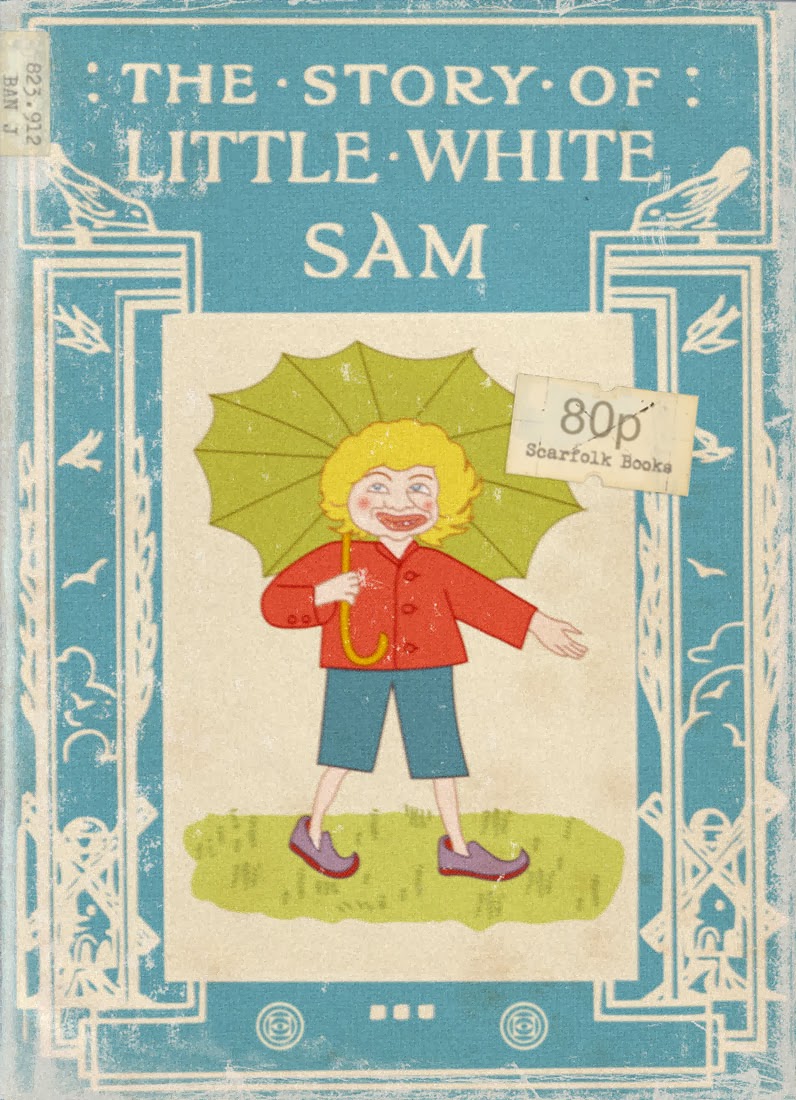
"Little White Sam" had always been a very popular book among Scarfolk children, but in 1977 the Scarfolk Association of Teachers caused controversy by withdrawing it from the school curriculum.
This had been triggered by a slew of international complaints: Children from developing countries (many of which had been liberated from themselves by the benevolent British Empire) were terrified and offended by the book's pale-skinned, blonde protagonist. He reminded them of days under British and European rule and the suffering (or 'learning' as the government preferred) that they had endured.
Historically, white people had always been unfairly picked on for trying to help the world be more like them and Jesus, so this was another major blow.
A legal battle over the book ensued, and when it was finally reprinted stringent efforts were made to completely remove any contentious material regarding race, colour and even gender. In the updated 1979 edition Sam was reimagined as a completely transparent flatworm which changed gender at will.
However, sales plummeted and, before long, environmentalists were reporting that crimes against flatworms had risen by as much as 23%.
This had been triggered by a slew of international complaints: Children from developing countries (many of which had been liberated from themselves by the benevolent British Empire) were terrified and offended by the book's pale-skinned, blonde protagonist. He reminded them of days under British and European rule and the suffering (or 'learning' as the government preferred) that they had endured.
Historically, white people had always been unfairly picked on for trying to help the world be more like them and Jesus, so this was another major blow.
A legal battle over the book ensued, and when it was finally reprinted stringent efforts were made to completely remove any contentious material regarding race, colour and even gender. In the updated 1979 edition Sam was reimagined as a completely transparent flatworm which changed gender at will.
However, sales plummeted and, before long, environmentalists were reporting that crimes against flatworms had risen by as much as 23%.
Sunday, 13 October 2013
"Audio Control for Baby" (Scarfolk Records & Tapes, 1970)
The cassette called "Audio Control for Baby" (Scarfolk Records & Tapes, 1970) has long been lost but we do have this recording of the music playing in the background at the Scarfolk Inconvenient Infant Playcenta. It was piped into every room around the clock at high volume and many child carers found it to be very effective: Enjoying drinks at the pub two doors down from the 'centa', the carers rarely heard any of the babies cry.
Many struggled with the pressures of the job. As one carer, Jocelyn Hurtt, noted at the time, "the kids really set your nerves on edge, especially if, like me, you don't have a natural affinity with children. You can be right in the middle of a good programme on the telly and one of them will start up: complaining about nightmares, appendicitis or wanting to be freed from their restraints. I really don't know what I'd do without my Martini & lemonades. You're not supposed to hit the little blighters, but if you've had a few drinks you're less tolerant and you don't know your own strength; it only stands to reason and is to be expected. After all, we're only human."
We hope the extraneous sounds on the recording do not distract too much from the music.
Many struggled with the pressures of the job. As one carer, Jocelyn Hurtt, noted at the time, "the kids really set your nerves on edge, especially if, like me, you don't have a natural affinity with children. You can be right in the middle of a good programme on the telly and one of them will start up: complaining about nightmares, appendicitis or wanting to be freed from their restraints. I really don't know what I'd do without my Martini & lemonades. You're not supposed to hit the little blighters, but if you've had a few drinks you're less tolerant and you don't know your own strength; it only stands to reason and is to be expected. After all, we're only human."
We hope the extraneous sounds on the recording do not distract too much from the music.
Labels:
1970s,
ambient,
changing attitudes,
children,
Hauntology,
healthcare,
hospitals,
music,
nightmare,
Scarfolk,
toys
Monday, 7 October 2013
"Charley says...[obey or die]" (1973)
Bad behaviour was rampant in 1970s Scarfolk and disciplining children was a major concern.
The so-called 'degenerate generation' of children, often from worthless-class backgrounds, was known to actively defy rules and social norms and frequently committed the following appalling offences:
- Stay awake after allotted bedtimes.
- Peel marzipan decorations from cakes.
- Laugh loudly while having fun.
- Read books more advanced than their official reading age.
- Question adults' belief in Father Christmas.
- Cry after having nightmares.
- Refuse to join in educational/life-skills games such as 'lie about a friend,' 'slap-the-immigrant', 'wet someone else's bed.'
In a desperate attempt to curb this destructive, nihilistic behaviour, Scarfolk Health Service launched a treatment regime employing the newly developed 'great flooding' psychological technique*, which exposes the subject to such long durations of relentless and exaggerated cruelty that any desire to be undisciplined is quashed.
*The technique largely comprised of repeated readings of a book called the bible which was written many hundreds of years ago by people who had never heard of knives and forks, washing machines, coat hangers, toilet seats, aluminium kitchen foil or shampoo.
Sunday, 29 September 2013
Porn-Education (1976-1979)
More rare screenshots this week.
In 1976 the Scarfolk Board of Education was faced with a problem: Children weren't educated enough to be able to learn anything, thus benefit from education.
Teenagers had lost all interest in schooling and spent their time indulging themselves in popular teenybopper pop groups such as The Wittgenstein Rollers and Arnold & the Schoenbergs.
To counter this apathy, the Board of Education decided to take advantage of the recent relaxing of film censorship and the rise of sexploitation.
From September 1976 they delivered the school curriculum via a series of feature-length pornographic films. In particular they wanted to enliven maths and English topics and to "put some lead back in the pencil" of pedagogy, as the minister for education, Tom Stiph, put it.
School attendance rose by 42% in less than six months, as did the birth rate.
Below are three of the long-lost maths and English, so-called 'Porn-Ed' films, as certified by the BBFC (British Board of Film Censorship).
Other films included:
"Debbie Does Differential Geometry" (1976)
"Lady Pythagoras' Love Triangle" (1977)
"HomoPhone Sex Operators" (1977)
"Vital Statistics and Alge-bra Overflows" (1977)
"Homonympho Grown-up Groans" (1978)
"Homonympho 2: Whole Holes Meet Man Meat" (1979)
To enlarge/zoom right-click and 'open in new page/tab'
In 1976 the Scarfolk Board of Education was faced with a problem: Children weren't educated enough to be able to learn anything, thus benefit from education.
Teenagers had lost all interest in schooling and spent their time indulging themselves in popular teenybopper pop groups such as The Wittgenstein Rollers and Arnold & the Schoenbergs.
To counter this apathy, the Board of Education decided to take advantage of the recent relaxing of film censorship and the rise of sexploitation.
From September 1976 they delivered the school curriculum via a series of feature-length pornographic films. In particular they wanted to enliven maths and English topics and to "put some lead back in the pencil" of pedagogy, as the minister for education, Tom Stiph, put it.
School attendance rose by 42% in less than six months, as did the birth rate.
Below are three of the long-lost maths and English, so-called 'Porn-Ed' films, as certified by the BBFC (British Board of Film Censorship).
Other films included:
"Debbie Does Differential Geometry" (1976)
"Lady Pythagoras' Love Triangle" (1977)
"HomoPhone Sex Operators" (1977)
"Vital Statistics and Alge-bra Overflows" (1977)
"Homonympho Grown-up Groans" (1978)
"Homonympho 2: Whole Holes Meet Man Meat" (1979)
To enlarge/zoom right-click and 'open in new page/tab'
Labels:
1970s,
BBFC,
censorship,
education,
Film,
Hauntology,
pornography,
Scarfolk,
school,
sex,
sexploitation
Saturday, 21 September 2013
"Seducing Students & Secretaries" (BBC 1, 1977)
In 1977 BBC Scarfolk broadcast a 'schools and colleges' series that prepared children for the world of work awaiting them. The programme was aimed at boys aged between eight and twelve (girls, of course, weren't allowed to watch such programmes because they interfered with weekly domestic servility exams).
"Seducing Students & Secretaries" focused on one of the more important aspects of employment; that of cornering and ensnaring female employees or students for personal gratification.
Based on his book "How To Get the Lady Beneath You Beneath You" (Pelican Books, 1974), Dr. Hugh Schaime (seen below) presented the programme and taught prospective bosses, in a classroom environment, how best to exploit their positions of power in the workplace.
His course covered subjects such as 'how to make women believe that an uninvited kiss is a compulsory dental exploration.' He also tutored obstinate female employees, teaching them how to submit with grace.
The programme was particularly memorable for its title sequence which featured a butcher preparing meat, something that Dr. Schaime felt was a perfect metaphor for the knowledge he imparted for over fifty years.
The programmes were accidentally erased by the BBC in 1979, but we do still have a selection of screenshots, as you can see below.
"Seducing Students & Secretaries" focused on one of the more important aspects of employment; that of cornering and ensnaring female employees or students for personal gratification.
Based on his book "How To Get the Lady Beneath You Beneath You" (Pelican Books, 1974), Dr. Hugh Schaime (seen below) presented the programme and taught prospective bosses, in a classroom environment, how best to exploit their positions of power in the workplace.
His course covered subjects such as 'how to make women believe that an uninvited kiss is a compulsory dental exploration.' He also tutored obstinate female employees, teaching them how to submit with grace.
The programme was particularly memorable for its title sequence which featured a butcher preparing meat, something that Dr. Schaime felt was a perfect metaphor for the knowledge he imparted for over fifty years.
The programmes were accidentally erased by the BBC in 1979, but we do still have a selection of screenshots, as you can see below.
Labels:
1970s,
BBC,
changing attitudes,
ethics,
harassment,
radio times,
school,
science,
sexism
Friday, 13 September 2013
Happy Friday the13th from Scarfolk Coven!
Everyone at Scarfolk Coven would like to you wish you all the best for today, Friday the 13th. So mote it be, dear citizens, so mote it be.
"Scarfolk Coven: Where every Friday is Friday the 13th"
To enlarge/zoom right-click and 'open in new page/tab'
Thursday, 12 September 2013
"Patient #249" EEG Recording 01.11.1977
In 1977 Scarfolk Clinic conducted sleep experiments on a local boy known only as 'Patient #249'. He suffered from severe nightmares and developed a rare condition known as 'manifest hypnagogia'.
Symptoms include the physical manifestation of hallucinations that sufferers endure between sleep and waking states. For example, Patient #249 frequently awoke to find, sitting on the end of his bed, a syphilitic, deformed Victorian clown eating trifle and pig's liver pâté. At other times, a confused sewing machine salesman from the Midlands would appear. Patient #249's parents found this inconvenient.
Doctors observed Patient #249 at home and wired his brain to an EEG, which they attached to a Bontempi electric keyboard. They wanted to record what Patient #249's brain was doing and translate it into music. In the recording you'll hear the TV in the background before Patient #249's unconscious brain takes over and he slips into a hypnagogic state.
Symptoms include the physical manifestation of hallucinations that sufferers endure between sleep and waking states. For example, Patient #249 frequently awoke to find, sitting on the end of his bed, a syphilitic, deformed Victorian clown eating trifle and pig's liver pâté. At other times, a confused sewing machine salesman from the Midlands would appear. Patient #249's parents found this inconvenient.
Doctors observed Patient #249 at home and wired his brain to an EEG, which they attached to a Bontempi electric keyboard. They wanted to record what Patient #249's brain was doing and translate it into music. In the recording you'll hear the TV in the background before Patient #249's unconscious brain takes over and he slips into a hypnagogic state.
Labels:
1970s,
ambient,
clown,
electronica,
experiments,
Hauntology,
hypnagogia,
medicine,
music,
nightmare,
TV
Subscribe to:
Posts (Atom)