Thursday, 28 January 2016

Emergency Supplies (1979)


The 1970s was a decade of social tension. Environmental disaster, terrorism, war and foreigners were a constant threat. Many citizens and some of their friends expressed concern about what would happen if the worst came to the worst.

In 1979 the government declared that it was fully prepared for any eventuality. A series of posters and leaflets introduced Pre-Emergency Services which had been set up to supply citizens with "essential survival items" including ping pong balls, rubber bands (see poster above), furniture polish, drinks coasters and crocheted toilet-roll covers that looked like Georgian ladies.

The minister for internal affairs wrote in one leaflet: "Our new emergency initiatives clearly demonstrate how seriously we take the welfare of British citizens. Should an unexpected catastrophe occur, such as the one which may or may not take place later this year on October 14th, we guarantee that working families and those most in need, such as table tennis players, will be the first to receive the emergency supplies listed in this leaflet." 

To further demonstrate his commitment to the people, the prime minister himself offered to forgo his own rubber band and drinks coaster rations saying that "the knowledge that the people of the United Kingdom are safe is all the comfort I need and I will gladly make do with less vital resources", which were later revealed to be water purification tablets, dried food goods and medical supplies.


For more archival documents about emergency procedures read this Public Information Booklet, this civil defence poster and take note of this new emergency services telephone number.

Thursday, 21 January 2016

1970s Games (Various)

These old games were found in a cupboard in the council office basement (click to enlarge).


The goal of 'Pollute' (1975) was to earn as much money as possible for your multinational corporation while contaminating the world's oceans. Extra points could be scored by inadvertently bringing about a genetically corrupted, mutant starfish which threatens to destroy mankind, then offering the monopolised solution at a vastly inflated price. Subsequent versions of the game included 'Super Pollute: Poison the Skies' and 'Pollute Deluxe: The Countryside is a Twat'.


Winner of the Queen's Award for Arrogance, 'Mister Smug' (1978) was an edutainment game which taught politicians and big business leaders how to emotionally and legally distance themselves from the catastrophic outcomes of uninformed decisions which affect millions of innocent people and ruin lives. Bankers and other sociopaths were banned from playing the game in competition because they always won, even when they had officially lost.


'Land Mine' (1970). Very little is known about this game because few players survived, though it appears that the military funded the game's production so that it could test the latest in concealed weapons technology and observe its explosive effects on a civilian population.


For more games see 'Discovering Scarfolk' by Ebury Press: Top Tramps (p.85); Junior Taxidermy Kit (p.86); and Singlemulty (p.105), and others.

Thursday, 14 January 2016

Forensic Litter Collection (1978)


The police budget for 1978 was only half of what it had been the previous year. This was because the treasury had been robbed and the subsequent investigation was thwarted by limited resources. The thieves were never apprehended.

Violent crime soared, particularly recreational parricide, and Scarfolk's woodlands, wastelands and canals were strewn with bodies and body parts. The police, overwhelmed by the sheer number of cases and keen to deflect any criticism, claimed that the problem was not one of unsolved homicide but of littering and blamed any failings on the Keep Britain Tidy campaign.

The two eventually agreed to pool resources and turned the task of forensic crime scene examination over to the community, children in particular. Much like the children's TV programme Blue Peter, schools launched charity appeals that encouraged pupils to collect victim debris, organic or otherwise, to raise money (see leaflet above). In 1978 children across the country collected nearly £9000 worth of gold fillings and 525 glass eyes, among other items. Some were cleaned and reconditioned for further use.

Homicide litter recycling became so popular in the late-70s that some overly-enthusiastic people tried to donate whole family members before they had passed away, but the rules were quite strict: donations could only be accepted if the person was murdered first. To this end, the police helpfully released a pamphlet describing those methods which were most likely to avoid detection.


Saturday, 9 January 2016

PUBLIC ANNOUNCEMENT: Scarfolk Television

Watch this short film about a very important development in Scarfolk. For more information please reread.


Thursday, 7 January 2016

The Fact Ban (1976)


In 1975 the government discreetly tortured citizens to find out what they thought of its leadership. The results revealed that many participants thought the state "cheerfully totalitarian","despotic, but in a nice way", and "I'll say anything you want as long as you stop waterboarding me and give me back my eye."

The government sensed a need for change and announced that it would be introducing more liberal attitudes to its policies, particularly those relating to facts and information.

Facts had always been problematic for the government because of their inflexibility. Though the use of facts in state administration was strongly disparaged and had largely been expunged from political life, some civil servants stubbornly refused to yield to inexplicable reversals in party policy.

An internal council memo to employees read: "Facts do not serve the best interests of a successful government and we must not permit them to hinder our healthy economy with their tyrannical, oppressive insistence on what is and isn't true. If you must employ a truth, ensure that you are liberal with it -  untamed, unedited facts can be dangerous in the wrong hands. Ideally, you will create your own facts so that you can retain control of them."

In early 1976, as part of its Truth Reform, the government went a step further and initiated an all-out ban on unsanctioned facts, as can be seen from the above council leaflet distributed to employees. Until the end of the decade all facts were created and authorised by a new governmental department called the Fact Office or F-OFF for short.

Thursday, 24 December 2015

Christmas Civil Defence. Public Information (1979)


By 1979, nuclear war was deemed an imminent threat. The  previous year the government had held a referendum on whether to have one and the majority of Scarfolk residents voted in favour, largely because they liked the siren and thought it sounded funny.

They also voted for the 3 minute warning to be extended to 10 minutes so that older, frailer people could get to their windows in time to see the initial flash and subsequent mushroom cloud. A festive atmosphere was expected and party poppers sold out in anticipation of the countdown and explosion.

The children of Scarfolk primary school painted their own post-detonation blast shadows onto walls around Scarfolk and instead of a traditional nativity play they put on a post-apocalyptic version in which the star was replaced by a missile, the donkey wore a hazmat suit and a glowing, malnourished Jesus and Mary were forced to eat Joseph after he perished from radiation poisoning.

More nuclear war related public information HERE. For advice about what to do during catastrophic social breakdown go HERE.

Merry Christmess and a happy new year from all the staff at Scarfolk Council. 

Wednesday, 16 December 2015

Unreleased Star Wars Merchandise Prototypes (1977)


Some claim that movies have become mere advertisements for their own merchandising and that even before a film is released the public has been overwhelmed by a tsunami of branded products, from toys to clothing, watches and perfumes; food and drinks to firearms and trafficked children.

The original Star Wars film was one of the first to capitalise on its merchandising potential by producing desirable, limited-edition toys that children (and their parents) could never afford. Even today, rare items such as the 1:1 scale, functioning Death Star can now reach upwards of £114 billion in auction, even more if it's still in the original box (batteries bought separately).

Back in 1977, SMS (Scarfolk Medical Supplies Ltd) desperately wanted to get on the Star Wars bandwagon and prepared a pitch for a series of potential tie-in products aimed at sick and other feeble citizens who are a drain on NHS resources. In addition to the product mockups posted above and below, there were also Darth Vader oxygen masks for asthmatics, X-Wing-X-Ray machines, Sith bedpans, and Chewbacca toupees. Even the slogan on the promotional catalogue reads: "Use the Forceps!" 


SMS were also very keen to tap the enormously valuable post-life demographic. For patients who didn't survive their medical conditions, there were mortuary items such as Greedo body bags, Jedi Embalming Materials and R2-D2 urns, all of which ensured that even after death it was impossible to escape exploitation by a movie brand.


Thursday, 10 December 2015

"Don't Wait to Hesitate" Public Information (1970)


Scarfolk Council wanted to nurture a generation of passive citizens so that it could do what it wanted without interference. But it was also fully aware that it needed to sell this passivity as positive action.

A 1970 government leaflet (see above) stated that "urgent, active dithering is strongly recommended" and that "citizens should be single-minded about being in two minds. Resolute hesitation may or may not have made Britain what it is today."

Dithering and faffing were also promoted in the media as attractive character traits and by summer of that year large DIY stores were selling specially-designed garden furniture to consumers who wanted to literally sit on their fences. Student activists wore T-Shirts emblazoned with fashionable slogans such as 'Don't Go to War With Hem & Haw', 'Yes & No & Maybe' and 'Erm'.

By the end of 1972, however, the state had become aware of the long-term physical and economic side-effects of sustained dithering. Unforeseen mass drooling, for example, cost the state hundreds of thousands of pounds in community bibs, and by 1973 the promotion of hesitation gave way to the more definitive 'Don't' campaign.


Tuesday, 1 December 2015

Advent Calendar (1976)


While Scarfolk Council did not officially endorse any religious denomination, many people felt that it strongly favoured the stationery and office-supply cult known as Officism (see Discovering Scarfolk for more details). In fact, several people in the upper echelons of local government were believed to be high-ranking members of the cult.

The council's bias can be seen in this state-funded advent calendar, which was sold in Scarfolk in 1976. The intention of the calendar, with its images of religious violence concealed behind an idyllic nativity scene, was to undermine the spurious message of love perpetuated by the country's dominant religion.

The calendar's violent imagery, however, was more attractive than the council had expected. Children wrote letters in their hundreds to Father Christmas asking for balaclavas, klan hoods, ducking stools and other torture instruments that hadn't been in use since the Spanish Inquisition.

The Officist cult realised that to compete in the competitive market of religion, it would have to introduce its own brand of fashionable cruelty. Following months of market research and an intensive collaboration with an advertising agency, the cult came up with Torment Mittens™, which were cheap to manufacture but produced the right balance of physical pain, psychological distress and fear of the divine.

Thursday, 26 November 2015

"This is...Scarfolk" (date unknown)


Many people will remember Miroslav Šašek's "This Is..." series of illustrated guide books for children. Following his famous works on London, Edinburgh, Ireland, Paris and New York, Šašek turned his attention to 1970s Scarfolk.

He worked on “This is…Scarfolk” for several months and included many recognisable places and people: the pagan Officist cult deity, Mr Johnson (see Discovering Scarfolk for more details); Kak the bird, mascot of the 'Don't' public information campaign, and the Council Christmas Boy.

However, when Šašek submitted the manuscript to the BCWA, the council's Board of Censorship and Whimsical Annihilation, he found himself facing legal obstacles.

The council felt that the book contained "untruths which could cast the town in a bad light". Firstly, the council complained that the front of the Scarfolk Death Bus on the book's cover was blood splattered, "which suggests that [the bus] wilfully drives at people with the intention of knocking them down, whereas, in actual fact, community Death Bus drivers prefer to back up over pedestrians who are dilly-dallying on pavements or in the doorways of shops".

The council also complained about the depiction of a nuclear mushroom cloud. A devastating accident at the local nuclear plant had not been scheduled for at least three more years.

Finally, the Council Christmas Boy did not like to be looked at under any circumstances and cursed the project. When a test print run of 20 copies was made, mysterious falling figures appeared on the covers. One week later 20 people connected with the book inexplicably threw themselves from the roof of the council building. They survived, but only briefly, as they were all quickly backed over by the Scarfolk Death Bus. It is perhaps these events which in part led to the Falling Disorder campaign.

The publication was cancelled and all that remains of it is the cover above.

Thursday, 19 November 2015

Brood Parasites (1970)


In 1970 there was a spate of cases involving brood parasites. Unknown children began appearing in households all over Scarfolk. So inconspicuous were these children that months would go by before a host family noticed a strange child in their midst, sitting at their dinner tables, taking over the bedrooms and toys of the youngest legitimate family members. Social workers reported that it was as if each host family had been "hypnotised" into believing the child was theirs.

It was also discovered that these children had been regularly stealing small, family possessions which they then sealed in wax and hair and buried in scrubland beneath a motorway flyover. When unmarked Scarfolk council vans were found collecting the wax-sealed objects, an enquiry was launched. The council rejected the accusation that the brood parasite offspring were part of a secret government deal with "an insistent non-human organisation", and they were pressured to tackle the problem, hence the poster campaign above.
Local corporations generously funded a community aid scheme, whose slogan was "The future of our real children is at stake". Scarfolk Tobacco Company recommended literally smoking out the preternatural children and sent thousands of complimentary packs of cigarettes to infant schools, while Scarf Distilleries Ltd. promoted the regular application of neat alcohol to any suspect minors.

It is now believed that there were very few officially accepted brood parasites and the vast majority of arrests turned out to be normal children rejected by their disappointed parents because of low exchange evaluations.

Friday, 13 November 2015

I-Spy Surveillance Books

In the years before digital surveillance and the government's Snooper's Charter, it was much harder for the state to spy on its citizens.

Without the technology we have today, the government had to rely on manpower, specifically from society's most innocent members - minors. Children in the UK especially were much easier to manipulate and were largely oblivious to the creeping diminishment of their civil liberties.

I-Spy books were published by the state and given as gifts, as well as distributed to schools, youth clubs and infant terror organisations (see "The Infant Liberation Front"). The books transformed the tedium of surveillance into play, encouraging children to routinely observe and record the actions, speech and private correspondence of people who the government deemed to be enemies of society. These included "free-thinkers, beneficiaries of welfare and other degenerates. [...] Extremists, potential extremists, and those whose profound lack of extremist attributes is extreme in itself, are also worthy of suspicion and censure."

The completed books even prompted children to spy on themselves, which many found difficult, even with the mirrors provided.

Each completed book was sent to a local government councillor whose job it was to forward the data to the relevant renditions team, and also to decide if any compensation was due to the child; for example, if the surveillance data they had submitted led to the arrest and execution of a parent.


More about surveillance in Scarfolk here:
"Unlearn Privacy Cards"
"We Watch You While You Sleep. TV Signal Intrusion"
"Roy, The Telekinetic Child-Owl"

Friday, 6 November 2015

Remembrance Poppies Leaflet (1977)


In 1977 a war briefly broke out in Scarfolk over how peacetime should be administrated. The government favoured aggressively pursuing corporate and economic interests in overseas territories. This was executed by the newly-founded Department of Foreign Business Acquisitions (FBA), another name for what was also known as the armed forces. By chance, international conflicts often broke out shortly before the FBA's scheduled arrival in troubled regions, and it was both fortunate and convenient that the FBA were on hand to liberate lucrative businesses, particularly those pertaining to natural resources, from enemy control.

Others in Scarfolk favoured the strict regimentation of peace on home turf. The council published a lengthy list of civic misdeeds which were regarded as "incompatible with war and/or peace". While the list included obvious restrictions such as "engaging in illegal conflict without paying appropriate war-spoils tax to the government", it also included lesser misdemeanours such as not wearing remembrance poppies. The red flower, a symbol of fought-for freedoms which are "to be exercised in precisely the manner stipulated by the state", was worn as a sign of respect to the honourable men and women who lost their lives in wars, honourable or otherwise.

Saturday, 31 October 2015

"Infant Catcherbots" Public Information Poster (1975)


After last week's post about the Bladder Clown surgical toy we thought it seasonally appropriate to show you another artefact filed in our Automaclown Archive B.  

Parents in the 1970s were required to submit their children to civic trials, the details of which are not fully clear to us now. We do know, however, that the few children who survived them developed debilitating paranormal powers such as retrospective-clairvoyance - the ability to see the future of people who lived in the past.

Perhaps understandably, many children went unregistered for "The Trials" and the council was forced to track them down by ever devious means. By 1975 the council had developed Catcherbots which, in various guises, lured and apprehended unregistered children. In addition to the Clown Catcherbot (see the council's Halloween poster campaign above) there were also the Jesus, 'lovely Nana', pony-demon and Noel Edmonds Catcherbot models.

Once an offending child had been identified, Catcherbots sucked them up through their 'catcherholes'. Early quantum technology made it possible for dozens of children to be imprisoned inside the Catcherbots in a space no larger than a shoe box. At least, that was the theory: many of the children were never seen again. The same technology was later used in recycling machines that crush and process plastic bottles.

Happy Halloween/Samhain! Do you know where YOUR child is tonight?

Thursday, 22 October 2015

"Surgical Toy Insertions Catalogue 1973-1974"


In August 1972 the BBC broadcast a documentary about how overcrowded prisons were forcing the authorities to address alternatives such as house arrest and electronic monitoring. At least a decade before homing devices in the form of ankle monitors or bracelets were first used, a Scarfolk inventor called Matthew Shipton set out to find a solution, drawing upon his years of experience working for toy manufacturer, Scar Toys.

Working with Dr. Hushson of Cavalier Pharmaceuticals, who had made his name hybridising children with kitchen appliances for the catering industries (see Discovering Scarfolk p. 121 for more details), Shipton surgically implanted his daughter's musical box into a lesser-favoured nephew. Whenever the boy released adrenalin (a sure sign of wrongdoing) the musical box opened and played Debussy's Claire de Lune, warning those nearby of potential ill intent on the boy's part.
The documentary had unexpected repercussions. Children up and down Scarfolk wanted to be fitted with their favourite toys. The demand was so great that Scar Toys and Cavalier Pharm went into production. Their Surgical Toy Insertions were the #1 Christmas gift five years in succession.
Meanwhile, the prison system adapted Shipton's musical boxes so that, instead of containing twirling ballerinas, they housed bulldog clips which nipped at the vital organs of criminals if they transgressed. Clare de Lune, however, was retained for its calming effects.

See more from Scar Toys here: Lung Puppy
See more from Cavalier Pharm here: Mindborstal

Wednesday, 14 October 2015

Public Information Booklet: "What To Do When..." (1976)


Below is one page from "What To Do When...", published in 1976. This government booklet was sent to Scarfolk schools, youth clubs and covens and taught children aged 5-12 the survival skills they would need in the bleak near future. The council took for granted, indeed had budgeted for, a complete social breakdown by the year 1979.

In the event of such a collapse, those in power, including Scarfolk's own mayor, would be housed in secure, luxury bunkers. Despite this, they deemed it "unsportsmanlike to let unprepared citizens perish so quickly. Besides, it wouldn't be at all entertaining for us"*. This referred to the many cameras which, as early as 1974, had been placed around the town to capture the unfolding dystopian drama, not for security reasons but merely for the amusement of the surviving elite - a prescient precursor to reality TV.

Chapters included:

"What To Do When..."
...Your Personality is Erased
...The Truth Doesn't Mean Anything Any More
...A Psychic Dog is Following You
...You Realise You Have Less Trading Value Than A Good Sock


* Excerpt from an internal council memo sent by Mayor Ritter to his most senior staff and his favourite office cactus, 32nd May 1976.

The subject of missing parents is also addressed in this post: "Is your mummy who she says she is?"

Monday, 5 October 2015

Personal Space Allowance (1975)


Until 1975, the standard PSA (Personal Space Allowance) had always been fixed at a comfortable, civilised 20 inch zone around each citizen. The government suddenly amended this, however, citing terrorism and a rising population as reasons to cut personal space along with other social benefits and civil liberties.

The PSA was more than merely reduced: The new bodily zone into which representatives of the state (and even some commercial organisations) were now free to pass was amended to minus 5.2 inches. Naturally, this made human bodies 'semi-permeable', legally speaking, and for many people only the depths of their intestines remained private.

Police, security and social services enthusiastically exploited the new laws, as did the health service which randomly pilfered internal organs from unsuspecting citizens, claiming quite lawfully that they were found in 'communal public places'. The nervous public caught on and by 1977 there were self-help groups springing up all over Scarfolk which helped citizens become as obese as possible in an effort to protect their innermost parts from state interference and even commercial exploitation.

Friday, 18 September 2015

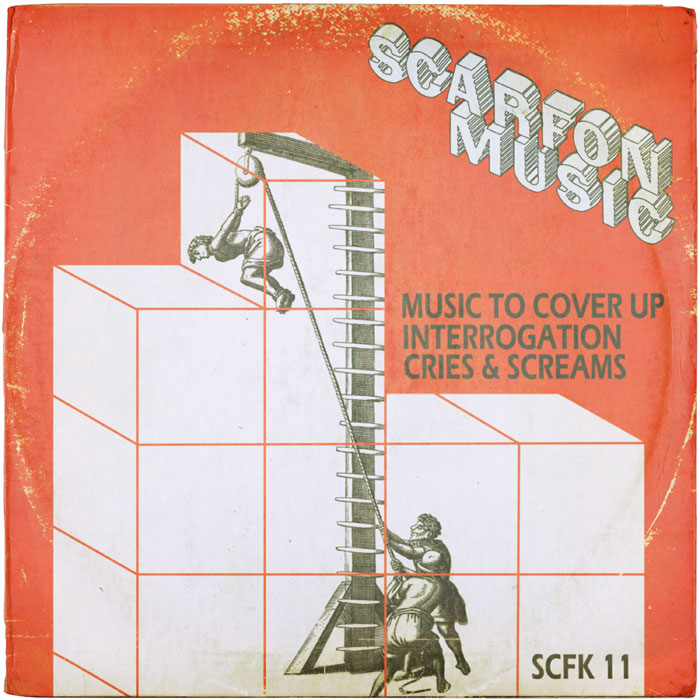
Library Music LPs (1970s)

Library music is often used in television, radio and film productions. This low-budget, pre-written music is intended to convey particular moods to the audience. Entire LPs, named by theme and often in multiple volumes, are dedicated to a wide variety of moods and concepts such as 'business dynamism', 'modern leisure', 'relaxed terror', 'perky dismay' and 'unspecified uncertainty'.


The library music records presented here were found in the Scarfolk Council archive. Our files show that audio from them was included not only in many of Scarfolk's public information and infant indoctrination films, but they were also the soundtracks to party political broadcasts of the 1970s.


Library music was also used by large corporations in their threatening advertising campaigns, as well as the aggressive training and breaking of ineffective, altruistic employees.


Additionally, subliminal audio from releases such as 'Sound Frequencies to Induce Unconditional Obedience' (Music de Scarfolke, 1970) was broadcast on all local television channels on the hour, every 8 hours, for a duration of 3 seconds. It triggered in citizens the compulsion to stand at their open front doors and shout out confessions to thought crimes they had perpetrated during the day. Teams of social workers hiding in bushes and beneath cars recorded the confessions for later exploitation by the state. For example, up until 1979, a portfolio of each citizen's crimes was buried with him so that any outstanding sentences or punishments incurred in this life may be carried over into the next.


Thursday, 10 September 2015

Citizen Value (1971-1979)


In 1971 a local government survey revealed that the citizens of Scarfolk were, by and large, content. This was of great concern to the council which worried that its people risked developing self-confidence - perhaps even dignity - and worse that they might even have false hopes for a brighter future.

By 1972 a government scheme to stifle these dangerous thoughts was in full effect. Schools were not permitted to grade any student higher than a 'D'; adults received personalised insults by post or telephone, and families attended compulsory classes which promoted subservience and feelings of shame.

Additionally, every Friday local newspapers published an updated list of individual citizens' current worth alongside prices for poultry, offal and other meat products. Some citizens' values frequently fell below that of brain, spleen, heart and tripe.

The poster above was ubiquitous at the time, but this example was found on a wall in Scarfolk hospital's maternity ward.

Thursday, 3 September 2015

"Welcome Refugees" Poster (1970)


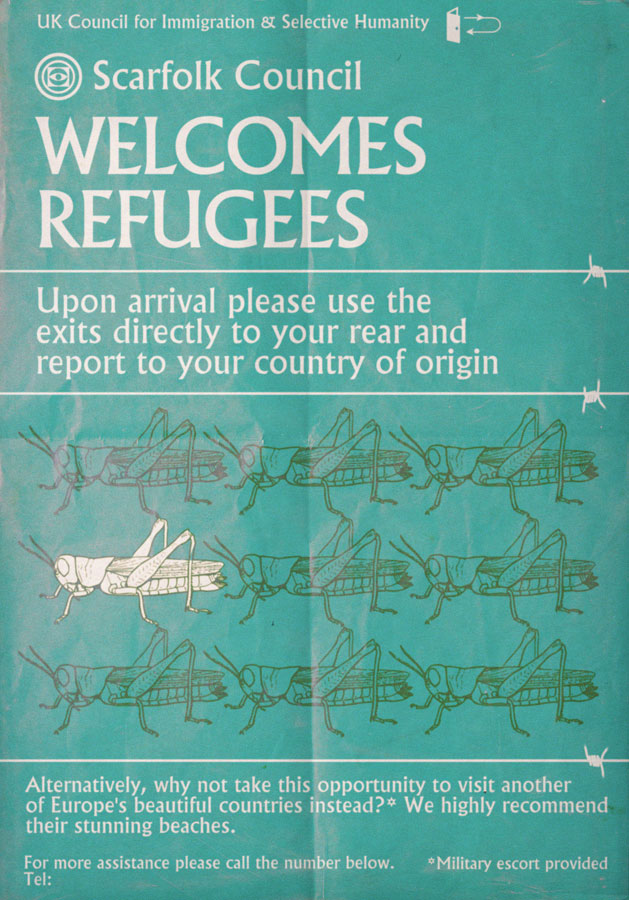
In 1970 Scarfolk Council faced a humanitarian crisis and was asked to take in refugees. Councillors warned that an influx of too many migrants could make Scarfolk susceptible to earthquakes, foreign food and other natural disasters, and that the town may even "become unbalanced, tip over and crash into a neighbouring town".

The mayor in particular expressed concern that a sudden population increase could affect the chances of him getting his favourite parking spot at Scarfolk Visitors' Welcome Centre and that the building of new housing to accommodate refugees may seriously impact the schedule of his builder who had already delayed the building of his kitchen extension twice that year.

Councillors also argued that Scarfolk didn't have the space for refugees and quickly redesignated vast regions of post-industrial wasteland as 'protected areas of outstanding natural beauty'. Despite this, the council was forced take in 1.3 refugees for every 20 citizens. The council promised to observe these requirements to the letter and even hired surgeons to ensure a precise quota.

When refugees finally arrived in Scarfolk, they were met by the poster above, which was clearly intended to deter them even before they passed through customs and immigration.

Thursday, 27 August 2015

"No" (1973-1975)


In 1973 Scarfolk Council released the above poster all over town. On the same day it also stopped responding to applications for welfare benefits, in fact it stopped responding to all enquiries from the public.

Those who called the council telephone number were answered by a distant, echoing voice which relentlessly repeated the word 'No'. It wasn't a recorded message and callers could sometimes hear faint whimpering in the background.

Some families received letters from the council which contained a single instance of the word, while others received multi-page letters with 'No' printed many hundreds of times. The longest 'No' letter received by a citizen contained 178,121 pages and was delivered by an articulated lorry, whose number plate also simply read 'No'.

Hoping for a 'No' answer, numerous residents tried to take advantage of the council by asking if they were required to pay their taxes or respect the law. Such people were visited by an impeccably dressed man called Mr. Custard who had rows of paper clips and occult symbols tattooed on his face. He would whisper briefly in the residents' ears before leaving. All were found dead within days of Mr Custard's visit, having slit their own wrists and daubed the word 'No' in their own blood on the walls of their homes.

In 1975 the 'No' era suddenly stopped. The council apologised and claimed that it had simply been the result of a clerical error.


For the 'Stop!' campaign see "Discovering Scarfolk" (page 154). For the 'Don't' campaign go HERE.

Friday, 21 August 2015

NHS Health Warning Poster (1978)


In 1978 the Notional Health Service was struggling to cope with its lack of funds. Overspending was unavoidable and the threat of closure was ever present. However, Scarfolk Council's department for health and knitting hit upon a simple method to radically reduce spending.

Firstly, taking its lead from a household insurance policy, the council recategorised many serious (thus expensive) illnesses as ineligible for treatment. Cases were dismissed due to "general wear and tear" or "acts of god", and the council even went as far as to recommend that patients with serious physical ailments "contact the manufacturer for further assistance". Secondly, the spread of disease in hospitals was cut by 90% by removing and prohibiting sick patients.

Patients with cheaper, non-threatening conditions were admitted to NHS hospitals, but only if they understood that they might share a bed with up to 9 other patients and/or a startup business that had rented the bed as office space. Patients were also subjected to virtually costless placebo trials. In fact, all treatments in 1979 were placebos consisting of either sherbert infusions (the town mayor was a major stakeholder in a Scarfolk confectionery factory) or daily rituals conducted by a coven of witches, who chanted in hospital car parks around an effigy of a nature deity made from balloons.

The cost-cutting scheme was successful and other regions adopted the same model. Not treating people was the only way to keep the NHS a viable, going concern, permitting it to continue what it has always done best: treat people.

Friday, 14 August 2015

"Thought Policy" Leaflet (1976)

Below is a leaflet published by the Scarfolk council department that was set up in 1973 to deal with citizen thought detection and control.

In addition to the thought-detector vans which prowled Scarfolk's streets (see HERE for more information), citizens were expected to undergo regular thought inspections.

At the time, thought terrorism was rife and most major public buildings and spaces had security checkpoints. Citizens were expected to read, understand and answer the questions put to them in the leaflet before being scanned by an IDS (Idea Detection Scanner). Initially, IDSs were just ex-policemen who had failed psychiatric empathy tests after sustaining severe head injuries. The practice of using such policemen was stopped when it was discovered that the method they used to extract thoughts from citizens' heads involved the use of a big, sharp stick and an ice-cream scoop. More accurate IDS machines eventually replaced the policemen, drastically reducing human error, though the stick and ice-cream scoop were retained.


Friday, 7 August 2015

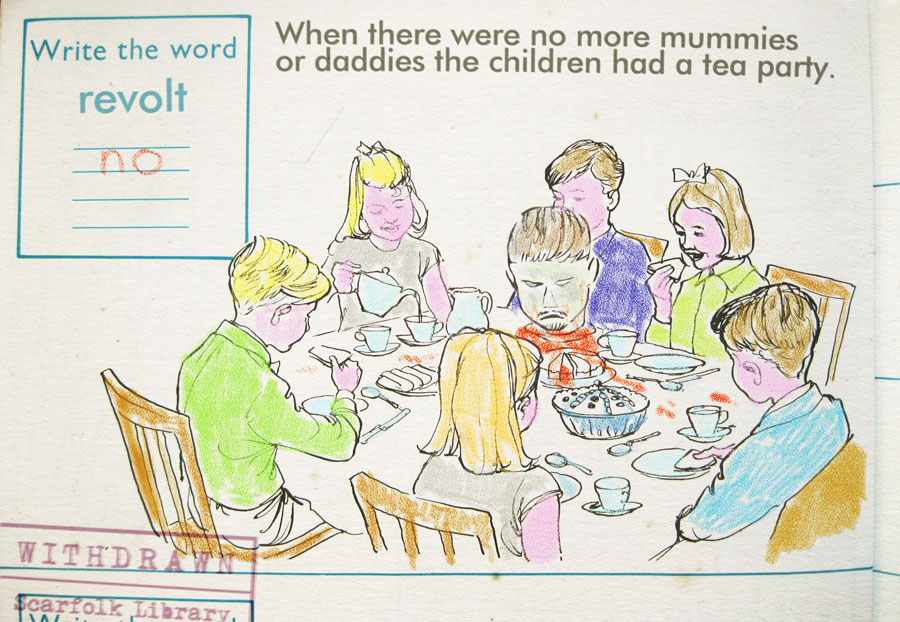
The "Infant Liberation Front" Colouring Book


1972 saw the birth of the ILF (Infant Liberation Front), a terrorist organisation for the under-10s. The anarchic underground group was slow to make an impact because many of its younger members had not yet developed the literacy skills required to understand the group's manifesto.

The breakthrough came in 1973 when the ILF published a more accessible colouring book. It outlined the group's aims and depicted recommended acts of terror which could be easily carried out before bedtime. The book was an instant hit and widely distributed in school playgrounds.

The ILF's goal was to create a paedocracy, but not only; it also wanted "the freedom to eradicate all grownups (without having to get their permission first)". To this end the group would go to any lengths. Hordes of children roamed the streets (after they had completed their homework) hunting stray adults, and in 1976 alone 250 grownups disappeared or met their fates.

In 1978 the ILF disbanded when Arthur Grubbe, a 50 year old investigative journalist, infiltrated the group by posing as a 3 year old girl. Grubbe revealed that the ILF was secretly funded by local government who intended to groom sociopaths for positions in the civil service once they reached the age of majority.

Grubbe became something of a celebrity and Arthur was the most popular baby girl name of 1979.


Below, an ILF leaflet. ILF members regularly held dirty protests, especially those under the age of one. They doggedly maintained around-the-clock demonstrations which were only interrupted by feeding time and naps.


You can learn more about infant civil disobedience HERE and HERE and HERE.

Thursday, 30 July 2015

Roy, The Telekinetic Child-Owl (1973-1979)

Scarfolk Council was no stranger to invading the privacy of ordinary families. Back in December we introduced you to the council Christmas Boy (see HERE) who strictly monitored the contentment of families during the festive season. We've since received letters asking how the council kept households in check during the rest of the year.


In 1973 the council engineered a genetically modified creature called Roy. He was the result of cross-breeding barn owls with surplus human infants raised by prying, judgemental, lower-middle-class parents. Roy was cloned and delivered to every family in Scarfolk. His job was to oversee domestic affairs, and, if any family member deviated from officially sanctioned activity, Roy was to berate them by tutting and shaking his head.

Unfortunately, there had been a clinical oversight. Volatile poltergeist DNA had accidentally contaminated Roy's genes when a careless scientist left open a lab window which looked out onto a supernatural-energy processing plant. Instead of the envisioned tutting and head-shaking, Roy flew into violent rages, triggering major telekinetic events. There were reports of Roys decimating entire families and, in one case, allegedly annihilating an entire housing estate.

The council was under pressure to recall the defective owls, but because there had been a sudden drop in the numbers of families claiming benefits, it announced instead that Roy was a resounding success and millions more of the human-owl hybrid were commissioned by the police and social services.

Thursday, 23 July 2015

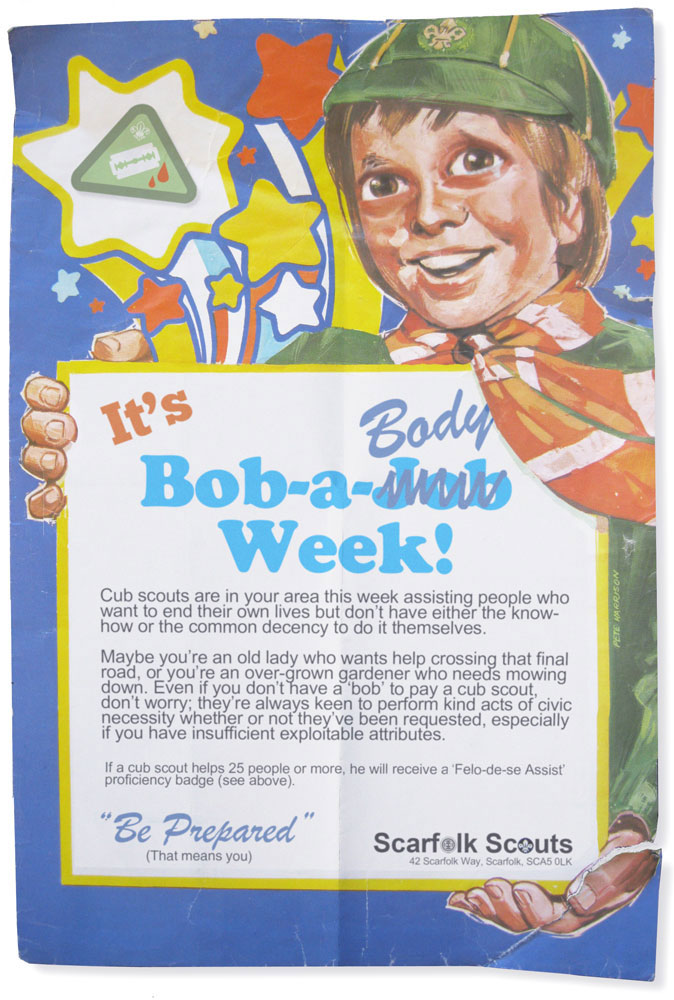
Cub Scout "Bob-a-Body" Week (1977)

The annual boy scout Bob-a-Job week was an institution. However, from 1975 the jobs that scouts were expected to undertake moved away from the mundane - the washing of cars, sweeping of leaves and mowing of lawns - and became much more demanding.

Below is a scout leaflet from 1977 which was the first year that Bob-a-Job week officially changed its name.


During Bob-a-Body week, hundreds of cub scouts roamed Scarfolk helping members of the community with their assisted suicide needs. The old, sick and formally shunned most frequently employed the services of the scouts, though the council's Oxygen Resource Board allegedly sent lists of reluctant residents to scout groups in advance, along with illicitly duplicated front door keys and gallon jars of a toxic nerve agent.

Wednesday, 15 July 2015

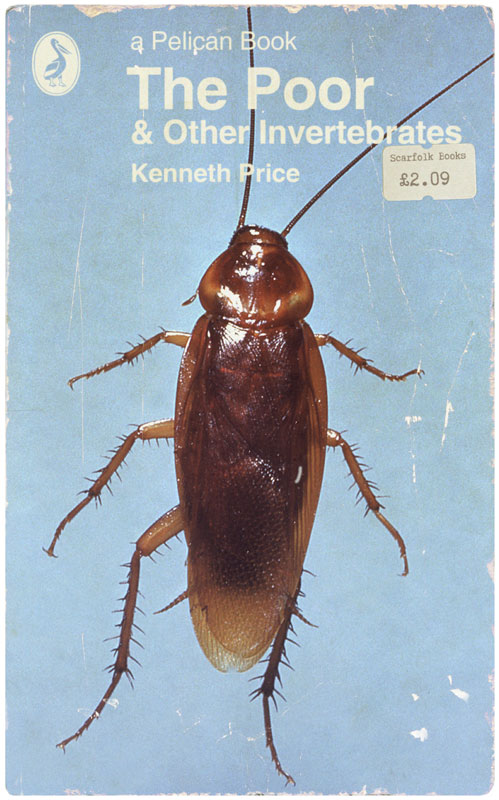
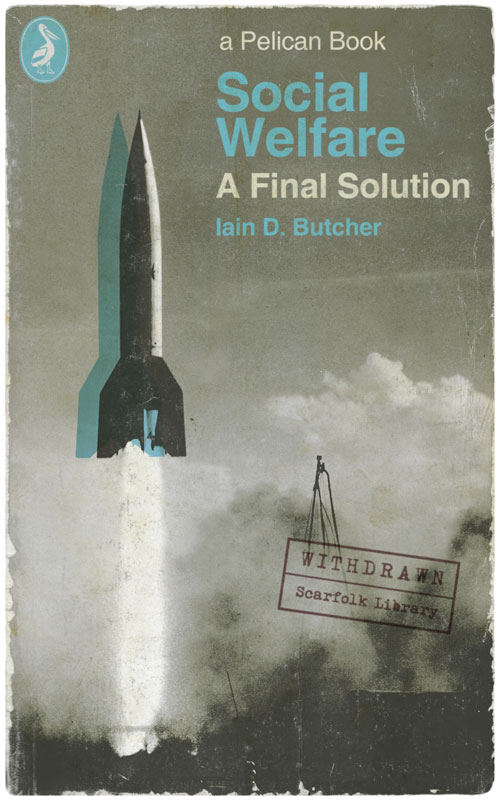
Poverty & 1970s Pelican Books

Poor, uneducated people have always been obstinate in their selfish desire to ruin the contentment of those from more important social classes.

Below are several Pelican books from the 1970s which deal with the decade's poverty, austerity and the blight of these self-centered people who relish being destitute.

For example, The Poor and Other Invertebrates, published in 1974, made the following claims about the nation's impoverished:

"[They] reproduce prolifically in 3 months rather than the conventional 9 months of properly evolved humans".

"They intentionally contract diseases by manufacturing their own bacteria at home, which they smear onto their cheap linoleum floors  [...] then roll around in it".

"They burgle respectable citizen's homes, then play Bingo".

In 1976, Scarfolk council dealt with the needy by taking away their autonomy and making them property of the state. Thousands of people below the breadline were requisitioned to be used as civic equipment such as street bollards and even sandbags in the case of flooding or terrorist bombings.