Showing posts with label freedom of speech. Show all posts

Thursday, 7 January 2016

The Fact Ban (1976)


In 1975 the government discreetly tortured citizens to find out what they thought of its leadership. The results revealed that many participants thought the state "cheerfully totalitarian","despotic, but in a nice way", and "I'll say anything you want as long as you stop waterboarding me and give me back my eye."

The government sensed a need for change and announced that it would be introducing more liberal attitudes to its policies, particularly those relating to facts and information.

Facts had always been problematic for the government because of their inflexibility. Though the use of facts in state administration was strongly disparaged and had largely been expunged from political life, some civil servants stubbornly refused to yield to inexplicable reversals in party policy.

An internal council memo to employees read: "Facts do not serve the best interests of a successful government and we must not permit them to hinder our healthy economy with their tyrannical, oppressive insistence on what is and isn't true. If you must employ a truth, ensure that you are liberal with it -  untamed, unedited facts can be dangerous in the wrong hands. Ideally, you will create your own facts so that you can retain control of them."

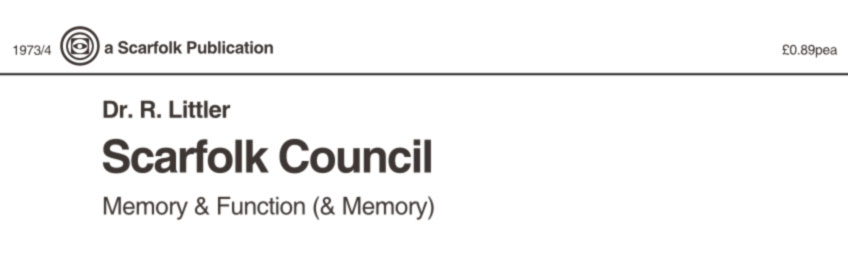
In early 1976, as part of its Truth Reform, the government went a step further and initiated an all-out ban on unsanctioned facts, as can be seen from the above council leaflet distributed to employees. Until the end of the decade all facts were created and authorised by a new governmental department called the Fact Office or F-OFF for short.

Tuesday, 13 January 2015

"Freedom of Speech" Public Information (1975)


While freedom of speech should, without exception, always be upheld and fought for, it was complicated in 1970s Scarfolk.

Take, for example, the case of the multinational New State Corporation, which converted decommissioned army personnel with psychological problems into soft toys that taught feral and left-wing children about Jesus. When two employees, Ed Manning and Julien Snowden exercised their freedom of speech to expose the company's illegal use of black magick (and candy floss) in the conversion process they soon found themselves in prison awaiting trial.

The problem was that there were so many (and sometimes contradictory) exceptions to freedom of speech that it was only practically possible to exercise it if you were a) very wealthy or b) the government had a vested political interest in what you were saying and were willing to endorse you, or c) you said what you had to say, then hid where no one could find you.

In addition to the help and guidelines offered in the 1975 leaflet above, the council also strongly recommended exercising one's freedom of speech in one's own head and not saying it out loud. A council spokesman said:
 "Everyone verbally exercising their freedom of speech at the same time not only contravenes a noise pollution bylaw, but also makes it difficult for our many council stenographers who are trying to illicitly record what everyone is saying".