Scarfolk is a town in North West England that did not progress beyond 1979. Instead, the entire decade of the 1970s loops ad infinitum. Here in Scarfolk, pagan rituals blend seamlessly with science; hauntology is a compulsory subject at school, and everyone must be in bed by 8pm because they are perpetually running a slight fever. "Visit Scarfolk today. Our number one priority is keeping rabies at bay." For more information please reread.
Showing posts with label social services. Show all posts
Wednesday, 31 May 2017
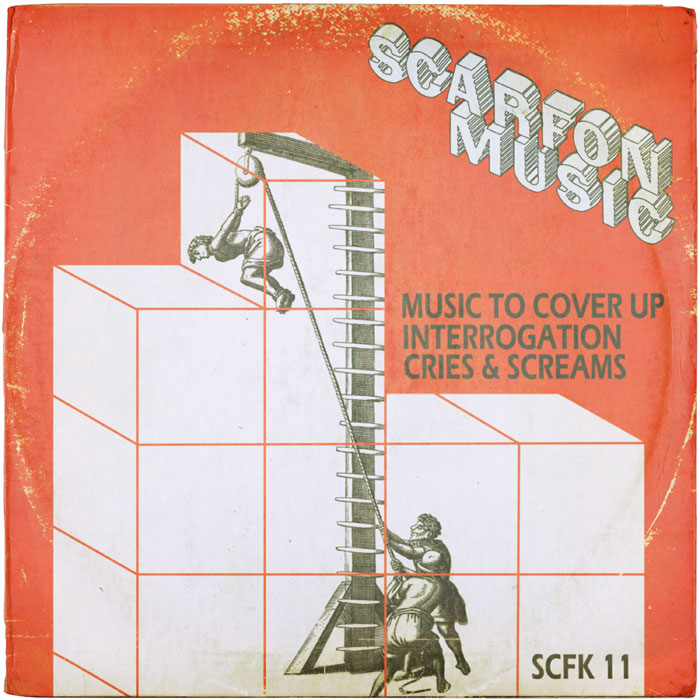
Police Interrogation Safewords
Almost everybody endured police interrogations at some point during the 1970s. They were so frequent that most families had a packed bag by the front door (people were expected to bring a spare change of underwear and their own first-aid supplies).
If by chance all members of a family were summoned together, they might make a day of it, have a picnic in the prison facility's Garden of Incorruptibility and watch the interrogation of their loved ones on big monitors. Laugh tracks were included to minimise distress.
While the security services were openly proud of their slogans such as "we promise to raise a glass to those who don't confess", if a detainee did suffer irreversible psychological or physical damage as a result of their interrogation, the family was awarded a £5 book token and a potted cactus as compensation.
More about Scarfolk Security Services.
Wednesday, 10 May 2017
Benefits Assessment Bouncers (1972)
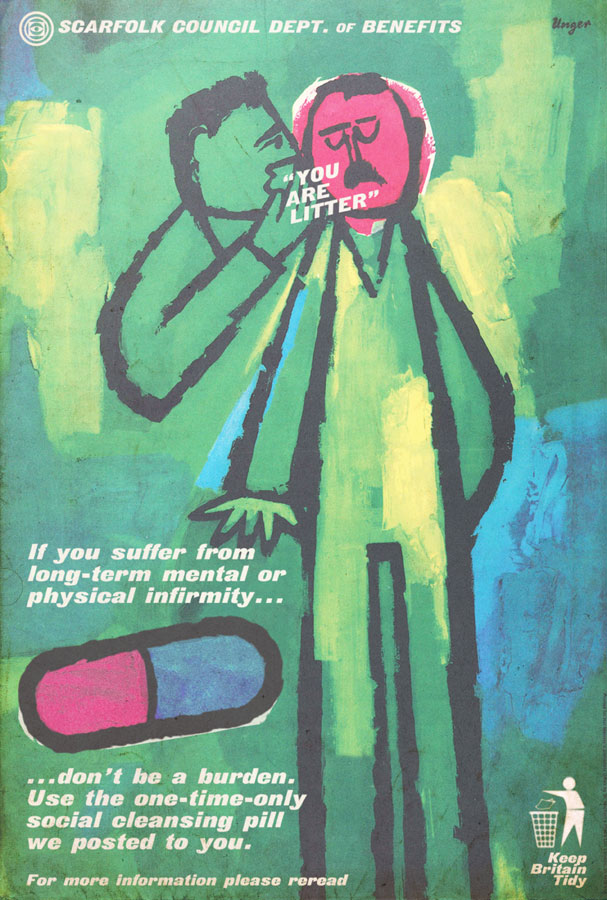
In 1972 the council outsourced its sick and disability benefits assessment service to a team of nightclub bouncers. The bouncers broke into the homes of claimants in the dead of night, shone lights in their faces and screamed threats at them.
Claimants who were identified as frauds were thrown down their own stairs, often repeatedly, to ensure that their physical and mental conditions matched their claims.
Genuine claimants were offered a menu of euthanasia options of varying price and bullied into choosing the most expensive, the so-called 'Kill Pill', which also contained a mild explosive (see poster above). However, claimants did have the choice to nominate another family member who could commit suicide in their place.
People who refused to take their own lives were officially recategorised as "potentially hazardous biological litter"; they were consequently charged with self-fly-tipping and taken away in vast fleets of skips on the first Monday of every month.
Thursday, 10 March 2016
Welfare Recipient Targets (1971-1979)
In 1971 it became compulsory for welfare recipients to sew targets onto their clothing so that they could be identified in public at all times. The minister for social services rejected claims that the target invited personal attacks, sidestepping the fact that the government had concurrently increased its funding of archery classes for newly released criminal sociopaths as part of their reintegration into society.
Despite these developments, the number of people claiming welfare tripled by 1973, in part because many families had lost one or more breadwinners to arrow-related injuries. The government, desperate to reduce spending, began promoting the idea that less dependent members of society involved in "crimes against target wearers" should be exempted from legal proceedings. In fact, they were rewarded. For example, points on drunk drivers’ licenses were removed following accidents which produced fatalities within the boundaries of large council estates.
There were also several instances of fully-armed Alvis FV101 Scorpion tanks, with the keys in their ignitions, inexplicably left by the army on the driveways of decent, middle-class citizens who neighboured built-up social housing areas.
Labels:
1970s,
armed forces,
class system,
conservatism,
Council,
crime,
driving,
estate,
euthanasia,
government spending,
healthcare,
homicide,
social services,
societal breakdown,
society,
state,
welfare
Thursday, 28 January 2016
Emergency Supplies (1979)
The 1970s was a decade of social tension. Environmental disaster, terrorism, war and foreigners were a constant threat. Many citizens and some of their friends expressed concern about what would happen if the worst came to the worst.
In 1979 the government declared that it was fully prepared for any eventuality. A series of posters and leaflets introduced Pre-Emergency Services which had been set up to supply citizens with "essential survival items" including ping pong balls, rubber bands (see poster above), furniture polish, drinks coasters and crocheted toilet-roll covers that looked like Georgian ladies.
The minister for internal affairs wrote in one leaflet: "Our new emergency initiatives clearly demonstrate how seriously we take the welfare of British citizens. Should an unexpected catastrophe occur, such as the one which may or may not take place later this year on October 14th, we guarantee that working families and those most in need, such as table tennis players, will be the first to receive the emergency supplies listed in this leaflet."
To further demonstrate his commitment to the people, the prime minister himself offered to forgo his own rubber band and drinks coaster rations saying that "the knowledge that the people of the United Kingdom are safe is all the comfort I need and I will gladly make do with less vital resources", which were later revealed to be water purification tablets, dried food goods and medical supplies.
For more archival documents about emergency procedures read this Public Information Booklet, this civil defence poster and take note of this new emergency services telephone number.
Labels:
1970s,
Council,
emergency,
government,
health & safety,
PIF,
poster,
prime minister,
protect and survive,
PSA,
Public Information,
public services,
social services,
societal breakdown,
society
Thursday, 7 January 2016
The Fact Ban (1976)
In 1975 the government discreetly tortured citizens to find out what they thought of its leadership. The results revealed that many participants thought the state "cheerfully totalitarian","despotic, but in a nice way", and "I'll say anything you want as long as you stop waterboarding me and give me back my eye."
The government sensed a need for change and announced that it would be introducing more liberal attitudes to its policies, particularly those relating to facts and information.
Facts had always been problematic for the government because of their inflexibility. Though the use of facts in state administration was strongly disparaged and had largely been expunged from political life, some civil servants stubbornly refused to yield to inexplicable reversals in party policy.
An internal council memo to employees read: "Facts do not serve the best interests of a successful government and we must not permit them to hinder our healthy economy with their tyrannical, oppressive insistence on what is and isn't true. If you must employ a truth, ensure that you are liberal with it - untamed, unedited facts can be dangerous in the wrong hands. Ideally, you will create your own facts so that you can retain control of them."
In early 1976, as part of its Truth Reform, the government went a step further and initiated an all-out ban on unsanctioned facts, as can be seen from the above council leaflet distributed to employees. Until the end of the decade all facts were created and authorised by a new governmental department called the Fact Office or F-OFF for short.
Labels:
1970s,
1984,
brainwashing,
business,
censorship,
civil service,
Council,
freedom of speech,
government,
Orwell,
Public Information,
social services,
society,
spin,
torture,
totalitarian
Saturday, 31 October 2015
"Infant Catcherbots" Public Information Poster (1975)
After last week's post about the Bladder Clown surgical toy we thought it seasonally appropriate to show you another artefact filed in our Automaclown Archive B.
Parents in the 1970s were required to submit their children to civic trials, the details of which are not fully clear to us now. We do know, however, that the few children who survived them developed debilitating paranormal powers such as retrospective-clairvoyance - the ability to see the future of people who lived in the past.
Perhaps understandably, many children went unregistered for "The Trials" and the council was forced to track them down by ever devious means. By 1975 the council had developed Catcherbots which, in various guises, lured and apprehended unregistered children. In addition to the Clown Catcherbot (see the council's Halloween poster campaign above) there were also the Jesus, 'lovely Nana', pony-demon and Noel Edmonds Catcherbot models.
Once an offending child had been identified, Catcherbots sucked them up through their 'catcherholes'. Early quantum technology made it possible for dozens of children to be imprisoned inside the Catcherbots in a space no larger than a shoe box. At least, that was the theory: many of the children were never seen again. The same technology was later used in recycling machines that crush and process plastic bottles.
Happy Halloween/Samhain! Do you know where YOUR child is tonight?
Friday, 18 September 2015
Library Music LPs (1970s)
Library music is often used in television, radio and film productions. This low-budget, pre-written music is intended to convey particular moods to the audience. Entire LPs, named by theme and often in multiple volumes, are dedicated to a wide variety of moods and concepts such as 'business dynamism', 'modern leisure', 'relaxed terror', 'perky dismay' and 'unspecified uncertainty'.
The library music records presented here were found in the Scarfolk Council archive. Our files show that audio from them was included not only in many of Scarfolk's public information and infant indoctrination films, but they were also the soundtracks to party political broadcasts of the 1970s.
Library music was also used by large corporations in their threatening advertising campaigns, as well as the aggressive training and breaking of ineffective, altruistic employees.
Additionally, subliminal audio from releases such as 'Sound Frequencies to Induce Unconditional Obedience' (Music de Scarfolke, 1970) was broadcast on all local television channels on the hour, every 8 hours, for a duration of 3 seconds. It triggered in citizens the compulsion to stand at their open front doors and shout out confessions to thought crimes they had perpetrated during the day. Teams of social workers hiding in bushes and beneath cars recorded the confessions for later exploitation by the state. For example, up until 1979, a portfolio of each citizen's crimes was buried with him so that any outstanding sentences or punishments incurred in this life may be carried over into the next.
Library music was also used by large corporations in their threatening advertising campaigns, as well as the aggressive training and breaking of ineffective, altruistic employees.
Additionally, subliminal audio from releases such as 'Sound Frequencies to Induce Unconditional Obedience' (Music de Scarfolke, 1970) was broadcast on all local television channels on the hour, every 8 hours, for a duration of 3 seconds. It triggered in citizens the compulsion to stand at their open front doors and shout out confessions to thought crimes they had perpetrated during the day. Teams of social workers hiding in bushes and beneath cars recorded the confessions for later exploitation by the state. For example, up until 1979, a portfolio of each citizen's crimes was buried with him so that any outstanding sentences or punishments incurred in this life may be carried over into the next.
Labels:
1970s,
brainwashing,
corporate,
Council,
library music,
LP,
media,
mind control,
music,
propaganda,
Public Information,
records,
social services,
subliminal,
thought crime,
totalitarian,
vinyl
Thursday, 3 September 2015
"Welcome Refugees" Poster (1970)
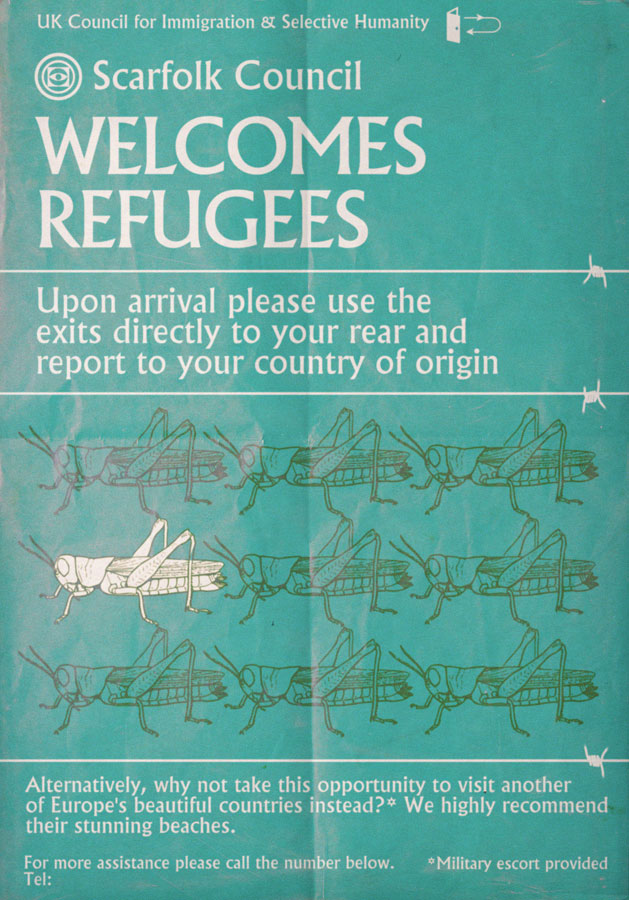
In 1970 Scarfolk Council faced a humanitarian crisis and was asked to take in refugees. Councillors warned that an influx of too many migrants could make Scarfolk susceptible to earthquakes, foreign food and other natural disasters, and that the town may even "become unbalanced, tip over and crash into a neighbouring town".
The mayor in particular expressed concern that a sudden population increase could affect the chances of him getting his favourite parking spot at Scarfolk Visitors' Welcome Centre and that the building of new housing to accommodate refugees may seriously impact the schedule of his builder who had already delayed the building of his kitchen extension twice that year.
Councillors also argued that Scarfolk didn't have the space for refugees and quickly redesignated vast regions of post-industrial wasteland as 'protected areas of outstanding natural beauty'. Despite this, the council was forced take in 1.3 refugees for every 20 citizens. The council promised to observe these requirements to the letter and even hired surgeons to ensure a precise quota.
When refugees finally arrived in Scarfolk, they were met by the poster above, which was clearly intended to deter them even before they passed through customs and immigration.
Friday, 21 August 2015
NHS Health Warning Poster (1978)
In 1978 the Notional Health Service was struggling to cope with its lack of funds. Overspending was unavoidable and the threat of closure was ever present. However, Scarfolk Council's department for health and knitting hit upon a simple method to radically reduce spending.
Firstly, taking its lead from a household insurance policy, the council recategorised many serious (thus expensive) illnesses as ineligible for treatment. Cases were dismissed due to "general wear and tear" or "acts of god", and the council even went as far as to recommend that patients with serious physical ailments "contact the manufacturer for further assistance". Secondly, the spread of disease in hospitals was cut by 90% by removing and prohibiting sick patients.
Patients with cheaper, non-threatening conditions were admitted to NHS hospitals, but only if they understood that they might share a bed with up to 9 other patients and/or a startup business that had rented the bed as office space. Patients were also subjected to virtually costless placebo trials. In fact, all treatments in 1979 were placebos consisting of either sherbert infusions (the town mayor was a major stakeholder in a Scarfolk confectionery factory) or daily rituals conducted by a coven of witches, who chanted in hospital car parks around an effigy of a nature deity made from balloons.
The cost-cutting scheme was successful and other regions adopted the same model. Not treating people was the only way to keep the NHS a viable, going concern, permitting it to continue what it has always done best: treat people.
Labels:
1970s,
Britain,
capitalism,
Council,
government,
healthcare,
hospitals,
NHS,
occult,
pharmaceutical,
PIF,
poster,
PSA,
Public Information,
Scarfolk,
sickness,
social services,
totalitarian,
witchcraft
Friday, 7 August 2015
The "Infant Liberation Front" Colouring Book
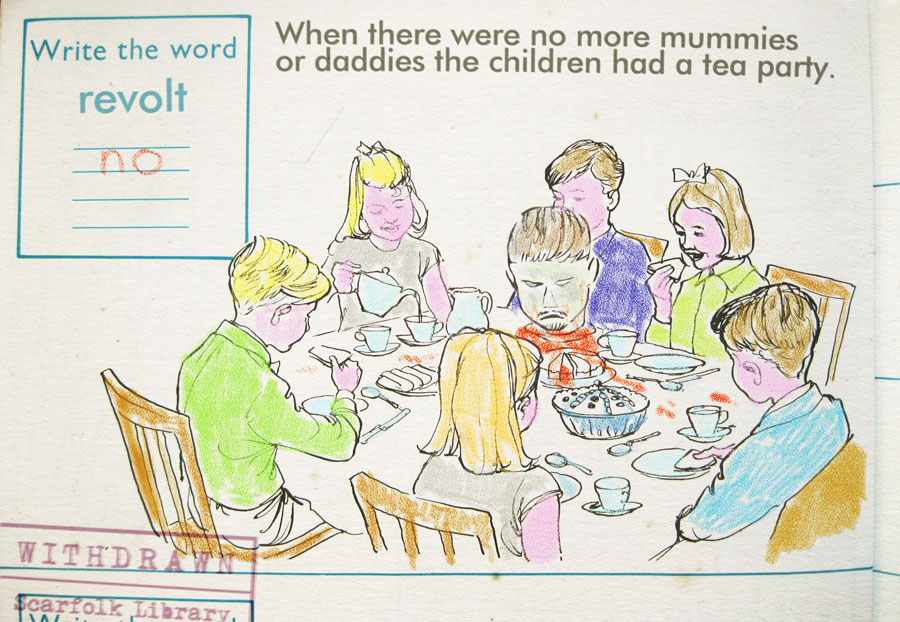
1972 saw the birth of the ILF (Infant Liberation Front), a terrorist organisation for the under-10s. The anarchic underground group was slow to make an impact because many of its younger members had not yet developed the literacy skills required to understand the group's manifesto.
The breakthrough came in 1973 when the ILF published a more accessible colouring book. It outlined the group's aims and depicted recommended acts of terror which could be easily carried out before bedtime. The book was an instant hit and widely distributed in school playgrounds.
The ILF's goal was to create a paedocracy, but not only; it also wanted "the freedom to eradicate all grownups (without having to get their permission first)". To this end the group would go to any lengths. Hordes of children roamed the streets (after they had completed their homework) hunting stray adults, and in 1976 alone 250 grownups disappeared or met their fates.
In 1978 the ILF disbanded when Arthur Grubbe, a 50 year old investigative journalist, infiltrated the group by posing as a 3 year old girl. Grubbe revealed that the ILF was secretly funded by local government who intended to groom sociopaths for positions in the civil service once they reached the age of majority.
Grubbe became something of a celebrity and Arthur was the most popular baby girl name of 1979.
Below, an ILF leaflet. ILF members regularly held dirty protests, especially those under the age of one. They doggedly maintained around-the-clock demonstrations which were only interrupted by feeding time and naps.
Thursday, 30 July 2015
Roy, The Telekinetic Child-Owl (1973-1979)
Scarfolk Council was no stranger to invading the privacy of ordinary families. Back in December we introduced you to the council Christmas Boy (see HERE) who strictly monitored the contentment of families during the festive season. We've since received letters asking how the council kept households in check during the rest of the year.
In 1973 the council engineered a genetically modified creature called Roy. He was the result of cross-breeding barn owls with surplus human infants raised by prying, judgemental, lower-middle-class parents. Roy was cloned and delivered to every family in Scarfolk. His job was to oversee domestic affairs, and, if any family member deviated from officially sanctioned activity, Roy was to berate them by tutting and shaking his head.
Unfortunately, there had been a clinical oversight. Volatile poltergeist DNA had accidentally contaminated Roy's genes when a careless scientist left open a lab window which looked out onto a supernatural-energy processing plant. Instead of the envisioned tutting and head-shaking, Roy flew into violent rages, triggering major telekinetic events. There were reports of Roys decimating entire families and, in one case, allegedly annihilating an entire housing estate.
The council was under pressure to recall the defective owls, but because there had been a sudden drop in the numbers of families claiming benefits, it announced instead that Roy was a resounding success and millions more of the human-owl hybrid were commissioned by the police and social services.
In 1973 the council engineered a genetically modified creature called Roy. He was the result of cross-breeding barn owls with surplus human infants raised by prying, judgemental, lower-middle-class parents. Roy was cloned and delivered to every family in Scarfolk. His job was to oversee domestic affairs, and, if any family member deviated from officially sanctioned activity, Roy was to berate them by tutting and shaking his head.
Unfortunately, there had been a clinical oversight. Volatile poltergeist DNA had accidentally contaminated Roy's genes when a careless scientist left open a lab window which looked out onto a supernatural-energy processing plant. Instead of the envisioned tutting and head-shaking, Roy flew into violent rages, triggering major telekinetic events. There were reports of Roys decimating entire families and, in one case, allegedly annihilating an entire housing estate.
The council was under pressure to recall the defective owls, but because there had been a sudden drop in the numbers of families claiming benefits, it announced instead that Roy was a resounding success and millions more of the human-owl hybrid were commissioned by the police and social services.
Subscribe to:
Posts (Atom)