Scarfolk is a town in North West England that did not progress beyond 1979. Instead, the entire decade of the 1970s loops ad infinitum. Here in Scarfolk, pagan rituals blend seamlessly with science; hauntology is a compulsory subject at school, and everyone must be in bed by 8pm because they are perpetually running a slight fever. "Visit Scarfolk today. Our number one priority is keeping rabies at bay." For more information please reread.
Showing posts with label public services. Show all posts
Wednesday, 31 May 2017
Police Interrogation Safewords
Almost everybody endured police interrogations at some point during the 1970s. They were so frequent that most families had a packed bag by the front door (people were expected to bring a spare change of underwear and their own first-aid supplies).
If by chance all members of a family were summoned together, they might make a day of it, have a picnic in the prison facility's Garden of Incorruptibility and watch the interrogation of their loved ones on big monitors. Laugh tracks were included to minimise distress.
While the security services were openly proud of their slogans such as "we promise to raise a glass to those who don't confess", if a detainee did suffer irreversible psychological or physical damage as a result of their interrogation, the family was awarded a £5 book token and a potted cactus as compensation.
More about Scarfolk Security Services.
Monday, 6 March 2017
"Life is Easier With Guilt" Public Information Campaign
This is part 2 of our look at crime in Scarfolk (see last week’s post about 'Real British Crime').
In 1972, Scarfolk Council decided that the "presumption of innocence before being proven guilty" was a bit too presumptuous.
A council spokesperson said that "such legal bureaucracy completely ignores the rights of guilty people who want to be legally recognised as guilty but have either committed a crime that has unfortunately gone undetected, or are, through no fault of their own, awaiting trials which could take many months, even years to rightfully establish their guilt.
The spokesman also pointed out that people may be guilty of actions that are not yet considered crimes and underlined the importance of recognising these people’s culpability to ensure peace of mind.
In the spring of 1973, the government's propaganda department launched a campaign that promoted guilt as a desirable attribute. It was so successful that many people feared they might not be guilty enough and committed horrific crimes to nurture in themselves feelings of self-worth and wellbeing.
The campaign featured a policeman whose nickname was "PC Fang". Allegedly, he had the ability to instil a deep sense of guilt in even the most innocent citizens. Some say he achieved this by using supernatural powers; others say he used a hammer.
In 1972, Scarfolk Council decided that the "presumption of innocence before being proven guilty" was a bit too presumptuous.
A council spokesperson said that "such legal bureaucracy completely ignores the rights of guilty people who want to be legally recognised as guilty but have either committed a crime that has unfortunately gone undetected, or are, through no fault of their own, awaiting trials which could take many months, even years to rightfully establish their guilt.
The spokesman also pointed out that people may be guilty of actions that are not yet considered crimes and underlined the importance of recognising these people’s culpability to ensure peace of mind.
In the spring of 1973, the government's propaganda department launched a campaign that promoted guilt as a desirable attribute. It was so successful that many people feared they might not be guilty enough and committed horrific crimes to nurture in themselves feelings of self-worth and wellbeing.
The campaign featured a policeman whose nickname was "PC Fang". Allegedly, he had the ability to instil a deep sense of guilt in even the most innocent citizens. Some say he achieved this by using supernatural powers; others say he used a hammer.
A frame from a lost public information film that played at cinemas during the advertisements.
A T-shirt compulsorily worn by children.
Thursday, 10 November 2016
The "Easy as 1-2-3" Campaign
From the launch of the 'Easy as 1-2-3' campaign:
"We live in worrying times. Many residents require help but feel that they are unable to discuss with the council the social issues that affect them.
While it is true that a) we adhere to a strict policy of not answering our public helpline telephones and b) our offices cannot be approached without the aid of a mine detector, we would like to alleviate any concerns you may have.
In the coming weeks you will see posters [see above] placed in public areas around the town. Read them thoroughly. They contain all the details you need to go about your daily life. You do not require any additional information from the council. Further solicitations for help or support, even in alleged emergencies, could incur a fine of up to £500."
Thursday, 25 August 2016
Human Rights Lottery Advertisement (1976)
In 1976, after three years of austerity and drastic cuts, the government admitted that there were no longer enough human rights to go around. Stockpiles diminished at such an alarming rate that only one UK citizen in twenty had access to inalienable human rights and by the end of the decade it would plummet to only one in a hundred.
The populace was dissatisfied with the government's initial solution, which was to mail out IOU letters. In lieu of human rights, these official missives offered a non-legally-binding 'gentlemen's agreement' to provide substitute rights akin to human rights, which were never fully defined and thus remained completely open to interpretation. Indeed, many citizens were not entirely sure that they adequately fulfilled the government's criteria to be considered human.
As a token of goodwill, the government offered an annual Human Rights Lottery (see magazine ad above), but cancelled it after three years because, according to an official press release, "granting human rights to only a few citizens is not in the interest of a fair and equal society".
Labels:
advertisement,
British Bill of Rights,
civil liberty,
civil rights,
corruption,
Council,
democracy,
government,
human rights,
Human Rights Act,
lottery,
newspapers,
public services,
totalitarian
Thursday, 11 August 2016
'Allclear' Open-Air Nuclear Bunkers
click to enlarge
In 1971 the government's civil defence budget was slashed. Local councils limited their building of conventional nuclear bunkers and focused instead on cheaper alternatives, for the general populace anyway.
From government public information literature:
"Though secure, Britain's existing nuclear bunkers are cramped and do not offer the comforts of home living. Built from drab, uninspiring concrete, they are brazenly unaesthetic and because they lack natural light, occupiers risk becoming fed up during their stay.
"Government officials, royals and the independently wealthy have courteously opted to endure these cheerless conditions so that you don't have to*.
"We think that you and your family deserve more agreeable accommodation when that 4-Minute Warning jingle sounds.
"Enter ALLCLEAR, the government's new post-nuclear solution for YOU. ALLCLEAR Open-Air Bunkers are easily erected in approx. 60 minutes. They are light, airy and available in a choice of fun colours: orange or yellowy-red. They even come with their own FREE power-string, velcro all-seasons flap and a multipurpose stick [...]
"*Please note that any attempt to secure a place in a traditional concrete bunker (and in doing so compromise the well-intended benevolence of the abovementioned persons) will be rejected with extreme prejudice."
Thursday, 21 July 2016
Drug Advertisements (1970)
When Scarfolk's Mayor Ritter announced his determination to fight the war on drugs, he meant it. He also knew that if you want to win a war, it has to exist in the first place. Fortunately, Ritter had shares in the Cavalier Pharmaceutical company with whom the council secretly collaborated on a scheme to introduce vast amounts of highly-addictive narcotics into the daily lives of Scarfolk children.
The scheme not only bolstered Cavalier Pharm and other local industries; by the end of the decade it had also attracted increased government funding for the region's police and prison services. Additionally, as many young addicts didn't make it to adulthood, the strain on the NHS and welfare programmes was greatly reduced.
When Ritter was lauded for his services to the town, he said he had only done it for the children who, he declared, "are the future", though it became apparent that he specifically meant his own children who had been conceived during occult rituals, had never been exposed to the drug schemes and now had many more career opportunities than they might have had otherwise.
Above and below are 1970 drug advertisements by Cavalier Pharm. By 1972 barbiturates had been introduced to school milk, and drugs such as heroin were included in the ingredients of Pick 'n' Mix sweet selections.
More Cavalier Pharm related posts: Mindborstal and Children & Hallucinogens: The Future of Discipline. See also: Lobottymed (Discovering Scarfolk. p.15) and Placebol (Discovering Scarfolk. p.66).
Labels:
big business,
capitalism,
children,
corruption,
Council,
drugs,
government,
government spending,
health & safety,
medication,
NHS,
pharmaceutical,
political nepotism,
public services,
war
Thursday, 2 June 2016
"Trampvertising" (1973-1979)
These big companies also insisted on the option of permanent tattoo advertising because their homeless human billboards frequently lost, ate or soiled the paper-based marketing materials.
It did this by targeting poor families and individuals at risk, ensuring that they lost their homes and livelihoods through a series of punitive taxes and fines. These included the exorbitant Gormless Tax and the Unemployment Tax, which charged jobless citizens 37% of the wage they would have earned had they become a barrister and not been barred from attending a good school.
Labels:
1970s,
advertising,
austerity,
big business,
capitalism,
corpocracy,
Council,
dystopia,
government,
homeless,
law,
politics,
poverty,
public services,
tax,
totalitarian,
tramp,
unemployed
Friday, 13 May 2016
Regional BBC Scarfolk TV Programmes
In 1979 the government told the BBC that it needed to have more control over its regional programming, especially in Scarfolk. The culture secretary delivered a whitepaper in the form of a nursery rhyme, the lyrics of which warned the BBC that it should "create distinction or face extinction". To illustrate his point, the culture secretary brought along the education secretary, who he dressed as a dinosaur, and the secretary of state for work and pensions who was dressed as the meteor which wiped out all living things.
However, the culture secretary did not define exactly what he meant by "distinctive" and within the year BBC Scarfolk had begun broadcasting programmes which it felt satisfied the government's demands. Many of these programmes didn't make it past pilots, much less receive full series commissions. Again, the culture secretary had to intervene. He suggested programme titles that the goverment would prefer to see, programmes such as "Great, Amazing, Incredible Conservative Heroes", "Report Your Neighbour!" and "Strictly Catapult", which saw the coastal construction of an immense contraption which launched unaccompanied child refugees at great velocity back to their native countries.
Thursday, 28 January 2016
Emergency Supplies (1979)
The 1970s was a decade of social tension. Environmental disaster, terrorism, war and foreigners were a constant threat. Many citizens and some of their friends expressed concern about what would happen if the worst came to the worst.
In 1979 the government declared that it was fully prepared for any eventuality. A series of posters and leaflets introduced Pre-Emergency Services which had been set up to supply citizens with "essential survival items" including ping pong balls, rubber bands (see poster above), furniture polish, drinks coasters and crocheted toilet-roll covers that looked like Georgian ladies.
The minister for internal affairs wrote in one leaflet: "Our new emergency initiatives clearly demonstrate how seriously we take the welfare of British citizens. Should an unexpected catastrophe occur, such as the one which may or may not take place later this year on October 14th, we guarantee that working families and those most in need, such as table tennis players, will be the first to receive the emergency supplies listed in this leaflet."
To further demonstrate his commitment to the people, the prime minister himself offered to forgo his own rubber band and drinks coaster rations saying that "the knowledge that the people of the United Kingdom are safe is all the comfort I need and I will gladly make do with less vital resources", which were later revealed to be water purification tablets, dried food goods and medical supplies.
For more archival documents about emergency procedures read this Public Information Booklet, this civil defence poster and take note of this new emergency services telephone number.
Labels:
1970s,
Council,
emergency,
government,
health & safety,
PIF,
poster,
prime minister,
protect and survive,
PSA,
Public Information,
public services,
social services,
societal breakdown,
society
Monday, 5 October 2015
Personal Space Allowance (1975)
Until 1975, the standard PSA (Personal Space Allowance) had always been fixed at a comfortable, civilised 20 inch zone around each citizen. The government suddenly amended this, however, citing terrorism and a rising population as reasons to cut personal space along with other social benefits and civil liberties.
The PSA was more than merely reduced: The new bodily zone into which representatives of the state (and even some commercial organisations) were now free to pass was amended to minus 5.2 inches. Naturally, this made human bodies 'semi-permeable', legally speaking, and for many people only the depths of their intestines remained private.
Police, security and social services enthusiastically exploited the new laws, as did the health service which randomly pilfered internal organs from unsuspecting citizens, claiming quite lawfully that they were found in 'communal public places'. The nervous public caught on and by 1977 there were self-help groups springing up all over Scarfolk which helped citizens become as obese as possible in an effort to protect their innermost parts from state interference and even commercial exploitation.
Labels:
1970s,
benefits,
dystopia,
government,
healthcare,
NHS,
personal space,
poster,
Public Information,
public services,
security,
snooper's charter,
social,
surveillance,
terrorism,
totalitarian,
violation,
welfare
Thursday, 3 September 2015
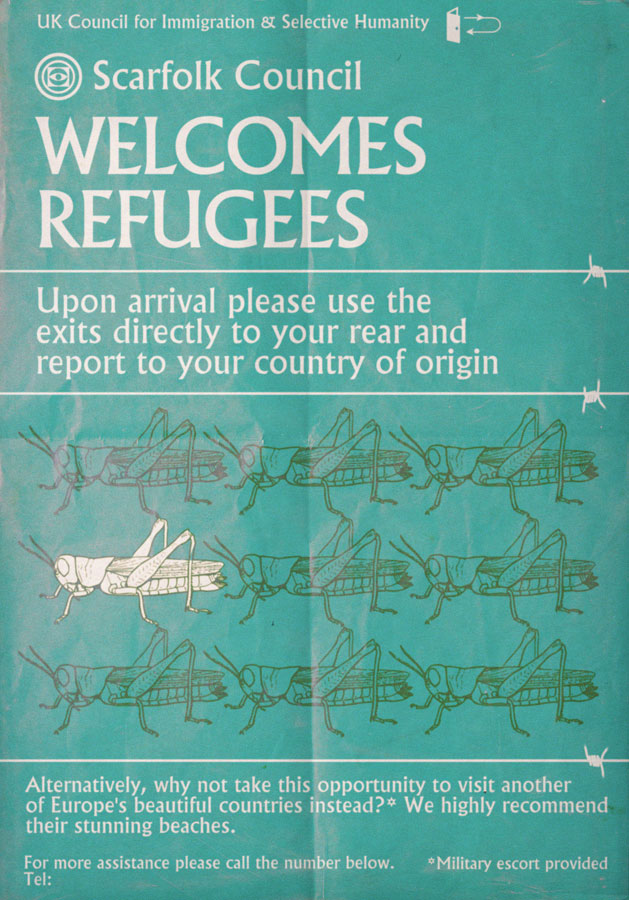
"Welcome Refugees" Poster (1970)
In 1970 Scarfolk Council faced a humanitarian crisis and was asked to take in refugees. Councillors warned that an influx of too many migrants could make Scarfolk susceptible to earthquakes, foreign food and other natural disasters, and that the town may even "become unbalanced, tip over and crash into a neighbouring town".
The mayor in particular expressed concern that a sudden population increase could affect the chances of him getting his favourite parking spot at Scarfolk Visitors' Welcome Centre and that the building of new housing to accommodate refugees may seriously impact the schedule of his builder who had already delayed the building of his kitchen extension twice that year.
Councillors also argued that Scarfolk didn't have the space for refugees and quickly redesignated vast regions of post-industrial wasteland as 'protected areas of outstanding natural beauty'. Despite this, the council was forced take in 1.3 refugees for every 20 citizens. The council promised to observe these requirements to the letter and even hired surgeons to ensure a precise quota.
When refugees finally arrived in Scarfolk, they were met by the poster above, which was clearly intended to deter them even before they passed through customs and immigration.
Thursday, 27 August 2015
"No" (1973-1975)
In 1973 Scarfolk Council released the above poster all over town. On the same day it also stopped responding to applications for welfare benefits, in fact it stopped responding to all enquiries from the public.
Those who called the council telephone number were answered by a distant, echoing voice which relentlessly repeated the word 'No'. It wasn't a recorded message and callers could sometimes hear faint whimpering in the background.
Some families received letters from the council which contained a single instance of the word, while others received multi-page letters with 'No' printed many hundreds of times. The longest 'No' letter received by a citizen contained 178,121 pages and was delivered by an articulated lorry, whose number plate also simply read 'No'.
Hoping for a 'No' answer, numerous residents tried to take advantage of the council by asking if they were required to pay their taxes or respect the law. Such people were visited by an impeccably dressed man called Mr. Custard who had rows of paper clips and occult symbols tattooed on his face. He would whisper briefly in the residents' ears before leaving. All were found dead within days of Mr Custard's visit, having slit their own wrists and daubed the word 'No' in their own blood on the walls of their homes.
In 1975 the 'No' era suddenly stopped. The council apologised and claimed that it had simply been the result of a clerical error.
For the 'Stop!' campaign see "Discovering Scarfolk" (page 154). For the 'Don't' campaign go HERE.
Labels:
1970s,
censorship,
conditioning,
conservative,
Council,
fascism,
fear,
government,
law,
NHS,
No,
PIF,
poster,
PSA,
Public Information,
public services,
punishment,
Scarfolk,
welfare,
welfare state
Thursday, 23 July 2015
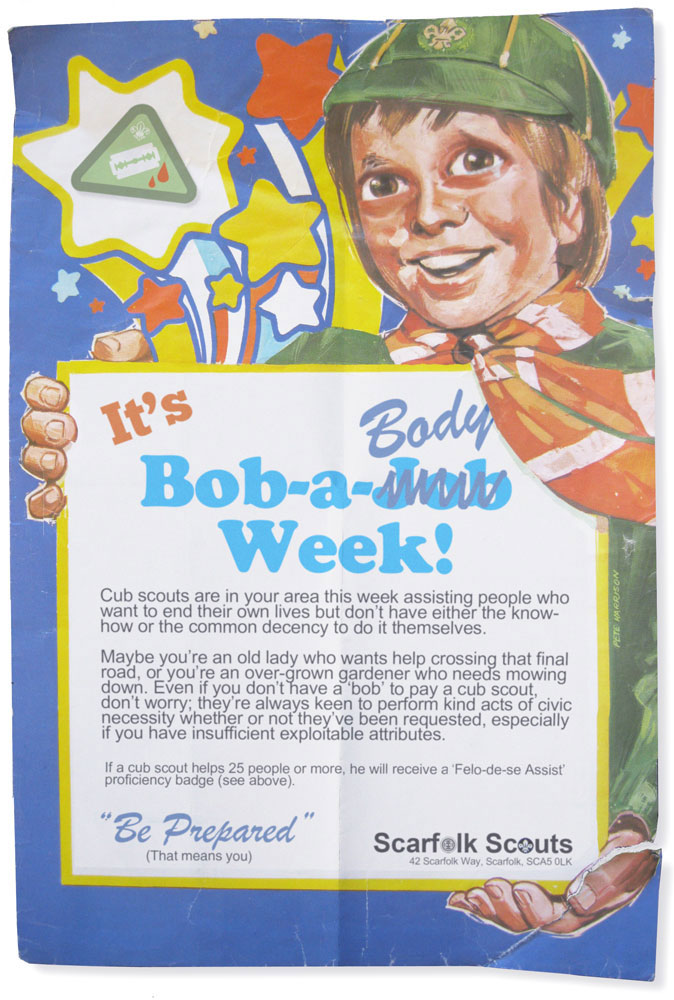
Cub Scout "Bob-a-Body" Week (1977)
The annual boy scout Bob-a-Job week was an institution. However, from 1975 the jobs that scouts were expected to undertake moved away from the mundane - the washing of cars, sweeping of leaves and mowing of lawns - and became much more demanding.
Below is a scout leaflet from 1977 which was the first year that Bob-a-Job week officially changed its name.
During Bob-a-Body week, hundreds of cub scouts roamed Scarfolk helping members of the community with their assisted suicide needs. The old, sick and formally shunned most frequently employed the services of the scouts, though the council's Oxygen Resource Board allegedly sent lists of reluctant residents to scout groups in advance, along with illicitly duplicated front door keys and gallon jars of a toxic nerve agent.
Labels:
1970s,
Council,
cubs,
euthanasia,
execution,
homicide,
immolation,
legal system,
massacre,
oap,
pensioners,
politics,
poverty,
Public Information,
public services,
scouts,
sickness,
termination,
totalitarian
Thursday, 28 May 2015
Expiration Cards (1970s)
"Have you ever worried about how and when you might pass away? With an Expiration Card you needn't worry ever again..." (From a 1971 Scarfolk information booklet).
As of 1970 all residents of Scarfolk were issued with Expiration Cards. A dedicated council department, run by someone known only as Tod XIII, calculated when each citizen was most likely to become an 'unreasonable imposition' on society, then set an official date and method of demise. Sometimes, the date was brought forward if the citizen's circumstances changed: for example, if a person had become undeservedly depressed or poorly and was unlikely to ever again be gainfully employed by any self-respecting organisation.
Each cardholder was expected to make the relevant preparations according to their allocated death event and to pay for it. Costs were taken directly out of citizens' income along with tax and costs incurred by governmental weekend breaks abroad. Unemployed cardholders had their assets and/or family members seized and auctioned off.
If a cardholder inconveniently died before their scheduled date and time, their card (and a hefty admin fee) was inherited by the next of kin who could either swap the card with their own - if the death event was preferred - or donate it to Scarfolk's Expiration Charity, which brought together poverty-stricken people to perish in the same event so that they may share costs. Charity expirations often took the form of driving a decommissioned double-decker bus off a pier into the sea while a brass band played. These expirations were televised on SBC TV's 'Beneviolence' programme, particularly if they featured once-popular celebrities who had fallen on hard times.
Note: Personalised Expiration Cards may be available for purchase in the future.
Labels:
1970s,
Council,
death,
euthanasia,
expiration,
funerals,
government,
healthcare,
holiday,
homicide,
ID card,
politics,
poverty,
public services,
sacrifice,
tax,
termination,
totalitarian,
TV
Thursday, 23 April 2015
"Don't Struggle" Campaign (1972)
In 1972 extensive government studies suggested that the people of Britain were in an odd mood. GPs were reporting higher incidences of depression, anxiety and state-sponsored disorders such as omphalophobia and scopophobia.
In an attempt to reassure the nervous nation, the government requested that each local council create its own version of the 'Keep Calm and Carry On' slogan, which had been so successful during the Second World War and the tedious stretches that followed it.
Scarfolk Council came up with the following poster campaign which depicted a kindly nurse gently helping an apprehensive, inadequate child to the 11th floor of Scarfolk's historic Pillywinks Building. No one really knew what happened in the Pillywinks Building; the only indication was a sign beside the front door which stated: 'Butchers and other educators, please use tradesman's entrance'.
The campaign also introduced its mascot, Neville Inevitable. Council workers routinely donned two-metre tall Neville costumes and turned up to sing a song to ailing and injured people just before they died. The song featured a loud countdown clock and lyrics that encouraged the dying to relinquish their grip on life as expeditiously as possible to reduce unnecessary strain on the NHS.
Thursday, 26 March 2015
"Emergency Services Telephone Number" (1977-1979)
In 1977, Scarfolk Council was disconcerted to learn that poor citizens and immigrants had figured out how to call the emergency services.
The council quickly launched a new number, which it claimed would better handle the increasing volume of emergency calls, and after three years the government proudly announced a significant decrease in emergency calls overall.
However, the telephone number (when it was finally identified) was traced to an answering machine in an industrial estate portacabin, which was completely deserted.
When questioned about the unattended service, a council spokesman stated that the intention was to "empower average and below-average people by enabling them to find their own solutions to problems which are probably the result of their own negligent actions in the first place."
Fully-working emergency services, which were of course funded by the taxpayer and the sale of undesirables to mediocre countries, were still available, but only to a select group of invited people, many of whom were banking and corporate magnates, as well as politicians, their friends, families and pets.
Emergencies most often reported included: strain brought on by stirring Martinis and not being able to reach the television from the bed to change channels. Additionally, the fire service was frequently called upon by beneficiaries to hose down citizens picketing their country estates.
Labels:
1970s,
class system,
Council,
democracy,
dystopia,
emergency,
government,
health & safety,
immigrants,
NHS,
PIF,
politics,
poster,
poverty,
PSA,
Public Information,
public services,
society,
status
Subscribe to:
Posts (Atom)