Scarfolk is a town in North West England that did not progress beyond 1979. Instead, the entire decade of the 1970s loops ad infinitum. Here in Scarfolk, pagan rituals blend seamlessly with science; hauntology is a compulsory subject at school, and everyone must be in bed by 8pm because they are perpetually running a slight fever. "Visit Scarfolk today. Our number one priority is keeping rabies at bay." For more information please reread.
Showing posts with label welfare state. Show all posts
Thursday, 8 March 2018
Opportunity Doorways For Women (1976)
The Opportunity Doorway scheme for women was launched in 1976. Here's an excerpt from the council's literature:
"Scientific studies conducted by some of the finest minds in the Gentlemen's Science Club of Great Britain clearly show it’s not your fault that you were born female.
But that doesn’t mean you are entirely blameless for your irresponsible birth. Lazing around the house all day looking after infants and cleaning your husband's home is all well and good for a few years. But what happens after that, when you have become redundant?
Enter The Opportunity Doorway scheme, which has been designed specifically for you. It won't dig into your housekeeping allowance and you won’t have to worry about reading anything complicated; however, a head for heights is recommended."
See also: International Women's Day 1970, romance novels, birth, sexual reproduction in females and Bastard Lanes for single mothers.
Wednesday, 10 May 2017
Benefits Assessment Bouncers (1972)
In 1972 the council outsourced its sick and disability benefits assessment service to a team of nightclub bouncers. The bouncers broke into the homes of claimants in the dead of night, shone lights in their faces and screamed threats at them.
Claimants who were identified as frauds were thrown down their own stairs, often repeatedly, to ensure that their physical and mental conditions matched their claims.
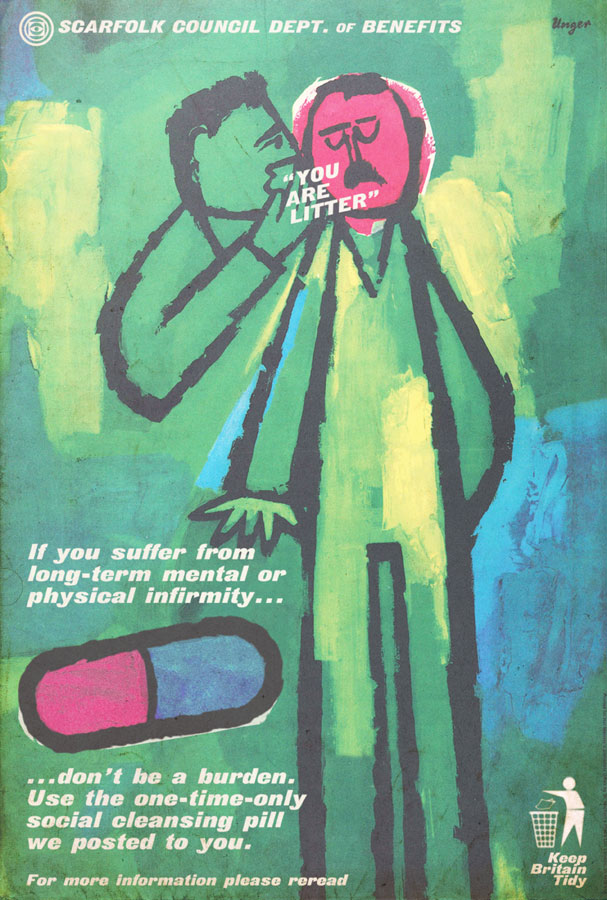
Genuine claimants were offered a menu of euthanasia options of varying price and bullied into choosing the most expensive, the so-called 'Kill Pill', which also contained a mild explosive (see poster above). However, claimants did have the choice to nominate another family member who could commit suicide in their place.
People who refused to take their own lives were officially recategorised as "potentially hazardous biological litter"; they were consequently charged with self-fly-tipping and taken away in vast fleets of skips on the first Monday of every month.
Thursday, 2 February 2017
Play & Learn Drowning Game (late 1970s)
This is part 2 of our feature on water-based toys (see last week's Action Man waterboarding accessories).
In the late 1970s, the government predicted that by the time the decade's children were grown up, suicides would be commonplace, perhaps even fashionable. This would be due to the "inevitable effects of living in a declining society in which the government has abandoned the welfare of its citizens in favour of fun hobbies it finds less boring", but mostly because "it will make suicide a compulsory part of national cutbacks".
The minister for welfare proposed that "suicide clubs" be established (they even launched a slogan: "Let's all say Felo-de-se!"), and that suicide methods be taught in schools and job centres by alternative-career advisors.
The government also funded several toy manufacturers who created products which cast suicide in a positive light. One such toy was the Play & Learn Drowning Game, which was also adapted into a console game in 1978.
In the late 1970s, the government predicted that by the time the decade's children were grown up, suicides would be commonplace, perhaps even fashionable. This would be due to the "inevitable effects of living in a declining society in which the government has abandoned the welfare of its citizens in favour of fun hobbies it finds less boring", but mostly because "it will make suicide a compulsory part of national cutbacks".
The minister for welfare proposed that "suicide clubs" be established (they even launched a slogan: "Let's all say Felo-de-se!"), and that suicide methods be taught in schools and job centres by alternative-career advisors.
The government also funded several toy manufacturers who created products which cast suicide in a positive light. One such toy was the Play & Learn Drowning Game, which was also adapted into a console game in 1978.
Thursday, 6 October 2016
Foreigner Identification Badges (1974)
From 1974, all foreigners (as well as citizens friendly to foreigners) were required by law to wear identification badges. The image above is just one page from a hefty, six volume guide distributed to local councils and border officials. The glossy guide and badges were so expensive to produce that they were manufactured abroad because the dwindling UK print industry no longer had adequate resources.
Additionally, the first print run of the guide had to be recalled after a typo was discovered: A foreign typesetter had accidently rendered every instance of the word 'British' as 'Brutish'.
Thursday, 11 August 2016
'Allclear' Open-Air Nuclear Bunkers
click to enlarge
In 1971 the government's civil defence budget was slashed. Local councils limited their building of conventional nuclear bunkers and focused instead on cheaper alternatives, for the general populace anyway.
From government public information literature:
"Though secure, Britain's existing nuclear bunkers are cramped and do not offer the comforts of home living. Built from drab, uninspiring concrete, they are brazenly unaesthetic and because they lack natural light, occupiers risk becoming fed up during their stay.
"Government officials, royals and the independently wealthy have courteously opted to endure these cheerless conditions so that you don't have to*.
"We think that you and your family deserve more agreeable accommodation when that 4-Minute Warning jingle sounds.
"Enter ALLCLEAR, the government's new post-nuclear solution for YOU. ALLCLEAR Open-Air Bunkers are easily erected in approx. 60 minutes. They are light, airy and available in a choice of fun colours: orange or yellowy-red. They even come with their own FREE power-string, velcro all-seasons flap and a multipurpose stick [...]
"*Please note that any attempt to secure a place in a traditional concrete bunker (and in doing so compromise the well-intended benevolence of the abovementioned persons) will be rejected with extreme prejudice."
Thursday, 27 August 2015
"No" (1973-1975)
In 1973 Scarfolk Council released the above poster all over town. On the same day it also stopped responding to applications for welfare benefits, in fact it stopped responding to all enquiries from the public.
Those who called the council telephone number were answered by a distant, echoing voice which relentlessly repeated the word 'No'. It wasn't a recorded message and callers could sometimes hear faint whimpering in the background.
Some families received letters from the council which contained a single instance of the word, while others received multi-page letters with 'No' printed many hundreds of times. The longest 'No' letter received by a citizen contained 178,121 pages and was delivered by an articulated lorry, whose number plate also simply read 'No'.
Hoping for a 'No' answer, numerous residents tried to take advantage of the council by asking if they were required to pay their taxes or respect the law. Such people were visited by an impeccably dressed man called Mr. Custard who had rows of paper clips and occult symbols tattooed on his face. He would whisper briefly in the residents' ears before leaving. All were found dead within days of Mr Custard's visit, having slit their own wrists and daubed the word 'No' in their own blood on the walls of their homes.
In 1975 the 'No' era suddenly stopped. The council apologised and claimed that it had simply been the result of a clerical error.
For the 'Stop!' campaign see "Discovering Scarfolk" (page 154). For the 'Don't' campaign go HERE.
Labels:
1970s,
censorship,
conditioning,
conservative,
Council,
fascism,
fear,
government,
law,
NHS,
No,
PIF,
poster,
PSA,
Public Information,
public services,
punishment,
Scarfolk,
welfare,
welfare state
Wednesday, 15 July 2015
Poverty & 1970s Pelican Books
Poor, uneducated people have always been obstinate in their selfish desire to ruin the contentment of those from more important social classes.
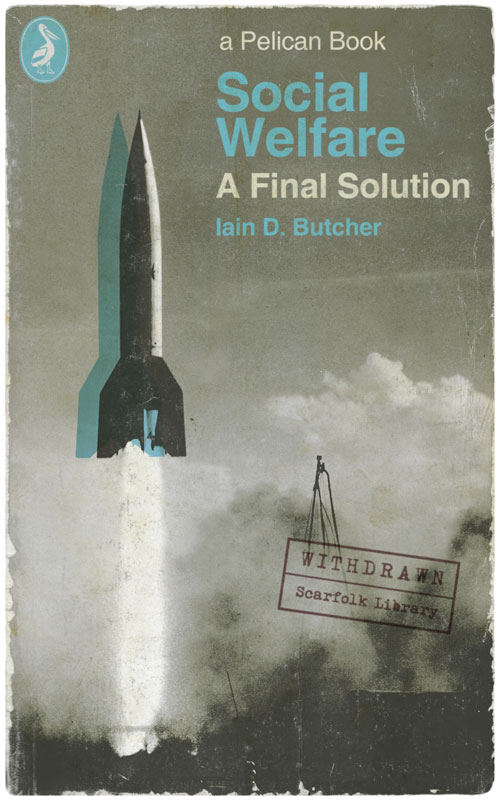
Below are several Pelican books from the 1970s which deal with the decade's poverty, austerity and the blight of these self-centered people who relish being destitute.
For example, The Poor and Other Invertebrates, published in 1974, made the following claims about the nation's impoverished:
"[They] reproduce prolifically in 3 months rather than the conventional 9 months of properly evolved humans".
"They intentionally contract diseases by manufacturing their own bacteria at home, which they smear onto their cheap linoleum floors [...] then roll around in it".
"They burgle respectable citizen's homes, then play Bingo".
In 1976, Scarfolk council dealt with the needy by taking away their autonomy and making them property of the state. Thousands of people below the breadline were requisitioned to be used as civic equipment such as street bollards and even sandbags in the case of flooding or terrorist bombings.
Below are several Pelican books from the 1970s which deal with the decade's poverty, austerity and the blight of these self-centered people who relish being destitute.
For example, The Poor and Other Invertebrates, published in 1974, made the following claims about the nation's impoverished:
"[They] reproduce prolifically in 3 months rather than the conventional 9 months of properly evolved humans".
"They intentionally contract diseases by manufacturing their own bacteria at home, which they smear onto their cheap linoleum floors [...] then roll around in it".
"They burgle respectable citizen's homes, then play Bingo".
In 1976, Scarfolk council dealt with the needy by taking away their autonomy and making them property of the state. Thousands of people below the breadline were requisitioned to be used as civic equipment such as street bollards and even sandbags in the case of flooding or terrorist bombings.
Subscribe to:
Posts (Atom)