Showing posts with label surveillance. Show all posts

Thursday, 30 January 2020

NHS Face Removals (1977- )


While some children were born without faces simply because they didn't deserve them (see the Scarfolk Annual 197X), the government became increasingly concerned about citizens who did have them. They found that people with faces are more likely to have personal desires, hopes and dreams, in short: a will and ideas of their own. 

Such idiosyncrasies were not only thought of as needlessly self-indulgent, they were also deemed inconsistent with the smooth running of a successful society. Scarfolk's was the first council benevolent enough to offer face removals on the NHS.

In 1976, the council trialled face removals on stray foreigners, prisoners, children nobody wanted, unsuspecting people who were picked up leisurely walking in a park after sundown and volunteers (see leaflet above). 

When the full scheme was rolled out in 1977, the council soon lost track of which faceless citizen was which. By 1978 a new law was passed which dictated that all faceless people were required to have a tattoo of their old face over their lost one to make identification easier.

Thursday, 29 June 2017

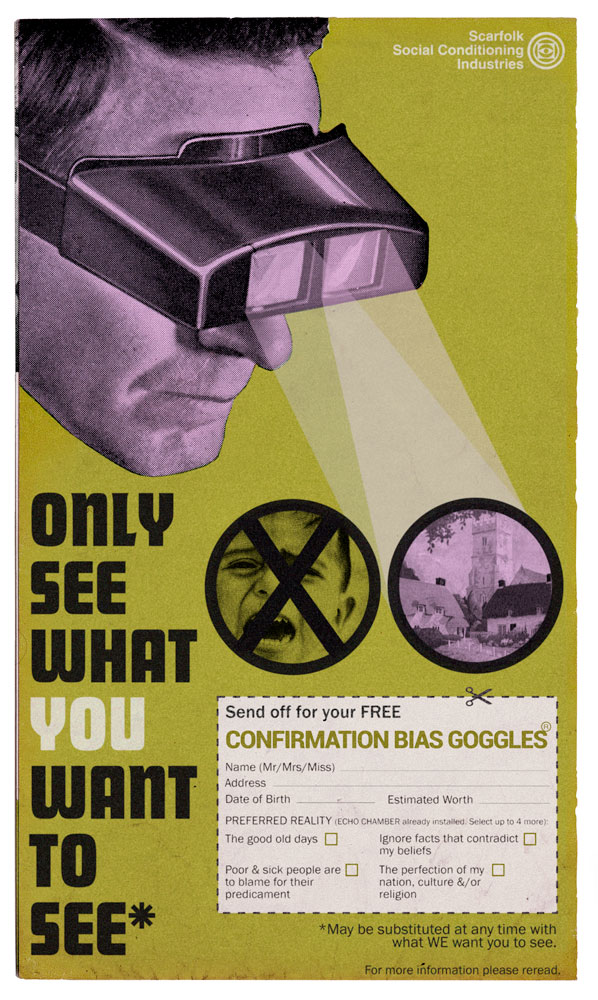
Confirmation Bias Goggles (1970)


Confirmation Bias Goggles were the first wearable technology to be wired directly into the brain. In addition to the pinhead-sized speaker which perpetually broadcast the statement 'Of course you're right!' into the auditory cortex, the goggles' sensors could also switch off those parts of the brain that deal with troublesome emotions and feelings such as empathy, decency and healthy scepticism.

By tapping into the wearer's biases, the goggles literally deleted undesirable objects from the wearer's field of vision. Sights that were too dominant to be erased completely were visually falsified to validate the wearer's preconceptions.

By 1971, the state had adapted the goggles for use in schools. Children were told precisely what to think and what their personal opinions as adults would be.  Unsurprisingly, everybody who tried the goggles, without exception, thought that they were a great idea.


See also: De-education classes, Rub-on transfer newspapers, Mindborstal drug, The Fact Ban, and Children & Hallucinogens: The Future of Discipline.

Thursday, 15 June 2017

"Wardrobe Men"


In 1973 there was an increase in complaints about odd, mumbling men appearing spontaneously in people's wardrobes. The council allocated funds to have them removed, but their efforts were in vain. No sooner had they expelled a 'wardrobe man' than another would appear in his place. Inexplicably, the men somehow found their way into residents' wardrobes regardless of how well doors and windows had been secured.

When the council realised that the wardrobe men's whispered mumbles were detailed (albeit slowed down, backward) accounts of what they saw and heard from their closeted vantage points, it quickly registered the mysterious men as state employees. Once a week, local council workers recorded the wardrobe men's accounts onto wax reels, processed the audio in vast laboratories and prosecuted residents who contravened any of the local laws, which changed almost daily.

Thursday, 6 October 2016

Foreigner Identification Badges (1974)


From 1974, all foreigners (as well as citizens friendly to foreigners) were required by law to wear identification badges. The image above is just one page from a hefty, six volume guide distributed to local councils and border officials. The glossy guide and badges were so expensive to produce that they were manufactured abroad because the dwindling UK print industry no longer had adequate resources.

Additionally, the first print run of the guide had to be recalled after a typo was discovered: A foreign typesetter had accidently rendered every instance of the word 'British' as 'Brutish'.

Wednesday, 20 April 2016

National Security Ear Grafts (1975)

Click to enlarge

When compulsory surveillance ear grafts were introduced in 1975, many Scarfolk citizens resorted to non-verbal forms of interpersonal communication to avoid the attention of government eavesdroppers. This in turn prompted a ban and users of sign language, mime artists and even fans of the party game charades suddenly found themselves on the wrong side the law. Writing was also subject to restrictions and was only permitted when verbal delivery was not possible. Incensed by the ban, a fervent group of mimes known as the MLA (Mime Liberation Army) committed several acts of silent terror and built invisible walls around government buildings preventing staff from entering.

The authorities recognised that national security ears were perhaps not as feasible as they had originally thought. Although several other surveillance schemes were launched in Scarfolk in the 1970s (see, for example, thought-detector vans, telekinetic child-owls, I-Spy books and Living-Eye surveillance computers), GCHQ realised that the most productive way to surveil a nation is for the citizens to unwittingly collate all their own personal data, verbal or otherwise, and transmit it directly to the government. In essence, citizens spying on and betraying themselves. Unfortunately, this idea would be not become workable on an industrial scale until the age of the internet.

Friday, 13 November 2015

I-Spy Surveillance Books

In the years before digital surveillance and the government's Snooper's Charter, it was much harder for the state to spy on its citizens.

Without the technology we have today, the government had to rely on manpower, specifically from society's most innocent members - minors. Children in the UK especially were much easier to manipulate and were largely oblivious to the creeping diminishment of their civil liberties.

I-Spy books were published by the state and given as gifts, as well as distributed to schools, youth clubs and infant terror organisations (see "The Infant Liberation Front"). The books transformed the tedium of surveillance into play, encouraging children to routinely observe and record the actions, speech and private correspondence of people who the government deemed to be enemies of society. These included "free-thinkers, beneficiaries of welfare and other degenerates. [...] Extremists, potential extremists, and those whose profound lack of extremist attributes is extreme in itself, are also worthy of suspicion and censure."

The completed books even prompted children to spy on themselves, which many found difficult, even with the mirrors provided.

Each completed book was sent to a local government councillor whose job it was to forward the data to the relevant renditions team, and also to decide if any compensation was due to the child; for example, if the surveillance data they had submitted led to the arrest and execution of a parent.


More about surveillance in Scarfolk here:
"Unlearn Privacy Cards"
"We Watch You While You Sleep. TV Signal Intrusion"
"Roy, The Telekinetic Child-Owl"

Saturday, 31 October 2015

"Infant Catcherbots" Public Information Poster (1975)


After last week's post about the Bladder Clown surgical toy we thought it seasonally appropriate to show you another artefact filed in our Automaclown Archive B.  

Parents in the 1970s were required to submit their children to civic trials, the details of which are not fully clear to us now. We do know, however, that the few children who survived them developed debilitating paranormal powers such as retrospective-clairvoyance - the ability to see the future of people who lived in the past.

Perhaps understandably, many children went unregistered for "The Trials" and the council was forced to track them down by ever devious means. By 1975 the council had developed Catcherbots which, in various guises, lured and apprehended unregistered children. In addition to the Clown Catcherbot (see the council's Halloween poster campaign above) there were also the Jesus, 'lovely Nana', pony-demon and Noel Edmonds Catcherbot models.

Once an offending child had been identified, Catcherbots sucked them up through their 'catcherholes'. Early quantum technology made it possible for dozens of children to be imprisoned inside the Catcherbots in a space no larger than a shoe box. At least, that was the theory: many of the children were never seen again. The same technology was later used in recycling machines that crush and process plastic bottles.

Happy Halloween/Samhain! Do you know where YOUR child is tonight?

Wednesday, 14 October 2015

Public Information Booklet: "What To Do When..." (1976)


Below is one page from "What To Do When...", published in 1976. This government booklet was sent to Scarfolk schools, youth clubs and covens and taught children aged 5-12 the survival skills they would need in the bleak near future. The council took for granted, indeed had budgeted for, a complete social breakdown by the year 1979.

In the event of such a collapse, those in power, including Scarfolk's own mayor, would be housed in secure, luxury bunkers. Despite this, they deemed it "unsportsmanlike to let unprepared citizens perish so quickly. Besides, it wouldn't be at all entertaining for us"*. This referred to the many cameras which, as early as 1974, had been placed around the town to capture the unfolding dystopian drama, not for security reasons but merely for the amusement of the surviving elite - a prescient precursor to reality TV.

Chapters included:

"What To Do When..."
...Your Personality is Erased
...The Truth Doesn't Mean Anything Any More
...A Psychic Dog is Following You
...You Realise You Have Less Trading Value Than A Good Sock


* Excerpt from an internal council memo sent by Mayor Ritter to his most senior staff and his favourite office cactus, 32nd May 1976.

The subject of missing parents is also addressed in this post: "Is your mummy who she says she is?"

Monday, 5 October 2015

Personal Space Allowance (1975)


Until 1975, the standard PSA (Personal Space Allowance) had always been fixed at a comfortable, civilised 20 inch zone around each citizen. The government suddenly amended this, however, citing terrorism and a rising population as reasons to cut personal space along with other social benefits and civil liberties.

The PSA was more than merely reduced: The new bodily zone into which representatives of the state (and even some commercial organisations) were now free to pass was amended to minus 5.2 inches. Naturally, this made human bodies 'semi-permeable', legally speaking, and for many people only the depths of their intestines remained private.

Police, security and social services enthusiastically exploited the new laws, as did the health service which randomly pilfered internal organs from unsuspecting citizens, claiming quite lawfully that they were found in 'communal public places'. The nervous public caught on and by 1977 there were self-help groups springing up all over Scarfolk which helped citizens become as obese as possible in an effort to protect their innermost parts from state interference and even commercial exploitation.

Thursday, 30 July 2015

Roy, The Telekinetic Child-Owl (1973-1979)

Scarfolk Council was no stranger to invading the privacy of ordinary families. Back in December we introduced you to the council Christmas Boy (see HERE) who strictly monitored the contentment of families during the festive season. We've since received letters asking how the council kept households in check during the rest of the year.


In 1973 the council engineered a genetically modified creature called Roy. He was the result of cross-breeding barn owls with surplus human infants raised by prying, judgemental, lower-middle-class parents. Roy was cloned and delivered to every family in Scarfolk. His job was to oversee domestic affairs, and, if any family member deviated from officially sanctioned activity, Roy was to berate them by tutting and shaking his head.

Unfortunately, there had been a clinical oversight. Volatile poltergeist DNA had accidentally contaminated Roy's genes when a careless scientist left open a lab window which looked out onto a supernatural-energy processing plant. Instead of the envisioned tutting and head-shaking, Roy flew into violent rages, triggering major telekinetic events. There were reports of Roys decimating entire families and, in one case, allegedly annihilating an entire housing estate.

The council was under pressure to recall the defective owls, but because there had been a sudden drop in the numbers of families claiming benefits, it announced instead that Roy was a resounding success and millions more of the human-owl hybrid were commissioned by the police and social services.

Thursday, 21 May 2015

"Unlearn...Privacy" Cards (1970s)


During the 1970s, the Scarfolk Education Publishing company produced packs of cards which taught children about society and its expectations. In particular, the cards focused on eradicating any false notions that children may have picked up from prohibited books, unauthorised wise people and illegal time immigrants (a flood of which materialised in 1979 to stockpile cake following a devastating pudding famine in the future).

In addition to the 1979 'Unlearn Privacy' pack, examples from which can be seen below, other series included 'Unlearn Altrusim', 'Unlearn Democracy' and 'Unlearn Contentment'.


The aforementioned time immigrants claimed that, by the year 2017, surveillance and the invasion of privacy become so ubiquitous that citizens' brains are connected to a central network. No thought, conscious or otherwise, is permitted expression unless it has been approved by a state computer programme nicknamed 'Brain O'Brien'. However, a backlog quickly accumulates, and many people go without a thought of their own for months, if not years at a time.

Fortunately, the government predicted such an emergency and prepared in advance a series of standardised thoughts, ideas and opinions which it inputs directly into citizens' minds. No doubt it is this considerate civic gesture which leads to the overwhelming majority vote for the incumbent party in many subsequent elections.


The bonus card above comes from an earlier pack, 'Unlearn Compassion', which was published in 1971.

Thursday, 14 May 2015

"Lung Puppy" Sentient Toy (1975)


This magazine scan is of an advert for 'Lung Puppy', one of the many so-called "sentient toys" on the market in the 1970s. Not only did it follow your child anywhere (as long as your child was breathing), it also contained a device in the tongue that tested the child's galvanic skin response. If it detected inappropriate sweating, it assumed guilt and administered a Taser-like shock (see also: electrified Bibles, 'Discovering Scarfolk' p.149). The toy was not recommended for asthmatics or those being regularly waterboarded.

A more sophisticated version of the Lung Puppy - the Lung Alpaca - was used by the prison service to patrol cell blocks in Scarfolk Gaol. However, Lung Alpacas were withdrawn from service when 12 prisoners harvested the Alpaca's wool, knitted tunnelling equipment and escaped. By chance the gang was recaptured when a Lung Puppy which was previously owned by one of the criminals as a child detected his owner's breathing and lead police to the hideout.

Friday, 1 May 2015

"Watch Out! There's a Politician About" Election Week Posters (1975)

The general election will soon be upon us so we thought we'd upload a new poster every day during the week's run up.

All the posters are from the 1970s 'Watch Out! There's a Politician About' campaign.

Just before the Scarfolk election of 1975 the ruling party was keen to permanently eradicate all political opposition and set out to smear what it called a 'hazardous surplus of politicians and others suffering from civic delusional disorders'. The incumbent's aim was to bring about a state of emergency that would permit a legal postponement of the election, a postponement that could, in theory, become indefinite.

The smear campaigns knew no bounds as one politician after another was exposed for corruption, sexual and moral improprieties, and poor table manners. The media was awash with reports that many election candidates were telepathically controlled by immigrants, who, it was alleged, were all born of the same non-human mother and functioned as a hive mind.

As the campaign gathered pace, there were even 'false flag' acts of terror. For example, when a bomb destroyed the headquarters of the National Health Service in May 1975, it was blamed on exploding lice carried by the children of liberal and intellectual parents, and in the same month a plot was uncovered to shackle the UK to mainland Europe with billions of tonnes of string below the waves of the English channel.

Use your vote wisely. Alternatively, vote for one of the parties currently on offer.


Wednesday, 25 February 2015

Pedestrian 'Bastard Lanes' (1970s)

'Bastard Lanes', as they came to be known, were devised for unwed mothers and their unclean offspring. The narrow pedestrian footpaths were identifiable by their double black lines and electrified fences which ran in the gutters of most town streets.

In these two posters, nearly a decade apart, we can see how social policy evolved in Scarfolk. In 1970, the local church authority proposed the lanes as part of its 'campaign for moral decency', but the council banned the campaign, claiming that the church's principles were 'in contravention not only of human rights, but also the rights of foreigners'.


However, it became apparent that the council had only condemned the church as part of a strategy to coax citizens away from traditional religion and toward the state-funded, shadowy cult of Officism (see Discovering Scarfolk).
As the later poster from 1979 shows, despite the council's declared opposition to the church's ethics, the unwed mother lanes were still very much in operation and the alleged injustices of the original religious campaign had simply been rerendered in secular terms.


By the late-1970s, 'Bastard Lanes' had become sites of intense paranormal activity. They were littered with ectoplasm and all over town malevolent pagan spirits wreaked havoc as they brazenly flouted the Green Cross Code.

Thursday, 5 February 2015

The SCS Living-Eye Surveillance Computer (mid-1970s)

Unfortunately, there's only scant reference to SCS (Scarfolk Clinical Security) in our archives. All we have is a screenshot from one of their television commercials and a page from a pamphlet given out by family doctors in the mid-1970s.


In 1973, SCS caught the government's interest when it claimed that it could combine and reduce the state's annual budgets allocated to the war on crime, censorship, organ donation and breakfast catering.

As you'll read below, the company proposed that reluctant citizens physically participate in the state surveillance process. Though the scheme was voluntary when it began, it quickly became mandatory.


Click to enlarge


However, in 1976 the scheme suddenly collapsed and SCS went into liquidation. The company had already collected the initial 17,001 eyes that were required to run its living-eye surveillance computer, when it realized that it had neglected to invent an eye-to-computer adapter cable.

The now redundant eyes were returned to their donors with a complimentary display stand (actually, an egg cup with 'thank you' painted on it) and a letter that read: "Be proud that you can look yourself in the eye in the knowledge that your eye was once the nation's eyes and ears".


Tuesday, 13 January 2015

"Freedom of Speech" Public Information (1975)


While freedom of speech should, without exception, always be upheld and fought for, it was complicated in 1970s Scarfolk.

Take, for example, the case of the multinational New State Corporation, which converted decommissioned army personnel with psychological problems into soft toys that taught feral and left-wing children about Jesus. When two employees, Ed Manning and Julien Snowden exercised their freedom of speech to expose the company's illegal use of black magick (and candy floss) in the conversion process they soon found themselves in prison awaiting trial.

The problem was that there were so many (and sometimes contradictory) exceptions to freedom of speech that it was only practically possible to exercise it if you were a) very wealthy or b) the government had a vested political interest in what you were saying and were willing to endorse you, or c) you said what you had to say, then hid where no one could find you.

In addition to the help and guidelines offered in the 1975 leaflet above, the council also strongly recommended exercising one's freedom of speech in one's own head and not saying it out loud. A council spokesman said:
 "Everyone verbally exercising their freedom of speech at the same time not only contravenes a noise pollution bylaw, but also makes it difficult for our many council stenographers who are trying to illicitly record what everyone is saying".

Wednesday, 1 October 2014

"How to Burn Books" (Pelican Books)

Scarfolk council was a staunch advocate of biblioclasm. It did not want citizens acquiring unsanctioned knowledge and expected families to regularly scour their cellars, attics and priest holes for prohibited books. Book burnings took place after Sunday Coven on every 3rd Sunday, unless it fell on a Saturday, in which case the following Sunday.

However, in the 1970s, after the inexplicable disappearance of many of Scarfolk's old age pensioners (which, incidentally, coincided with a much-needed boost to the town's flagging sausage industry), the time-honoured method of how to correctly burn a book fell out of common knowledge. No one could remember how to do it because the traditional know-how had not been passed on to them.

The council had no choice but to publish 'How to Burn Books' (1970), which furnished people with the required skills for correct book burning.

Unfortunately, the book- and education-starved populace could not read and attempted, albeit clumsily, to burn all the copies before they had looked at them properly.

Frustrated, the council had no choice but reteach people how to read, or at least well enough for them to be able to read and comprehend the 2nd edition of 'How to Burn Books' (1978). Both editions, including the rare 1st edition, can be seen below.


Wednesday, 10 September 2014

'Hand Amnesty' (1972)

You may recall that we recently touched on crime in Scarfolk. One ubiquitous problem was 'subconscious crime', which was so prevalent in the 1970s that the council was forced to take drastic measures. Although it had complete faith in the integrity and innocence of it citizens, the council did not trust their hands. What were the town's approx. 80,000 hands doing and who were they talking to? There was no way of effectively monitoring or policing the situation.

That's why in 1972 the council offered its first Hand Amnesty and announced that no legal action would be taken against citizens if they turned in their hands to the police. A week before the amnesty date, each home received through the post a parcel containing a local anaesthetic, a miniature hacksaw (or sharp spoon, for working class families) and a raspberry lolly (as an incentive to carry out the necessary procedure).

However, many citizens were confused. If their hands had committed crimes without them being aware of it, how would they know if they were guilty or not? The average person had neither the time nor the resources to systematically surveil their own hands.

Council guidelines suggested the following:

1. If you are already conscious of your subconscious crime please take advantage of the amnesty and surrender your hands to the police. 

2. If you do not recall committing a crime, it is likely that your conscious mind is suppressing the memory of committing a crime. Please take advantage of the amnesty and surrender your hands to the police.

If you fail to comply with either 1. or 2. you will be visited by council surgeons. 

They are on hand 24 hours a day to give you a hand handing in your hands.

Monday, 18 August 2014

Investigation & Prosecution Pigeons (1973-1979)


In the 1970s the government realised that more crimes were being committed than was technically possible. This was partly due to the fact that 31% of crimes were fabricated by the government to keep citizens in a constant state of anxiety. To maintain its own credibility, the government banned the use of contraceptives for 3 months per year in the hope that the population would rise and thus generate the citizens required to meet the implausible high crime figures.

The scheme backfired when the new population proved to comprise largely blameless, model citizens. However, the government was not convinced of their apparent virtue and created a special, combined investigation & prosecution squad. It invested birds, insects and other animals with the full power of a law court and trained them to spy on citizens, assuming that guilt would inevitably be detected.

In addition to pigeons (see below), there were crack teams of sparrows, cats, butterflies, stoats and tuna, but there were also 'lone wolf' operatives, the most infamous of which was a ladybird who everyone knew as Two-Spots Bailey, though his real identity remains a mystery to this day.
For more about animals being converted into surveillance devices please see the book "Discovering Scarfolk"

Wednesday, 19 February 2014

"We Watch You While You Sleep" TV signal intrusion 1975

Below is a rare video from the Scarfolk archives.

In 1975 there was a series of anonymous signal intrusions on the Scarfnada TV network. Many believed that the council itself was directly responsible for the illegal broadcasts, though this was never confirmed.

However, in 1976 a BBC TV documentary revealed that the council had surreptitiously introduced tranquillisers to the water supply and employed council mediums to sing lullabies outside the bedroom windows of suspect citizens.

Once a suspect had fallen asleep, the medium would break into their bedroom and secrete themselves in a wardrobe or beneath the bed. From these vantage points the medium could record the suspect's dreams and nocturnal mumblings into a specially designed device called a 'Night Mary', named after the woman who invented it.

The data would then be assessed by a local judge who could meter out the appropriate punishments. Many subconscious criminals were caught this way and the numbers of dream crimes plummeted. Literally overnight.

In addition to the video below, a poster, which can be viewed here, accompanied the scheme.