Showing posts with label racism. Show all posts

Saturday, 18 June 2022

Bad Kingdom (1972)

In 1972, the government drew up plans to construct a deportation facility off the coast of Ireland that could house as many as 70 million people - the entire population of the UK, if need be. The intention was to make it an exact replica of the United Kingdom and call it Bad Kingdom. Nobody, it seemed, fulfilled the increasingly stringent criteria of what it meant to be truly British. 

Experts estimated that, by 2050, the United Kingdom's only remaining residents would be members of the Cabinet, the Royal family, and bald-headed perpetually enraged men with a poor command of the English language whose idea of patriotism was to attack with deckchairs anyone who so much as spoke with a foreign accent. 

In all likelihood, without enough people to maintain a working infrastructure, these UK residents would have to sneak into Bad Kingdom in order to stock up on supplies and to have a shower, although doing so would be illegal and carry a sentence of deportation back to the United Kingdom where they risked being deported to Bad Kingdom, leaving the UK empty.

Friday, 25 August 2017

Scargos Mail-Order Catalogue (1977)

[click to enlarge]

Mail-order catalogues were very popular in the 1970s, so much so that Scarfolk Council carefully monitored them to ensure all the products promoted and maintained the state's social agendas.

Anybody who contravened the attitude regulations of the day was shipped to a makeshift island three miles off the coast and enrolled in reeducation classes that employed electrodes and toxin-dipped knitting needles as teaching aids.

Thursday, 6 July 2017

Vegetable Politicians


Many publications in the 1970s attempted to predict how we might live in the future. The above excerpt from the Children's Journal of Political Science & Catering showed that the state’s official soothsayers often came uncannily close to reality.

Scarfolk, which was among the most progressive towns in the UK, actually trialled a vegetable-based political system in the mid-1970s. Citizens could elect the vegetable that they believed would best lead the town. However, despite the wide range of vegetables and legumes available, the system was quickly reduced to a binary one when extremist pro-legume groups clashed with pro-tuber factions in political allotments and nurseries across the region.

Additionally, any vegetables considered to be of foreign origin were interned in farm camps, later to be deported.

Further reading. For information about the conversion of children into kitchen appliances, see 'Discovering Scarfolk' p. 121-123.

Thursday, 13 October 2016

Points-Based Citizenship (1972-)


While politicians debated a points-based system for immigrants in the early 1970s, Scarfolk went a step further and introduced a similar system for existing citizens.

The council didn't see why it should be burdened with unimportant, objectionable people.

Surprisingly, many citizens had never even entertained the idea that their country of birth was purely accidental and that their value to society might be lower than that of a pack of disposable nappies or a plate of tripe*, never mind better educated, more civilised foreigners.

Between 1972 and 1976 thousands of British citizens were deported to an immense raft which floated five miles off the coast of Blackpool. Realising that they were now the foreigners they had previously denigrated, the deportees hurled racist abuse at themselves and each other and frequently got into fights.

* see Citizen Values for further details.

Thursday, 6 October 2016

Foreigner Identification Badges (1974)


From 1974, all foreigners (as well as citizens friendly to foreigners) were required by law to wear identification badges. The image above is just one page from a hefty, six volume guide distributed to local councils and border officials. The glossy guide and badges were so expensive to produce that they were manufactured abroad because the dwindling UK print industry no longer had adequate resources.

Additionally, the first print run of the guide had to be recalled after a typo was discovered: A foreign typesetter had accidently rendered every instance of the word 'British' as 'Brutish'.

Friday, 15 July 2016

Xenophobic Postcards


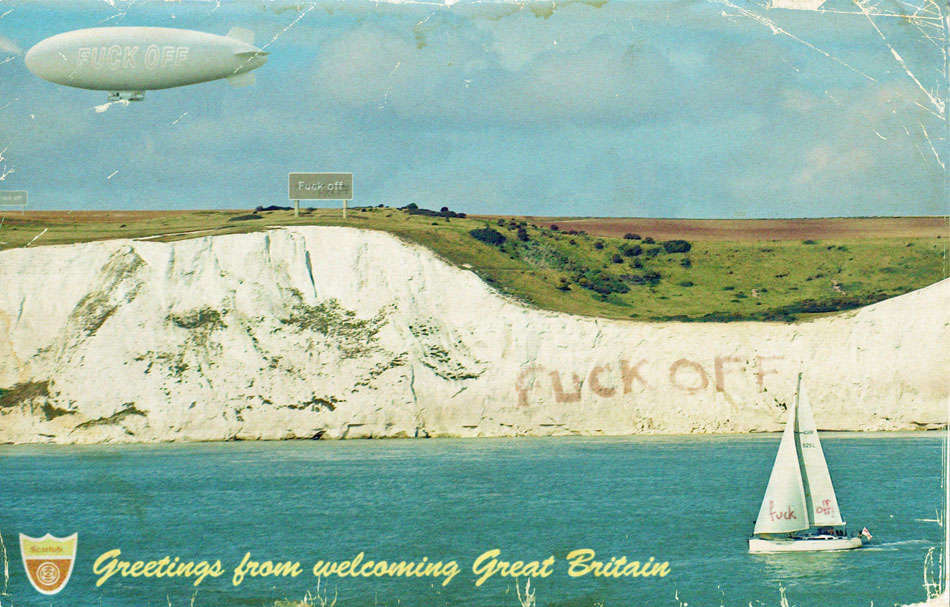
In 1972 the University of Scarfolk trialled a new drug that affects the part of the brain that produces racist attitudes.

Researchers observed that the subjects lost control of their bodily functions and had to wear clinical incontinence products. Additionally, many subjects found it difficult to form coherent thoughts, much less verbalise them, and their mental ages registered as those of infants.

The experiment was discontinued, not on ethical grounds, but because the researchers concluded that there were no discernible behavioural and psychological differences between the racists who had taken the drug, and the control group of racists that hadn't.

When the Foreign Secretary read the study's findings, he decided that xenophobia should be extolled as one of Britain's defining virtues and he immediately set out to promote this idea abroad.


Friday, 5 June 2015

"Sense a Presence?" Public Information (1970)


In 1970 a council public information campaign warned citizens that they should be afraid, though it didn't clarify exactly what it was they were supposed to be afraid of. Inevitably, this lead to widespread panic. Police, council and coven telephone helplines were inundated with calls by distressed citizens of Scarfolk who had been previously unaware of the danger they were in.

In an attempt to define what the campaign's 'presence' might refer to, the Daily Ail newspaper printed what it believed everyone should fear. What began as a ten-point list quickly grew into a publication as thick as a telephone directory and included: Foreigners; magic gypsies; diseases with a foreign origin or name, e.g, Asian Squid Flu; asylum-seeking succubi and other demons that haunt Britain without the appropriate paperwork; 'other foreigners' not included in the first mention of foreigners; and the threat of rabies from migrating continental bats which refuse to make any attempt to learn the English language.

By the mid-70s Scarfolk was in a frenzy and adults and children alike were accusing all and sundry of being invisible, malevolent presences. Eventually, to allay the fear of its citizens, the council allocated a handful of social workers to each household. Every evening, these workers (actually, mentally-ill criminals sentenced to community service) would conceal themselves beneath beds, in wardrobes, in cellars and attics to ensure that sinister entities had no place to lurk.

Sunday, 15 June 2014

"Ethnic Cleansing Playset" (Scartoys, 1972)

Scarfolk parents thought it was crucial that their children play with educational toys. This was to help familiarise youngsters with the everyday items that would be indispensable to their adult lives: Vacuum cleaners and kitchenware for girls, for example, and for boys the M1941 Johnson Light Machine Gun, or the M4 Sherman Tank with the 75mm M3/40 cannon.

Toys like the 'Ethnic Cleansing Playset' from Scartoys also taught children invaluable life-lesson skills, such as how to defend oneself against marauding foreigners whose homeland you have decimated for either selfish economic gain, or for parochial, sanctimonious, religious reasons.

Most importantly, over time, such toys inculcated in the child the belief that though the righteousness of their actions was self-evident, they needn't be mundane; they could also be fun.
Click to enlarge

Monday, 13 January 2014

"Babies Are Killers" Awareness Week (Part 1)

Today is the start of Babies Awareness Week in Scarfolk, so make sure you check back for updates. The first Babies Awareness Week took place in 1973 after health and literacy clashed with wide-reaching consequences.

Here is an excerpt from a 1974 leaflet: "While babies are stunted, mostly inefficient humans, 'Babies' is the name of a viral disease carried by unbaptised infants born out of wedlock. It is usually transmitted to other animals by a bite from an infected baby. 'Babies' travels via the nervous system through the anxious gland to the brain, which is most often stored within easy reach of the cranium. The virus is untreatable and invariably fatal within days, especially if panicking family members leave the delirious patient to stumble aimlessly along the motorway at night.

Early stage symptoms include gurgling, inability to walk or solve complex mathematical problems, an inexplicable contempt for mashed banana, and defecating without panache accompanied by a sense of unjustified triumph."

Back in the 1970s, concerned parents vaccinated their children daily and those suspected of having contracted 'Babies' were taken away by the council in large trucks then pickled, varnished and used as clothes mannequins in department stores. However, this practice was stopped when the virus spread to a range of medium-priced sweaters. It was the first time that the disease had passed from one species to another.

Here's the first of several posters designed in the 1970s to warn Scarfolk citizens of the dangers of babies with 'Babies.'

Friday, 18 October 2013

The "Little White Sam" Book Ban (1977)

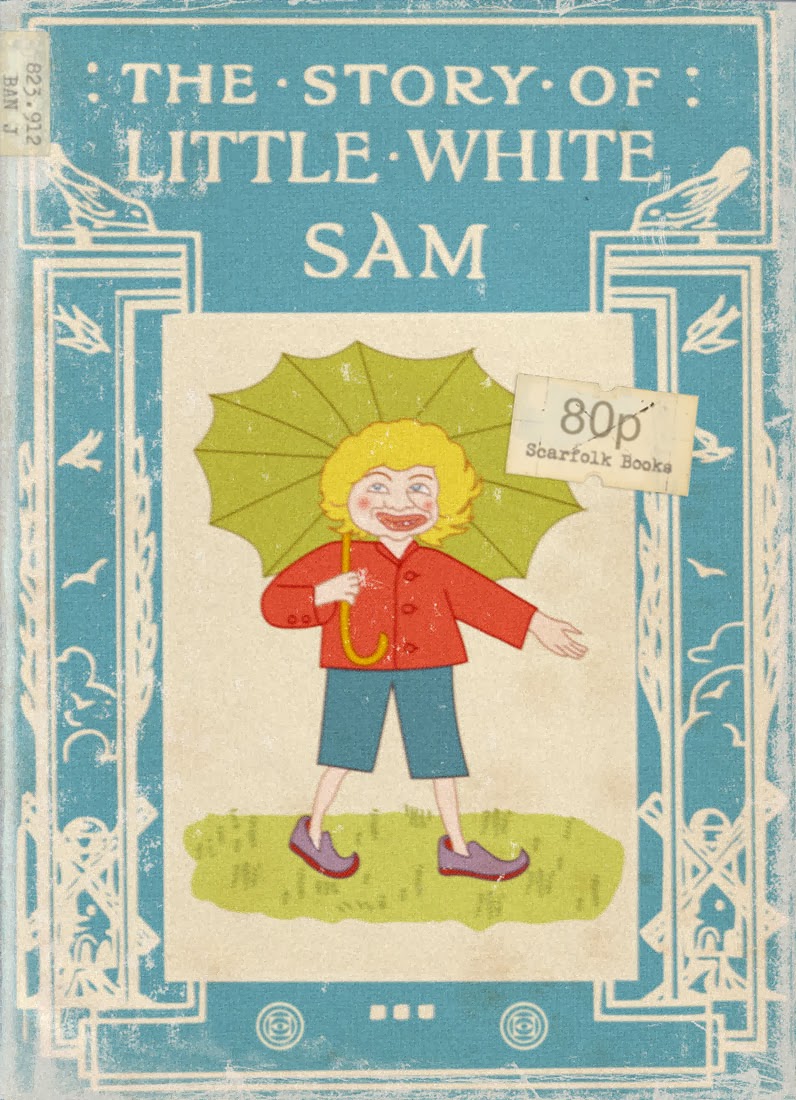
"Little White Sam" had always been a very popular book among Scarfolk children, but in 1977 the Scarfolk Association of Teachers caused controversy by withdrawing it from the school curriculum.

This had been triggered by a slew of international complaints: Children from developing countries (many of which had been liberated from themselves by the benevolent British Empire) were terrified and offended by the book's pale-skinned, blonde protagonist. He reminded them of days under British and European rule and the suffering (or 'learning' as the government preferred) that they had endured.

Historically, white people had always been unfairly picked on for trying to help the world be more like them and Jesus, so this was another major blow.

A legal battle over the book ensued, and when it was finally reprinted stringent efforts were made to completely remove any contentious material regarding race, colour and even gender. In the updated 1979 edition Sam was reimagined as a completely transparent flatworm which changed gender at will. 

However, sales plummeted and, before long, environmentalists were reporting that crimes against flatworms had risen by as much as 23%.

Monday, 5 August 2013

'Go Home' Racism & Living Toys (mid-1970s)

This allegedly innocuous British Rail poster, which could be seen all around Scarfolk in the mid-1970s, is pertinent because it touches on issues raised by the recent controversial anti-illegal immigrant campaign in the UK.

The campaign, which threatens illegal immigrants with its 'go home or face arrest' message, smacks of 1970s racist rhetoric, in fact it quotes it outright. The Home Office's claim that the campaign is not discriminatory is also reminiscent of 1970s racist attitudes which were subliminally woven into public life.

When racism was finally exposed as being detrimental to society, it was blamed on foreigners.

This post is the last in a short series which addresses dolls in society. Many Scarfolk children took part in after-school occult rituals to animate their toys but this practice was banned after schoolboy Peter Colons brought to life an immense Slinky which killed 237 people and destroyed public property.

Monday, 15 July 2013

"Twice Tasty" Secondhand food schemes (1970s)

Tolerating poor people has always been a challenge to more civilised, useful members of society.
Because of a historical legal statute the poor, unemployed and homeless were not formally recognised as homo sapiens until 1971. Before then they were officially categorised as a class of 'fruit or vegetable' below melon but slightly higher than turnip. Technically, this meant that they could be traded, thrown at petty criminals and fed to pigs, though this rarely occurred.

The government always endeavoured to strike a balance between eliminating the poor (and thus the strain on society) and needing them to fulfill menial, demeaning work:  cleaner, road sweep, theologian, etc. It was Dr. Max Gongfarmer, professor of Socially Debased Ethics, who had the idea of feeding secondhand food to the poor after reading an amateur historian's account of Marie-Antoinette's life. According to the typo-ridden book, she uttered "Let them eat cak."

Unsurprisingly, the poor, who have no sense of aesthetics or cleanliness, welcomed the idea and it thrived in 1970s Scarfolk, as can be seen from this newspaper advertisement for the COUP supermarket chain. 

Monday, 24 June 2013

"Mr. Nationalist"

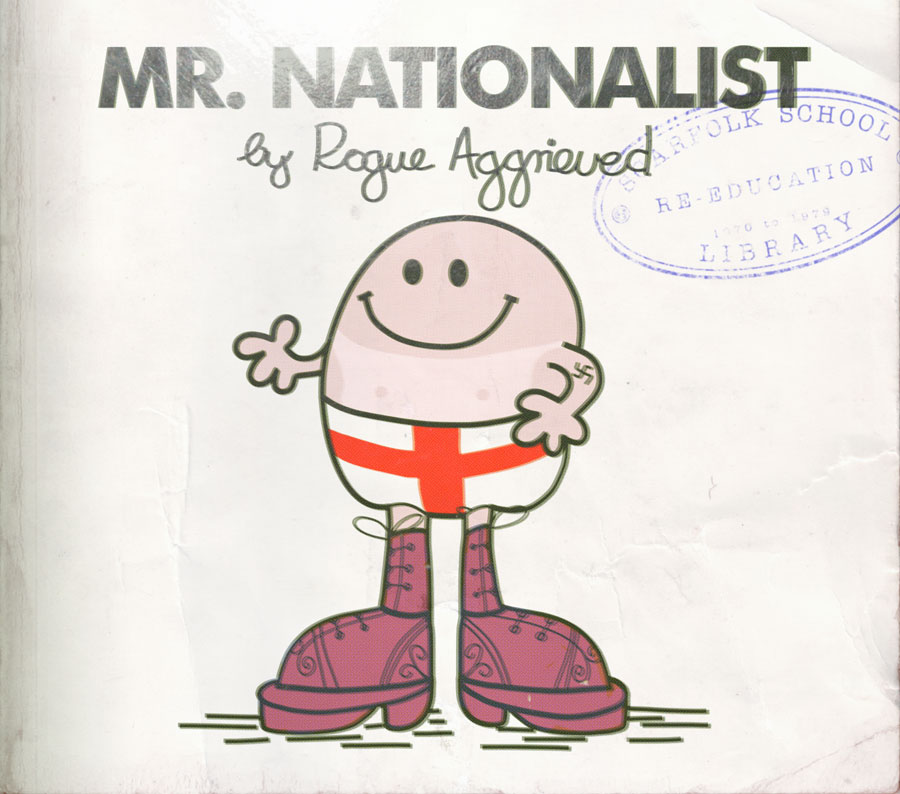
Until 1978 foreigners were officially classified by the government as livestock and were subcategorised by odour.

Defining who was and wasn't English became complicated. By the end of the decade, right-wing nationalists had drawn up a list that demanded the deportation of everyone apart from 9 people, all of who claimed to be the only true English. They even insisted on the deportation of all foreign foods (which they later amended, granting visas to pizza, kebab and curry sauce).

Their spokesperson, Colin Head, said at a 1976 rally:  

"We reject foreign influences in England. That is our weltanschauung. Multiculturalism is our bête noire and we strongly believe that English culture is destined to become kaput if the current zeitgeist continues to be de rigueur. But it doesn't have to be a fait accompli and that's why we will continue to be the enfant terrible of modern politics. It's time to act: Carpe diem!"


Friday, 31 May 2013

"Scarfolk Drop" Tourism poster. 1970

Decades before 'assisted suicide' was offered by organisations such as Switzerland's Dignitas, Scarfolk Council had its own kind of 'suicide tourism.'

The mayor and his councillors were always torn between the economic benefits of the tourist industry and not particularly liking outsiders. To balance the dichotomy, advertising man and stand-up arsonist Taylor Church suggested that the tourism board considerably exaggerate how exciting Scarfolk's tourist attractions were and then advertise them to depressives, the terminally ill, etc.

The plan was to raise the hopes of despairing tourists, so that when they arrived at an attraction it was an extreme disappointment - just the nudge they needed to 'take a plunge into the ocean'.

Cleverly, Church also recommended that tourists be guided through gift-shops before visiting the attractions, before disillusionment took too strong a hold.  

After the tourist season ended, Scarfolk children would comb the beaches for washed-up snow globes, key-rings, tea towels and other items which were then resold in the shop.


Saturday, 6 April 2013

"Black Spot" public discretion cards, 1978

Scarfolk Council had a few problems with outsiders, or "Scarfnots" as they were known, interfering in town affairs throughout the 1970s, so it developed a scheme to encourage civic discretion.

The severity of punishment for a "loose tongue" more or less guaranteed obedience, though a few Black Spot cards were issued.

For example, four year old Jeremy Chapped inadvertently discussed with his "Scarfnot" trepanning teacher the sudden, inexplicable appearances of ancient megaliths in schools and community centres, and found himself facing capital punishment.

In lieu of this penalty he pushed an unloved aunt in the path of a speeding hovercraft for which he received not only a cub scout badge, but also a £5 book token from the mayor.


Wednesday, 13 February 2013

Oh Golly...

Here's a rare "Golly" design that didn't make the cut, unfortunately. Scarfolk Board of Art & Design decided that it wasn't degrading enough, so they went with the other design.