Showing posts with label torture. Show all posts

Thursday, 11 January 2018

Real English Wine (Magazine Ad)


The government strongly promoted the ‘Buy British’ message in the 1970s. It was so keen to prove the scientific superiority of British products that large-scale experiments were commissioned.

Scarfolk University, for example, was given four million pounds to develop a computer that could record the brainwaves of hundreds of Real English Wine drinkers and then convert those brainwaves into sounds and images.

Scientists (and advertising agency executives who planned to exploit the results) predicted the result would produce “a wide variety of positive images, including majestic British landscapes accompanied by the sounds of waves and music as beautiful as anything written by maestros such Sir Edward Elgar or Cliff Richard”.

In actual fact, all the subjects’ brains produced exactly the same image: An electrified cage containing a baby monkey whose mind had been destroyed by medical experiments, systematic torture and the jarring sound of a toy mechanical bear mercilessly beating a drum 24 hours a day.

Despite this apparent setback, the Real English Wine committee ran with this image in their advertising campaigns. The wine sold well in Scarfolk, simply by virtue of being British, as did a spin-off ‘soft-toy’ monkey, which wasn’t actually a soft-toy at all, but a real dead monkey.

Thursday, 5 October 2017

Illegal Public Displays of Emotion (1970s Public Information)


In Scarfolk, public displays of emotion were governed by draconian laws. Negative or even ambiguous feelings (such as curiosity and hesitation) were deemed seditious and on-the-spot fines and punishments were often meted out by police (and by the Council Christmas Boy during the season of good will).

Distress (see poster above), a broad term which included "psychological breakdown", "suffering personal injury or attack" and "tutting in a queue at the post office", was considered to be a criticism of the state and therefore treasonous.

The only emotional expression truly free of censure was, according to government guidelines, "an abiding, unmistakable demonstration of pride in Our Joyous State (even if that demonstration requires the forfeiture of one's pride - and/or physical body - for the sake of Our Joyous State)". By 1979, feelings such as scepticism and doubt had been declared acts of terrorism.

These laws permitted police to cast a wide net in their investigations and arrests. Even if citizens did manage to pass the stringent, invasive contentment examinations they were still eligible for arrest if their pets exhibited negative emotions. Records show that many people were detained because of their sulky dogs and there was even one case of an arrest due to a livid tortoise.

See also The Anti-Weeping Campaign, which was aimed at children.

Wednesday, 31 May 2017

Police Interrogation Safewords


Almost everybody endured police interrogations at some point during the 1970s. They were so frequent that most families had a packed bag by the front door (people were expected to bring a spare change of underwear and their own first-aid supplies).

If by chance all members of a family were summoned together, they might make a day of it, have a picnic in the prison facility's Garden of Incorruptibility and watch the interrogation of their loved ones on big monitors. Laugh tracks were included to minimise distress.

While the security services were openly proud of their slogans such as "we promise to raise a glass to those who don't confess", if a detainee did suffer irreversible psychological or physical damage as a result of their interrogation, the family was awarded a £5 book token and a potted cactus as compensation.

More about Scarfolk Security Services.

Thursday, 18 May 2017

"Children: The Cause of All Crime"


In 1970 the Scarfolk Crime Commission embarked on the largest study into crime to date. After two years of intense investigation it found a startling correlation between the types of people who commit crime and their early life experiences.

The findings were unequivocal: 100% of criminals had also once been children.

The council immediately put into effect acts intended to reduce, if not entirely eradicate this insidious cause of crime. Thousands of children were rounded up in camps. Toys were burnt in massive pyres. Adults were sterilised. Anyone who had been in regular contact with children, or had ever been a child, was quarantined in vast bunkers specially built several storeys below the council building.

Though Scarfolk was reduced to a ghost town, the scheme proved a success. During the first month that these stringent measures had been implemented not one crime had been committed. Consequently, at the 1972 Conference of Sham Utopias, a local conservative MP predicted that the most successful towns, and even countries, of the future will be those that eradicate all citizens who have any connection to, or dealings with, children or the adults they grow into.

For more about bad children, see: Brood parasites, Serious Infant Dental Assault, the Never Go with Strange Children campaign and the Infant Liberation Front terror group.

Friday, 27 January 2017

Action Man Waterboarding Accessories (early 1970s)

The image below shows the instruction booklet that came with an Action Man accessory kit. Like many boys' toys, such as tractors, diggers and trains, the Action Man waterboarding kit was designed to help young boys develop a sense of what they might like to be when they grow up.

A survey conducted in 1978 found that the jobs boys most wanted when they were older included astronaut, engine driver and chief torturer for a totalitarian regime which uses its cover as a civilised democracy to commit national and international atrocities with impunity.

(click to enlarge)

Thursday, 7 January 2016

The Fact Ban (1976)


In 1975 the government discreetly tortured citizens to find out what they thought of its leadership. The results revealed that many participants thought the state "cheerfully totalitarian","despotic, but in a nice way", and "I'll say anything you want as long as you stop waterboarding me and give me back my eye."

The government sensed a need for change and announced that it would be introducing more liberal attitudes to its policies, particularly those relating to facts and information.

Facts had always been problematic for the government because of their inflexibility. Though the use of facts in state administration was strongly disparaged and had largely been expunged from political life, some civil servants stubbornly refused to yield to inexplicable reversals in party policy.

An internal council memo to employees read: "Facts do not serve the best interests of a successful government and we must not permit them to hinder our healthy economy with their tyrannical, oppressive insistence on what is and isn't true. If you must employ a truth, ensure that you are liberal with it -  untamed, unedited facts can be dangerous in the wrong hands. Ideally, you will create your own facts so that you can retain control of them."

In early 1976, as part of its Truth Reform, the government went a step further and initiated an all-out ban on unsanctioned facts, as can be seen from the above council leaflet distributed to employees. Until the end of the decade all facts were created and authorised by a new governmental department called the Fact Office or F-OFF for short.

Thursday, 2 July 2015

"Mindborstal" Psychological Detention Drug


Following the publication of Children and Hallucinogens: The Future of Discipline in 1971, several products were developed by Cavalier Pharm, Scarfolk's largest pharmaceutical company.

In addition to Panopticon, a truth serum designed for minors (see Discovering Scarfolk p.65 for further details), Cavalier Pharm also manufactured a drug called Mindborstal which, as the advertisement above indicates, induced children into a mental state that functioned as a psychological prison.

The detention hallucinations produced by the drug were so potent that they were indistinguishable from reality and children under its influence sat motionless for days and even weeks, locked in delirious trances. They were convinced that they were incarcerated within physical spaces policed by intimidating entities tailored to their own personal fears.

Yet for all of the drug's obvious benefits, it was ultimately recalled when several children were reported to have escaped on imagined giraffes, which their subconscious psyches had somehow conjured into existence. At least, that was the official explanation. Sceptics weren't convinced, even when hundreds of dead giraffes conveniently washed up on Scarfolk beach. Recently leaked documents suggest that the real reason for the recall was a desperate attempt by the council to cover up its covert plan to have the drug renamed and introduced to the town's water supply.

Thursday, 19 February 2015

"Management Psychology" (Klofracs Books, 1972)


In the 1970s, big business concerned itself exclusively with getting results, irrespective of negative effects on employees. Some Scarfolk companies were so successful that the state's secret service turned to them for advice on how to get more productive results when interrogating dangerous terrorists.

In 1972, under the guidance of management staff from a Scarfolk pickle factory, imprisoned terrorists saw their holidays reduced to 25 days per annum, lunch breaks reduced to 30 minutes, and per diem expenses decreased from 5 pounds to 3 pounds. They had to participate in regular trust and team-building exercises, such as group games, sing-a-longs, waterboarding, sensory deprivation and, as the book indicates, mock execution - all the techniques that had made British business profitable, at home and abroad.

But when interrogations were further reduced to 3 days per week and some detainees were even made redundant, many terrorists said enough was enough and went out on strike. They refused to engage in any interrogations until a full 5-day week, as well as tea breaks and afternoon naps were reinstated.

Thursday, 22 January 2015

"Fraction Action" Charity Newspaper Ad (1972)


Many charities in 1970s Scarfolk were actually illegal fronts for corporate and political organisations.

Rising costs meant that even the once reliable trading of unsatisfactory citizens was not enough to feed expanding budgets. Additional revenue sources had to be found.

The charity 'Fraction Action' (see newspaper ad above) was the brainchild of Sir John Elegy who was not only a member of Scarfolk council but also had shares in Scarfolk Laboratories, a company owned by the Cavalier Pharmaceutical company (see 'Discovering Scarfolk' for more details).

To be fair, 'Fraction Action' did redirect some of the donations it received: 1.2p out of every £100,000 was put in a jar in the Scarfolk Labs canteen as a contribution to the dinner ladies' Christmas lunch. The remainder of the donations was consumed by 'administration' (i.e., administering recreational medication), 'running costs' (i.e., running to ground people who had been farm-bred specifically for hunting) and 'over heads' (i.e., literally expensive flights abroad).

The 'Fraction Action' campaign ads also efficiently foreshadowed and justified the council's later random purging of citizens, which was necessary if Scarfolk Labs was to continue its crucial genetic experiments into human/furniture hybridisation, a noted example of which was the Hair Chair.

Monday, 22 December 2014

Council Christmas Boy

Over the Christmas period, families in 1970s Scarfolk were plunged into a state of fear. They desperately tried to appear happy - or at least meet the minimum contentment levels - in case a council Christmas Boy turned up at their door to inspect them. Though many families were visited, seemingly concurrently, the council claimed there was ever only one boy. Nobody knew his real name.

Family members would often take turns standing in the front windows of their homes where they mimed laughter in the desperate hope that the Christmas Boy would pass them by. He rarely did. Once inside a home, he would sniff or lick the occupants for signs of stress or unhappiness.The Christmas Boy rarely found what he would deem a legally cheerful family and harsh punishments, which varied, were often meted out on the spot.

Families did not usually realise that they had been visited by the Christmas Boy until an hour or two after he had left because his flute was designed to have soporific effects. When these effects wore off, families might find that one or more members had been removed or that broad grins had been fixed on their faces following minor surgery.


A lawfully merry Christmas from Scarfolk Council. Be content...

Thursday, 23 October 2014

"Ritual & Invasive Mind Control" (Mayflower Books, 1978)

From children to teachers to pensioners; from secretaries to factory workers to black propaganda operatives secretly working for the government disguised as school dinner ladies, mind control was all the rage in 1970s Scarfolk.

Everyone was at it. Dozens of 'DIY' books flooded the market and there was a schism over which was the better method: occult ritual magick, the use of precision medical implements such as straightened wire coat hangers, or television advertising.

Because the government had already employed potent thought-control techniques to cap the cognitive abilities of citizens, most people didn't master much more than the basics, such as the Disco Leech Maneouver (see the book cover below), which reduced the mental age of a subject by up to 4 hours.

An except from chapter one:

"...Carefully insert a finger or medical (non-musical) instrument into the nasal cavity. The opening is quite narrow but about 2 metres in it opens out into a larger chamber. Here you will encounter a marsupial called Zimbardo, who guards the entrance to the brain. You will not be able to pass him unless you agree to a wrestling match (Blavatsky rules). Let him win. Once you have access to the brain you will see that its interior resembles bubble wrap. Use your finger/instrument to pop as many of these 'think pockets' as you feel is appropriate. If the subject begins to gurgle or talk backwards, immediately exit the brain via the nostril, ensuring that you take any litter with you..."


Thursday, 29 May 2014

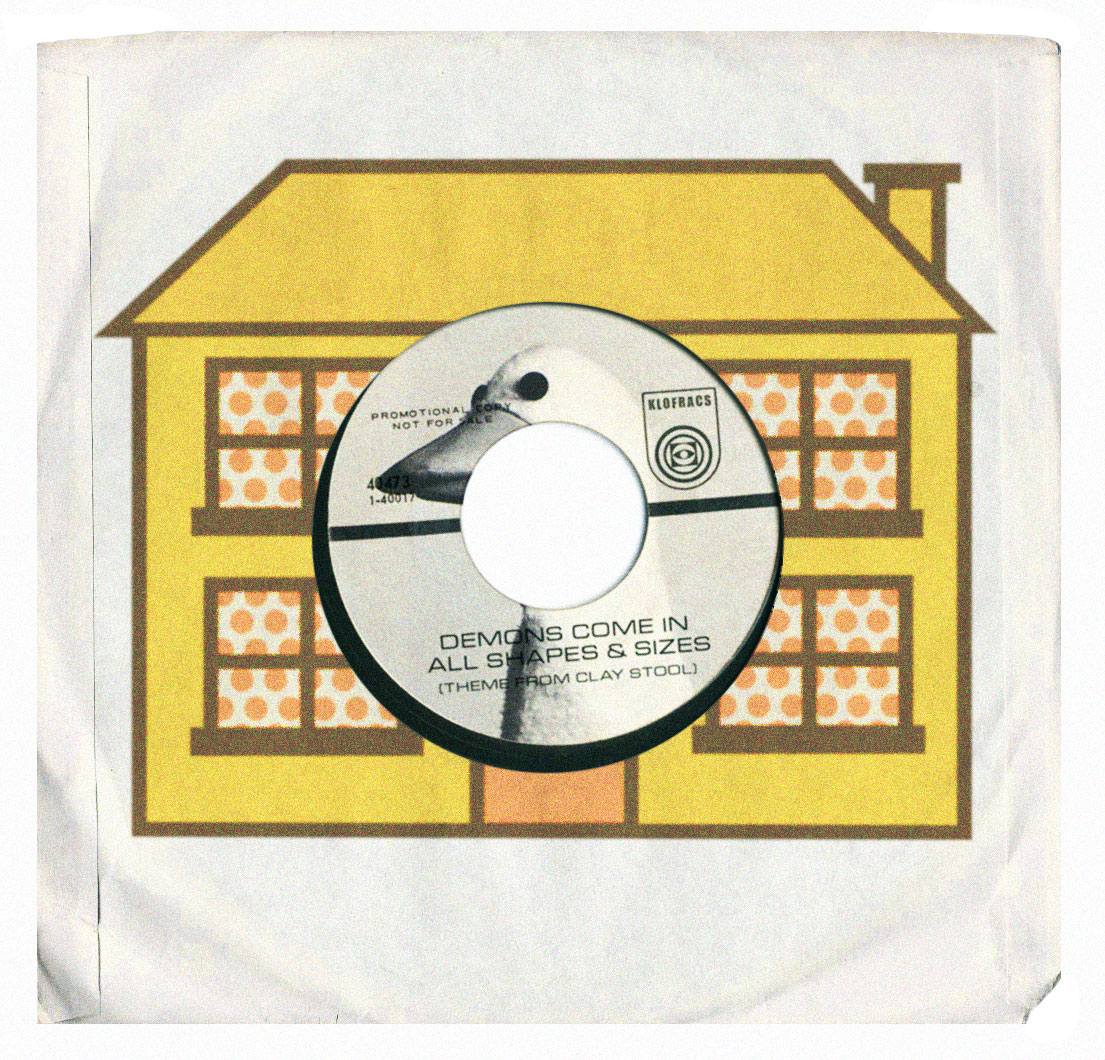
"Clay Stool" TV theme tune (Klofracs Records, 1973)

The theme tune from "Clay Stool," a popular 1970s children's daytime TV programme for 4 to 7 year olds, was released as a single in 1973 under the title "Demons Come In All Shapes & Sizes."


"Clay Stool" acquired its name from a form of medieval punishment for witchcraft. Originally, alleged witches were strapped to a wooden chair - a ducking stool - then plunged into a river. If they sank they were innocent, if they floated they were in league with the devil and summarily executed.

Samuel Revile, a local priest and freelance misogynist, wondered if ducking stools, which were traditionally festooned with dozens of inflated pigs' bladders, colourful helium balloons, and tethered albatrosses had something to do with the high numbers of people being found guilty.

Revile set about inventing the heavier "clay stool." A year after its introduction 100% of accused witches, mostly women, had plummeted to the riverbed where they drowned, proving their innocence.

Revile's work also alerted communities to the dangers of balloons. It was they, he maintained, not the women, that floated and were therefore in league with Satan. To this day, people who make balloon animals are considered unholy and are barred from church jumble sales.

Though Revile revolutionalised the justice system by inventing compassionate torture, he inadvertently caused widespread redundancies in the execution sector.


Listen to the single here:


Or watch the video here:

Saturday, 6 July 2013

"Son Oil" Baby Marinade (1979)

It has been some time since the mayor permitted us access to his collection of 1970s pharmaceutical postcards. Here's one for the summer:


The text on the reverse of the postcard:

"A child's skin is vulnerable and can easily burn, which could impair the flavour. To avoid damaging the skin first blanch the child for fives minutes then generously apply Son Oil. Add salt, pepper and newts to taste, then leave the child in the garden during the hottest part of the day. Whimpering usually means that the child is ready to be transferred to the grill or oven. Warning: Illegitimate or unbaptized children burn more quickly."

Friday, 28 June 2013

"We Won't Forget. So You Can't" (1973)

Illicitly and unconstitutionally spying on a whole nation requires an enormous amount of taxpayers' money. That is why, in 1973, Scarfolk started a scheme to sell surveillance data to the public, the actual object of the aforementioned spying.


By 1970, Scarfolk Council had bugged every room, every street, every public and private space. Even forests, beaches and bouncy castles were wiretapped. Every moment of every resident's life was recorded and archived in vast bunkers in the mountains of Snowdonia and abroad.


All this information was subcontracted to a consortium of corporations called RIMPS that used the data to exploit citizens' psychological weaknesses and/or blackmail them into acts of personal depravity for entertainment. These acts were televised and had viewing figures of millions per broadcast. Many people became household names as shame and celebrity became synonymous.

Sunday, 16 June 2013

Primary school tapeworm experiments (1970s)

Back in the 1970s there was no way of ascertaining how some medical products might affect humans.

Rabbits, chimps and other animals were needed for dark ritualistic purposes and human volunteers were not forthcoming, especially after several high-profile medical scandals.

The Cavalier Pharmaceutical Company hit on the brilliant idea of publishing a series of primary school science and maths books. They donated them along with a generous endowment to Scarfolk Education Board which had no choice but to introduce the books to the curriculum.

The textbooks invited young children to conduct experiments on themselves and record the data, which contributed to higher end-of-year grades. The best scoring pupils from each school were awarded the chance to try out the medicine to which their schoolwork had contributed. They also won free cigarettes, as well as courses of either anti-seizure or anti-psychotic medication.

There's another page from the Scarfolk maths and science book here.
 
(click image to enlarge)

Friday, 31 May 2013

"Scarfolk Drop" Tourism poster. 1970

Decades before 'assisted suicide' was offered by organisations such as Switzerland's Dignitas, Scarfolk Council had its own kind of 'suicide tourism.'

The mayor and his councillors were always torn between the economic benefits of the tourist industry and not particularly liking outsiders. To balance the dichotomy, advertising man and stand-up arsonist Taylor Church suggested that the tourism board considerably exaggerate how exciting Scarfolk's tourist attractions were and then advertise them to depressives, the terminally ill, etc.

The plan was to raise the hopes of despairing tourists, so that when they arrived at an attraction it was an extreme disappointment - just the nudge they needed to 'take a plunge into the ocean'.

Cleverly, Church also recommended that tourists be guided through gift-shops before visiting the attractions, before disillusionment took too strong a hold.  

After the tourist season ended, Scarfolk children would comb the beaches for washed-up snow globes, key-rings, tea towels and other items which were then resold in the shop.


Wednesday, 1 May 2013

1970s greetings cards

On the subject on stationers (see previous post), here's a greetings card sold during the mid-70s. This one was recently found behind a radiator in the Scarfolk police department of homicide and light entertainment.

Back in 1976 James Sprout was found dead in a Scarfolk canal. He was in a sack weighed down by his favourite toys (Action Man 'plague doctor', Fisher-Price 'death row' and concrete Play-doh)

A murder investigation was soon underway but the police ultimately found no evidence of foul play. They concluded that James had somehow inflicted upon himself a severe head injury from behind then, delirious, climbed into the sack. A forensics expert postulated that while James snoozed, the sack was then dragged four miles by either a vast litter of feral kittens, or the ghosts of unvaccinated foreigners, to the canal bridge where James fell to his watery grave.

When James' grief-stricken parents learned of their son's tragic fate they entered a lengthy period of mourning, consoling themselves by opening a beach-front bar in Barbados where they moved the day after James' funeral.


Wednesday, 17 April 2013

"Put Down Old People At Birth" Conservative Party campaign leaflet, 1979

With the funeral of ex-prime minister and hobby taxidermist Margaret Thatcher underway, it is perhaps appropriate that this item from the archive is posted today.

This leaflet was distributed throughout Scarfolk during the 1979 Conservative Party campaign. With such clear policies and faultless logic, it's little wonder that the Tories won the election. The Labour Party had pushed Britain into a deep recession following numerous strikes by miners, postal workers and the royal family who, throughout 1976, refused to politely wave on Tuesdays, weekends and bank holidays.

However, under the Tory government, Scarfolk lost several of its community covens, and the council's plans to convert Scarfolk Towers, the site of a series of occult killings, into a children's nighttime playground were thwarted. Additionally, Scarfolk residents were vexed that mystical phenomena became taxable, which led to an increase in back-street astral projections.

Friday, 12 April 2013

"Let's Learn About...Torture" 1976

This textbook was taught in Scarfolk schools in 1976. Here's an excerpt from the introduction:

"Experts agree that information and its communication will be very important in the late 20th and early 21st centuries. Information will become a commodity, sold only to the highest bidders, so it is crucial that students learn how to acquire information as quickly as possible if they want to survive.

Some information can be found in library books, but oftentimes, the most valuable information is buried inside another person's mind. It is up to pupils to mine that information, much like a prospector searches for coal. Sometimes he will use dynamite, other times a powerful drill is more appropriate. There are many ways that a person's mind may be mined.


Here are just a few techniques that you can try on your classmates:

--Scream at them in a high-pitched, helium-inhaled voice without pause for 47 hours.


--Beat the soles of their feet with an effigy of Jesus made out of frozen, compacted ladybirds.


--Pass a pair of stockings dipped in marmalade through their entire body from anus to mouth and then refuse to let them win a game of Monopoly.


--Bake them at gas mark 4 (350 degrees F) for 45 minutes or until the top becomes a rich, golden brown.


--Staple or glue them to a panicking, claustrophobic ostrich..."