Showing posts with label disease. Show all posts

Saturday, 11 December 2021

"Plan C" (1979)

This internal council document was only recently unearthed in our archives. It refers to a secret governmental emergency plan to "purify" the town following some kind of "infestation or plague," the details of which have now been lost. 
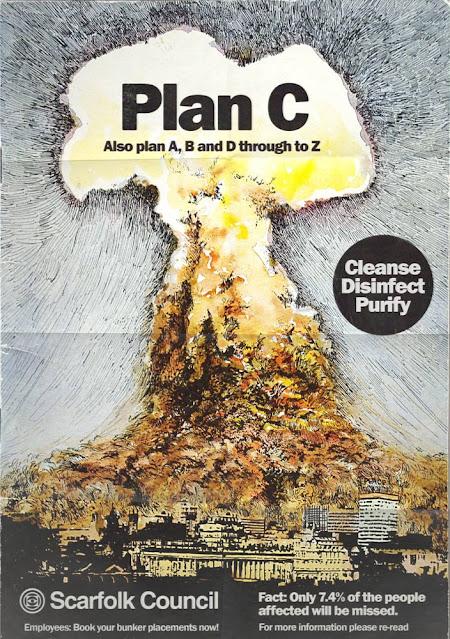
Although we can now no longer be entirely sure what Plan C consisted of, the image of a nuclear mushroom cloud offers us a clear indication of the council's intention. Our archivists have postulated that the council might have thought it simpler and more cost effective to remove all living things than to target specific vermin and/or undesirable microscopic pathogens. 

What also seems clear is that an unidentified but enthusiastic council employee took it upon themselves to extend Plan C to almost every eventuality, in effect making the nuclear Plan C simply the only plan.

The notion that the council planned to employ a nuclear option is further supported by a minor story in a local newspaper from the time. In October 1979, seven-year-old schoolboy Nigel Johnson, mixed up his family's contribution to his school's annual harvest festival. Instead of the intended box containing four cans of oxtail soup and spaghetti hoops in tomato sauce, he took a quarter tonne of enriched uranium and other weapons-grade nuclear materials.

The boy's father, a local councillor, when questioned how his son could have found such materials at home, claimed ignorance. "Boys are always picking up things like this in the playground," he said and added "it's the fault of liberal teachers and communist dinner ladies and I firmly believe they should be among the first to be cleansed."

Sunday, 28 June 2020

Beer Mats of the 1970s


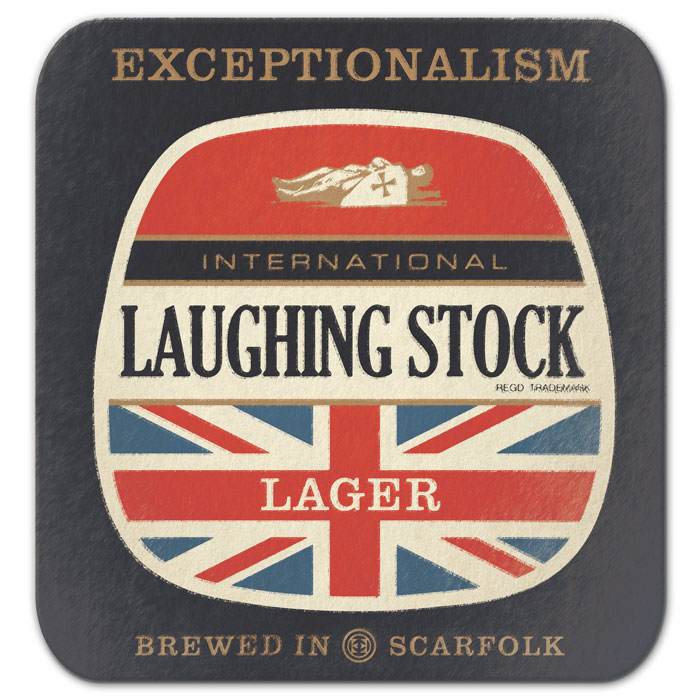
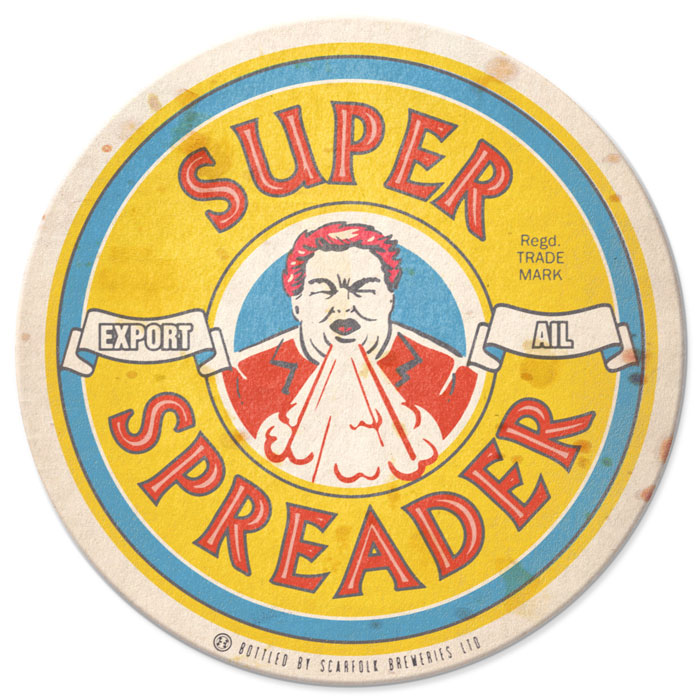
The pubs have reopened. Here is a selection of 1970s beer mats from the Scarfolk council archives. Collect them all!


NOW AVAILABLE to buy from Saatchi Gallery!

Includes:
8 x Different beer mats
1 x printed insert
1 x presentation box


Friday, 8 September 2017

Laissez–faire Childcare (1978)


In 1978, Scarfolk Health Council launched a campaign which exploited people's fear of children (especially those with uncontrolled supernatural powers), to normalise the idea of letting kids do whatever they want without censure.

It was no accident that the infants in the campaign's various posters were depicted smoking, drinking and licking chocolate-covered asbestos.

A 1979 magazine interview revealed that the campaign had been privately funded by Mrs Bottomlip, a pensioner who worked in the local cancer charity shop on Scarfolk High Street. Her reasons were largely personal. Apart from the fact that she enjoyed her part-time job and "wouldn't ever want it to end because one meets such lovely people and it gets me out of the house", her son worked for a cancer research institute. Mrs Bottomlip was concerned that he, along with a whole generation of scientists and support staff, could find themselves out of work unless the number of people developing cancer was maintained, or preferably raised.

For her support of cancer research, the institute presented her with an award, which, unbeknownst to science at the time, was made from highly carcinogenic materials. 

Thursday, 6 April 2017

"Diseases are cool!"


In the 1970s, the Notional Health Service envied those public sectors that received more funding from the government. The NHS was particularly resentful of the Department of Education & Indoctrination and in 1977 it set out to entice children away from schools and state-run brainwashing covens into hospitals so that it could justify larger budget requests.

The NHS initially launched a major campaign aimed at children and teens, which promoted the health benefits of serious medical diseases and conditions, especially those which required substantial financial resources. In addition to adverts in magazines such as Look-In (see above), it also produced collectable bubble-gum cards (see below), badges, T-shirts and cuddly toys that resembled bacterial cells and viruses.

While the idea of being dangerously sick did become very popular among the nation's school children (indeed, the Staphylococcus aureus flesh-eating disease playset was the biggest seller of Christmas 1978), it still wasn't enough to attract the desired funding to the health sector and in 1978 the NHS took the inevitable step of directly infecting its merchandise with actual diseases to ensure success.


Saturday, 24 September 2016

"Positive Outlook? Look Out!" (1976)


In the hot summer of 1976, people were enjoying the rare sunshine and the opportunity to socialise, sometimes even with foreigners. Scarfolk Council became concerned that its citizens were developing something akin to happiness, which it considered a destabilising threat to its authority.

Government operatives illicitly carried out false-flag acts of terror in an attempt to discourage positivity and regain control, but Scarfolk citizens were undeterred.

Fearing that this pandemic of cheerfulness was a prelude to social breakdown, perhaps even leading to revolution, the government quickly passed a health bill to formally recategorise "psychological states such as contentment, gratification and satisfaction" as mental illnesses "as dangerous in their effects as diseases such as rabies".

The above poster, which played on deep-seated personal doubts, appeared on the walls of cafes and restaurants, leisure centres and in other locations where people might be at risk of enjoying themselves or becoming contaminated by peace-of-mind

Friday, 6 May 2016

DIY Childcare Books


DIY was all the rage in the 1970s, but in Scarfolk it wasn't just limited to household repairs and interior decoration. Childless, sterilised adults, many of whom had been specially bred for civic or sacrificial service, decided that unauthorised parenting might prove to be a nice hobby or weekend pastime.

When children began mysteriously disappearing in their dozens, police detective Evan Brown of Scarfolk constabulary dedicated himself to rigorously investigating the cases. He swiftly came to the conclusion that there was a gap in the market for self-help and DIY parenting books for child abductors. Brown quit his job and penned several books on the subject (see above and below). He was also responsible for a change in law that required abductors to compensate parents for the loss of their children with hampers containing fruit, chutneys and a selection regional cheeses.

click to enlarge


Thursday, 9 April 2015

Confectionery-Branded Cigarettes (1970s)

As part of its decade-long Cigaretiquette campaign (see here), Scarfolk council wanted children to start smoking cigarettes, cigars and pipes as young as possible.

The council's first attempt to sell candy cigarette sticks (sometimes in faux tobacco-branded packaging) hadn't appealed to Scarfolk children and the council was forced to revise its approach.

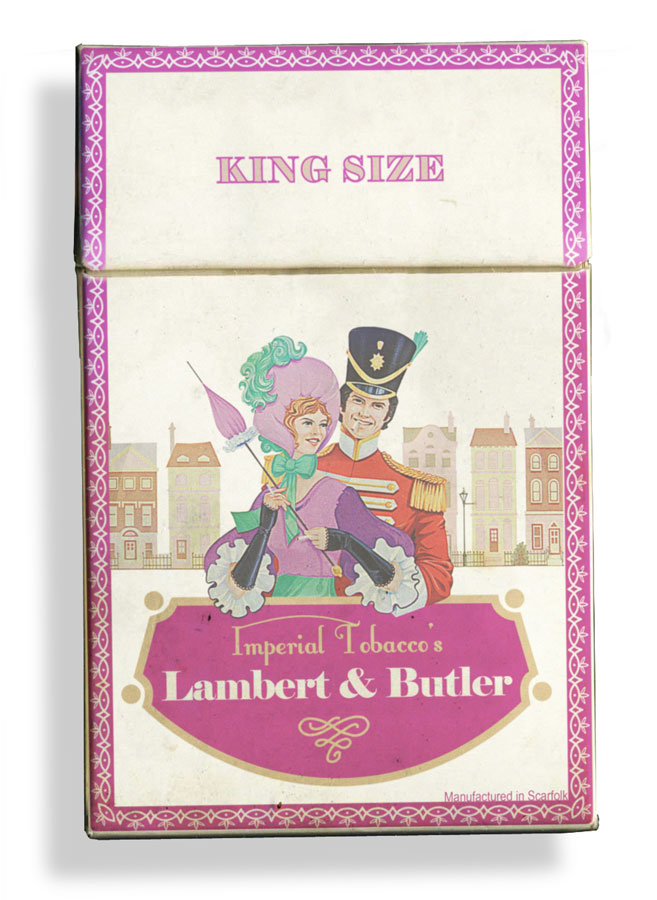
It did so by simply reversing the concept: Real cigarettes were now packaged as familiar, desirable confectionery (see right & below) and then mixed in among genuine chocolates, sweets and other products containing experimental, addictive, psychotropic temperament modifiers.

Additionally, the council funded a 1979 big-budget remake of 'Charlie and the Chocolate Factory', renamed 'Toby and the Tobacco Factory'. As in the original, the hero, Toby Bucketkicker, eventually becomes the owner of the tobacco factory, though in the update only after the factory's owner dies of a respiratory illness. In the musical sequel, Toby also goes on to intimidate governments and falsify medical research to feed his own rapacity.


Confectionery companies didn't like children cutting down on chocolate. They strongly opposed the substitutions, particularly because, as was later revealed, they had invested heavily in the Cavalier Pharmaceutical Company, which had been stockpiling insulin for several years to raise its value.

By the end of the decade, the council's scheme paid off and juvenile smoking was up 68%, generating a huge tax revenue.


Saturday, 14 February 2015

"Romantic Bile Awareness" (1979)


The romantic bile awareness campaign was launched on Valentine's Day, 1979. It came about following medical research into "that pernicious malady: love", which scientists believed was responsible for the secretion of a mysterious black bile produced in the hearts of the afflicted.

The bile perplexed experts, some of who claimed it to be sentient, though all agreed that it caused irreparable damage to internal organs including the lungs, kidneys and luncheon balls. But it was the brain that was the most susceptible to the bile which could trick the sufferer into demeaning acts such as befriending foreigners and other undesirables.

While the state did turn a blind eye to restrained fondness between its citizens, it could not permit love, requited or otherwise, to go unchecked. As the poster states, all relationships required authorisation from local councils and sexual proficiency was evaluated by a social worker.

In addition to relationship management, Scarfolk council also drew up a definitive list of human traits that it deemed attractive, thus potentially dangerous. Anyone who fulfilled more than three attributes was forced to attend a plastic surgery course during which they were taught self-surgery techniques and given a sterilised Swiss army penknife to ensure compliance with the government's guidelines on physical attraction.

Happy Valentine's Day from everyone at Scarfolk Council

Friday, 10 October 2014

"Inhale for Britain" (1974)

In the 1970s a government think-tank headed by Scarfolk councillor E. Bernays predicted that 21st century Britain might see a much-increased elderly population. Already faced with a recession, the government decided on a two-pronged solution that would not only reduce the numbers of future senior citizens but also boost the economy.

It strongly encouraged people, especially children, to smoke and then, once addiction had become more widespread, the tax on cigarettes was raised. The short-term plan was to bolster the economy with the tobacco levy and, in the long term, drastically reduce the number of people reaching pensionable age by ensuring they develop fatal, smoking-related illnesses.

To further secure economic stability the government also began slowly dismantling the NHS (Notional Health Service) so that it could not be made financially accountable for any pensioners who accidentally slipped through the net and stubbornly endured.

The poster below from 1974, which was aimed at impoverished children, took advantage of the national pride and sense of 'Britishness' which had been fabricated by an earlier government propaganda campaign intended to control the uneducated.


Find out how this campaign developed with confectionery branded cigarettes.

Tuesday, 15 April 2014

"An End to Starvation?" (Pelican Books, 1973)

Before the 1970s, the idea of reprocessing human body parts had only been officially proposed once. In 1790, Arnold Bumb, an alchemist, necromancer and avid shopper, suggested that amputated human limbs be surgically spliced onto livestock to make them more efficient. His pamphlet "The Duck With My Wife's Foot" was very popular among agriculturists (and fetishists) of the time.

But it wasn't until the 1970s, when poverty levels were at their highest since the the second world war, that the government published a white paper proposing a solution to Britain's impending food deficit.

Since the advent of modern medicine, hospitals had been incinerating post-operative surgical and biological waste, and to many people this was considered both uneconomical and unethical. In the early 1970s, a nationwide study into the numbers of body parts amputated annually showed that there were enough discarded limbs, organs and even hair, to feed a county the size of Lancashire, as long as people supplemented their diet with fingernail biting, thumb sucking, and by popping over the border into Yorkshire for an occasional pub lunch.

The government's trial schemes were so successful that some hospitals, such as Royal Wimpy Infirmary, St. McDonalds General and North Findus Hospital shifted away from healthcare and became fully-fledged food processors and suppliers.


Friday, 14 February 2014

Friday, 7 February 2014

NHS organ returns (1974)

There have been recent reports about National Health Service plans to sell off patient data (i.e. your personal medical records) to the highest bidding drug and pharmaceutical companies. It's worth remembering that something similar happened when the NHS almost closed down in 1974.

This leaflet was distributed at the time:


Click to enlarge

By Autumn of 1974 the government, which was not prepared for the sheer numbers of returned prostheses and organs, declared a state of medical emergency. Warehouses up and down the country spilled over with artificial legs, arms and buttocks.

"It looked like the piles of confiscated possessions one sees at concentration camps,"
said one man who was forced to return all his limbs and an ovary he wasn't aware he had.

Mountains of returned livers, kidneys and hearts (and even children who had been born as a result of artificial insemination) spoiled in unrefridgerated conditions and the overwhelmed government had no choice but to return the decaying, by now useless  organs to their owners. However, to make amends they did also send packs of complimentary lemon-fresh hand wipes.

Though thousands died, the government did not consider it to be a failing of the NHS. The fault was squarely aimed at the public who were accused of being unhygienic and told to wash more.

Returned prostheses: Wellcome Library, London.

Wednesday, 15 January 2014

"Babies Are Killers" Awareness Week (Part 2)

Babies Awareness Week continues with this poster which was placed in airports, harbours, maternity units and other entry points into the United Kingdom.

Monday, 13 January 2014

"Babies Are Killers" Awareness Week (Part 1)

Today is the start of Babies Awareness Week in Scarfolk, so make sure you check back for updates. The first Babies Awareness Week took place in 1973 after health and literacy clashed with wide-reaching consequences.

Here is an excerpt from a 1974 leaflet: "While babies are stunted, mostly inefficient humans, 'Babies' is the name of a viral disease carried by unbaptised infants born out of wedlock. It is usually transmitted to other animals by a bite from an infected baby. 'Babies' travels via the nervous system through the anxious gland to the brain, which is most often stored within easy reach of the cranium. The virus is untreatable and invariably fatal within days, especially if panicking family members leave the delirious patient to stumble aimlessly along the motorway at night.

Early stage symptoms include gurgling, inability to walk or solve complex mathematical problems, an inexplicable contempt for mashed banana, and defecating without panache accompanied by a sense of unjustified triumph."

Back in the 1970s, concerned parents vaccinated their children daily and those suspected of having contracted 'Babies' were taken away by the council in large trucks then pickled, varnished and used as clothes mannequins in department stores. However, this practice was stopped when the virus spread to a range of medium-priced sweaters. It was the first time that the disease had passed from one species to another.

Here's the first of several posters designed in the 1970s to warn Scarfolk citizens of the dangers of babies with 'Babies.'

Friday, 30 August 2013

Scarfolk Council Health & Safety (1973-1974)

As many of you know, a vaccination introduces a small amount of a virus to the body so that it may build up an immunity.

Scarfolk Council applied the same principle to preparing its employees for accidents in the workplace. For example, to prepare for the eventuality of falling from the roof of the seven storey council building, an employee, during a drill, would be thrown out of a low first floor window. In the case of a gas leak explosion, which could kill fifty people, only three employees would be terminated during the drill.

This method ensured that health and safety ideals were maintained to a high standard throughout the 1970s.


To enlarge/zoom right-click and 'open in new page/tab'

Tuesday, 30 July 2013

"Gynaecology for Anxious Patients" & Puppetology (1973)

After the last post about inflatable child substitutes, a young reader has written in asking about the use of dolls in general.

Puppets and marionettes were frequently used in 1970s healthcare. For example, at Scarfolk Hospital & Confectioners, electro-shock therapy was administered by ventriloquist dummies. Even Scarfolk Council's very own Barbara, the omphalophobic hand puppet, performed amateur lobotomies on disobedient children and undesirable tourists in her weekend hobby group.

Bi-weekly prostate examinations were performed by a wooden Pinocchio puppet who initiated the procedure by telling a series of lies (whilst attached to a polygraph machine to ensure a rigorous, productive examination).

If Pinocchio discovered anything to be concerned about he would withdraw and squeal: "We've found a nasty one, Jiminy Cricket!"*


*Before the advent of fibre-optic cameras the use of crickets or grasshoppers for exploratory surgery was common. However, there was a breakthrough in 1978 when a local scientist invented a miniature polaroid camera which he taught locusts to operate.

Sunday, 16 June 2013

Primary school tapeworm experiments (1970s)

Back in the 1970s there was no way of ascertaining how some medical products might affect humans.

Rabbits, chimps and other animals were needed for dark ritualistic purposes and human volunteers were not forthcoming, especially after several high-profile medical scandals.

The Cavalier Pharmaceutical Company hit on the brilliant idea of publishing a series of primary school science and maths books. They donated them along with a generous endowment to Scarfolk Education Board which had no choice but to introduce the books to the curriculum.

The textbooks invited young children to conduct experiments on themselves and record the data, which contributed to higher end-of-year grades. The best scoring pupils from each school were awarded the chance to try out the medicine to which their schoolwork had contributed. They also won free cigarettes, as well as courses of either anti-seizure or anti-psychotic medication.

There's another page from the Scarfolk maths and science book here.
 
(click image to enlarge)

Wednesday, 1 May 2013

1970s greetings cards

On the subject on stationers (see previous post), here's a greetings card sold during the mid-70s. This one was recently found behind a radiator in the Scarfolk police department of homicide and light entertainment.

Back in 1976 James Sprout was found dead in a Scarfolk canal. He was in a sack weighed down by his favourite toys (Action Man 'plague doctor', Fisher-Price 'death row' and concrete Play-doh)

A murder investigation was soon underway but the police ultimately found no evidence of foul play. They concluded that James had somehow inflicted upon himself a severe head injury from behind then, delirious, climbed into the sack. A forensics expert postulated that while James snoozed, the sack was then dragged four miles by either a vast litter of feral kittens, or the ghosts of unvaccinated foreigners, to the canal bridge where James fell to his watery grave.

When James' grief-stricken parents learned of their son's tragic fate they entered a lengthy period of mourning, consoling themselves by opening a beach-front bar in Barbados where they moved the day after James' funeral.


Monday, 8 April 2013

"How to Wash a Child's Brain" Pelican Books, 1971

With the SHS (Scarfolk Health Service) stretched to its limits and running low on resources, parents in the early 1970s were encouraged to remove and wash their children's brains at home.

In 1971 Scarfolk Council collaborated with Pelican Books to produce this handy 21-page guide to brain and cranial cavity cleansing.

An excerpt from the book:

"... Always wear woollen gloves (or mittens) [...] After the child's brain has been removed with the two brain spoons, rinse it in a solution of vinegar, ammonia and curry powder, then rest the brain on a soft cloth or tea towel for a few minutes, or for as long as is convenient. During this time remove all your clothes and incant pagan ritual #23, as found in the appendix (of this book, not your child) [...] Do not spit on the brain or leave it near a hungry or rabid pet, such as a guinea pig [...] If the brain has swelled outside the cranial cavity and will no longer fit, simply snip away part of the frontal or temporal lobe with nail clippers and discard. This will not affect your child's development. [...] If your child has a seizure slap it and insist that bad behaviour will not be tolerated..."