Showing posts with label massacre. Show all posts

Thursday, 7 November 2019

'Little Lady' Breath Mirror Corpse Detection Set (mid-70s)


Apocalyptic toys were all the rage in the late 1970s, not that they were thought of as apocalyptic at the time. Citizens didn't fear their annihilation; they quite looked forward to demonstrating their 'Dunkirk spirit' with the misguided belief that it would somehow bring the country together. It didn't occur to them that their dogmatic nationalism might instead bring about the demise of the nation.

As the country moved toward collapse, social unrest and inevitable casualties increased. The paranoid state began anonymously exterminating citizens who so much as hinted at insurrection. Average (and the vast numbers of below-average) people were killed in street clashes between opposing factions and there were spates of frightened suicides.

Scar Toys exploited this expanding market opportunity and created a range of toys aimed at the many children in the process of being orphaned. One such toy, the Breath Mirror Set, aimed at young girls, was designed to accompany their more traditional beauty/vanity toys. The deluxe set (see picture above) included one mirror for each parent, colour-coded as per gender convention: pink for girls, blue for boys.

The wording on the back of the packaging encouraged children to use the mirrors beyond the death of their own parents. Included was a little booklet into which little pink stars could be affixed for every corpse that was identified using the mirrors. Highly sought-after prizes were awarded to the girls with the most stars and council archival documents reveal that the police turned a blind eye when gangs of little girls began slaughtering adults in frenzied attempts to accumulate more stars.

Thursday, 21 September 2017

Lavaland Holiday Camp (1970-1970)


Lavaland was a holiday camp on the outskirts of Scarfolk built around an active volcano, which had been designated an area of outstanding natural peril.


It opened on the first of May 1970 and closed on the first of May 1970, a mere eight hours after opening, following a catastrophic volcanic event that killed nearly three thousand guests and could be heard as far away as the bowling green in Torquay.


The Council's Tourism & Leisure Department claimed that the tragedy was a freak accident that could not have been predicted. It soon became apparent, however, that the victims were people the council had previously tried, unsuccessfully, to evict from the town: children born out of wedlock, foreigners, the poor, people with lisps, and women with ideas of their own, among others.


Thursday, 5 January 2017

Real British Living Cement


Scarfolk's elite lived in hillside enclaves on both sides of the town. In 1971, these rich, wealthy and powerful residents decided that they wanted to travel freely between each other without having to pass through town where they might "contract a disease such as rabies or poverty from one of the underdeveloped proles".

They resolved to build a vast bridge over the town but soon learned that the costs would be exorbitant. Collaborating with the council and building contractors, they invented a new, cheaper cement aggregate that was not only "freely available and completely natural" but it also helped to reduce spending in other areas, mainly social welfare.

For weeks after the opening of the bridge, the muffled cries and groans that could be heard coming from within the structure were ascribed to high winds. It was only when limbs and other body parts began poking through the time-worn concrete years later that the bridge acquired its nickname "the big bridge in which all the worthless missing townspeople are buried".

Local business leaders were outraged that the truth had not come to light much earlier, especially because they had missed out on years of exploiting the bridge as a tourist destination.

More cement-related artefacts HERE.

Thursday, 23 July 2015

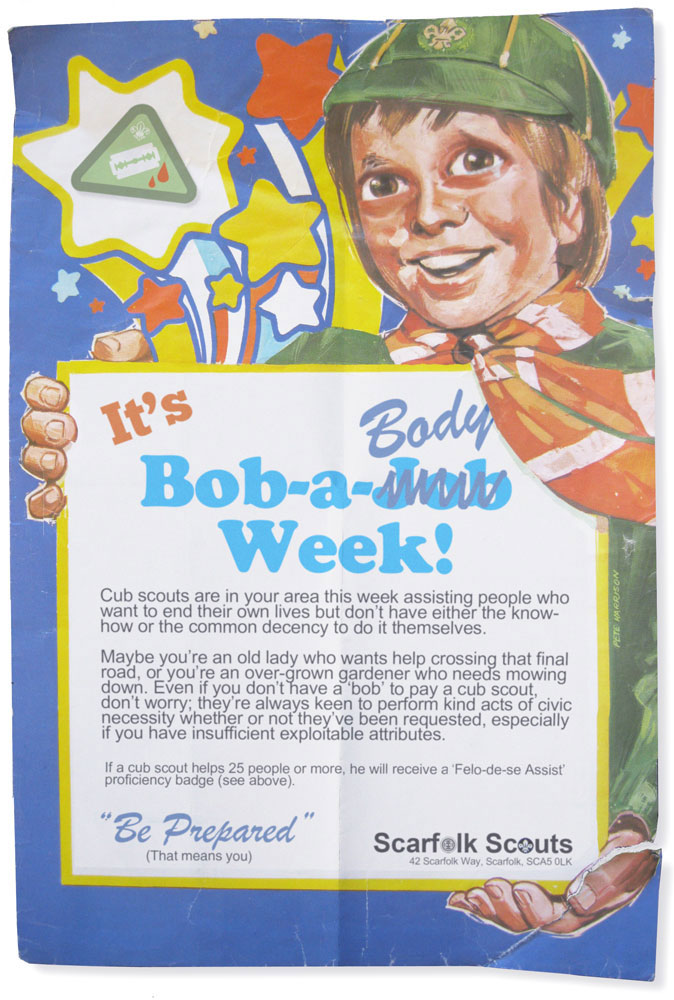
Cub Scout "Bob-a-Body" Week (1977)

The annual boy scout Bob-a-Job week was an institution. However, from 1975 the jobs that scouts were expected to undertake moved away from the mundane - the washing of cars, sweeping of leaves and mowing of lawns - and became much more demanding.

Below is a scout leaflet from 1977 which was the first year that Bob-a-Job week officially changed its name.


During Bob-a-Body week, hundreds of cub scouts roamed Scarfolk helping members of the community with their assisted suicide needs. The old, sick and formally shunned most frequently employed the services of the scouts, though the council's Oxygen Resource Board allegedly sent lists of reluctant residents to scout groups in advance, along with illicitly duplicated front door keys and gallon jars of a toxic nerve agent.

Thursday, 16 April 2015

"Raingods" Children's TV Programme (1970s)

Rainbow was a popular daytime children's television programme in the 1970s. Yet very few people realise that it was originally pitched as an altogether different show called Raingods. Below are the only extant frames from the pilot.


Raingods introduced children to a pink, one-eyed, Aztec god of rain, Tlaloc, whose name translates as 'enraged niece of Bruce Forsyth'. Other characters included minor deities such as Tezcatlipocabungle, the bear executioner deity; Zippyloc, god of arrogance and poor dentistry; and Geoffrey the Devil.

Ultimately, a full series was not commissioned because it became apparent in the pilot that Tlaloc's fearful cohorts not only had to appease their vengeful god with sweet songs, but they also had to sacrifice live human children in his name.


In the first twenty minutes alone, two thousand children perished and the programme's producers received upwards of fourteen complaints from disgruntled parents and sweatshop owners.

The programme was soon thereafter redeveloped as the less malevolent Rainbow, Tlaloc was renamed George and the number of child sacrifices was reduced to an acceptable level.

Sunday, 15 June 2014

"Ethnic Cleansing Playset" (Scartoys, 1972)

Scarfolk parents thought it was crucial that their children play with educational toys. This was to help familiarise youngsters with the everyday items that would be indispensable to their adult lives: Vacuum cleaners and kitchenware for girls, for example, and for boys the M1941 Johnson Light Machine Gun, or the M4 Sherman Tank with the 75mm M3/40 cannon.

Toys like the 'Ethnic Cleansing Playset' from Scartoys also taught children invaluable life-lesson skills, such as how to defend oneself against marauding foreigners whose homeland you have decimated for either selfish economic gain, or for parochial, sanctimonious, religious reasons.

Most importantly, over time, such toys inculcated in the child the belief that though the righteousness of their actions was self-evident, they needn't be mundane; they could also be fun.
Click to enlarge