Scarfolk is a town in North West England that did not progress beyond 1979. Instead, the entire decade of the 1970s loops ad infinitum. Here in Scarfolk, pagan rituals blend seamlessly with science; hauntology is a compulsory subject at school, and everyone must be in bed by 8pm because they are perpetually running a slight fever. "Visit Scarfolk today. Our number one priority is keeping rabies at bay." For more information please reread.
Showing posts with label benefits. Show all posts
Wednesday, 10 May 2017
Benefits Assessment Bouncers (1972)
In 1972 the council outsourced its sick and disability benefits assessment service to a team of nightclub bouncers. The bouncers broke into the homes of claimants in the dead of night, shone lights in their faces and screamed threats at them.
Claimants who were identified as frauds were thrown down their own stairs, often repeatedly, to ensure that their physical and mental conditions matched their claims.
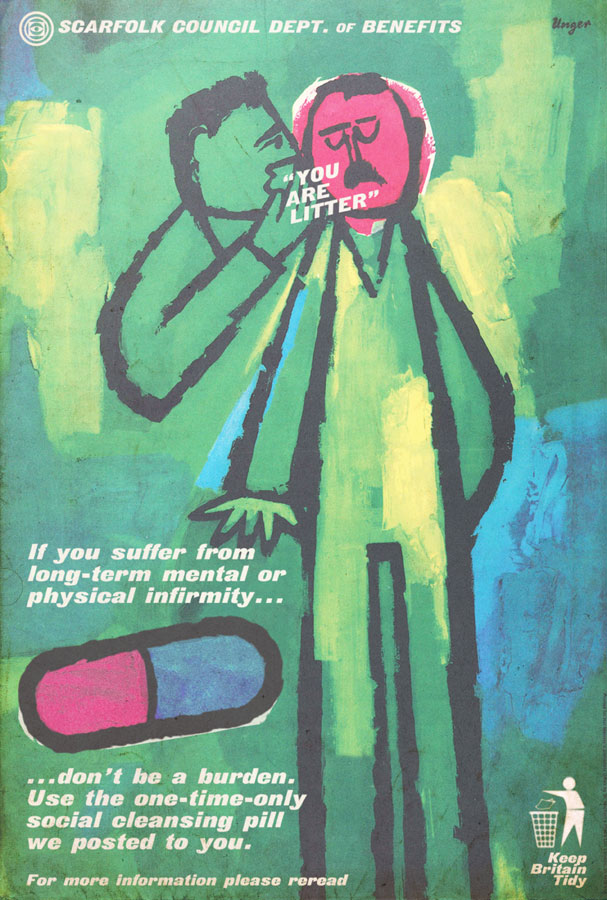
Genuine claimants were offered a menu of euthanasia options of varying price and bullied into choosing the most expensive, the so-called 'Kill Pill', which also contained a mild explosive (see poster above). However, claimants did have the choice to nominate another family member who could commit suicide in their place.
People who refused to take their own lives were officially recategorised as "potentially hazardous biological litter"; they were consequently charged with self-fly-tipping and taken away in vast fleets of skips on the first Monday of every month.
Thursday, 6 October 2016
Foreigner Identification Badges (1974)
From 1974, all foreigners (as well as citizens friendly to foreigners) were required by law to wear identification badges. The image above is just one page from a hefty, six volume guide distributed to local councils and border officials. The glossy guide and badges were so expensive to produce that they were manufactured abroad because the dwindling UK print industry no longer had adequate resources.
Additionally, the first print run of the guide had to be recalled after a typo was discovered: A foreign typesetter had accidently rendered every instance of the word 'British' as 'Brutish'.
Thursday, 29 September 2016
Accidents in the Workplace (1971)
In the first half of the 1970s, accidents in the workplace increased one-hundred fold, largely because work equipment and machinery were poorly maintained by employers. In fact, health and safety guidelines were so frequently overlooked by corporations that the government could see no reason why employees shouldn't be able to accurately foresee and schedule the life-changing accidents that would befall them; especially because every major company was obliged to provide its workers, as per union regulations, with the services of a clairvoyant or witch.
In January 1971 the scheduling of accidents became policy. The state would only pay disability benefits and/or sick pay if the time and nature of an employee's workplace accident had been approved in advance by his employer.
Employees who had unplanned accidents as a result of their employer's negligence were accused of unprofessionalism and many were fired for damaging company resources and impeding productivity.
Some enterprises, however, turned the nuisance of careless workers to their advantage: One company that manufactured metal warning and safety signs for Scarfolk Council saw its employees mutilated by volatile machinery so many times that it stopped sign-making and moved into the far more lucrative decorative finger business.
Labels:
accidents,
benefits,
civil rights,
corporate,
decorative fingers,
department of work and pensions,
DWP,
employees,
government,
health & safety,
injury,
PIF,
poster,
Public Information,
totalitarian,
witchcraft,
work
Monday, 5 October 2015
Personal Space Allowance (1975)
Until 1975, the standard PSA (Personal Space Allowance) had always been fixed at a comfortable, civilised 20 inch zone around each citizen. The government suddenly amended this, however, citing terrorism and a rising population as reasons to cut personal space along with other social benefits and civil liberties.
The PSA was more than merely reduced: The new bodily zone into which representatives of the state (and even some commercial organisations) were now free to pass was amended to minus 5.2 inches. Naturally, this made human bodies 'semi-permeable', legally speaking, and for many people only the depths of their intestines remained private.
Police, security and social services enthusiastically exploited the new laws, as did the health service which randomly pilfered internal organs from unsuspecting citizens, claiming quite lawfully that they were found in 'communal public places'. The nervous public caught on and by 1977 there were self-help groups springing up all over Scarfolk which helped citizens become as obese as possible in an effort to protect their innermost parts from state interference and even commercial exploitation.
Labels:
1970s,
benefits,
dystopia,
government,
healthcare,
NHS,
personal space,
poster,
Public Information,
public services,
security,
snooper's charter,
social,
surveillance,
terrorism,
totalitarian,
violation,
welfare
Subscribe to:
Posts (Atom)


