Showing posts with label echo chamber. Show all posts

Thursday, 29 June 2017

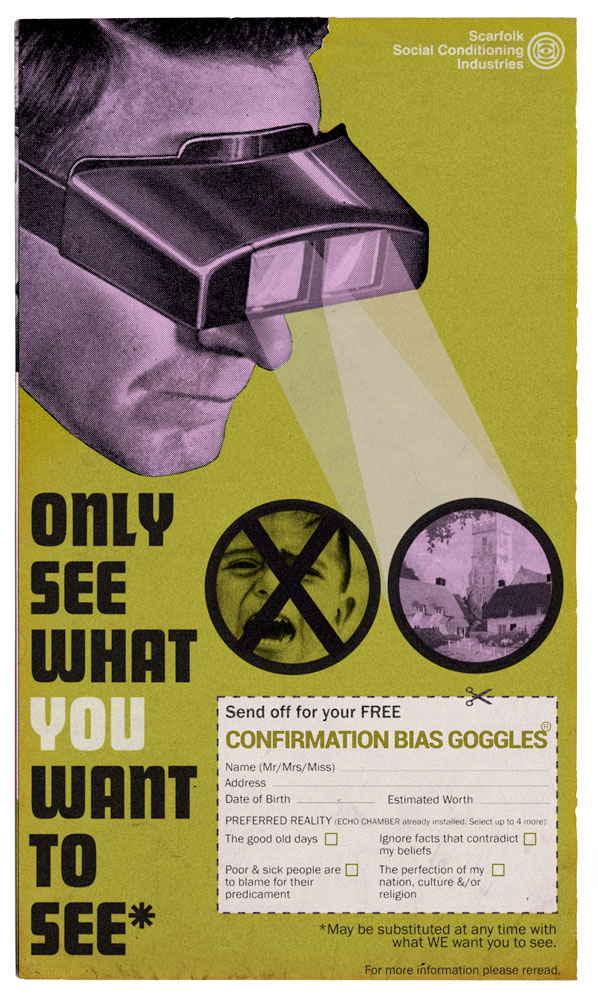
Confirmation Bias Goggles (1970)


Confirmation Bias Goggles were the first wearable technology to be wired directly into the brain. In addition to the pinhead-sized speaker which perpetually broadcast the statement 'Of course you're right!' into the auditory cortex, the goggles' sensors could also switch off those parts of the brain that deal with troublesome emotions and feelings such as empathy, decency and healthy scepticism.

By tapping into the wearer's biases, the goggles literally deleted undesirable objects from the wearer's field of vision. Sights that were too dominant to be erased completely were visually falsified to validate the wearer's preconceptions.

By 1971, the state had adapted the goggles for use in schools. Children were told precisely what to think and what their personal opinions as adults would be.  Unsurprisingly, everybody who tried the goggles, without exception, thought that they were a great idea.


See also: De-education classes, Rub-on transfer newspapers, Mindborstal drug, The Fact Ban, and Children & Hallucinogens: The Future of Discipline.

Friday, 31 March 2017

Scarfolk Mail Rub-On-Transfer News


In the early 1970s, local newspapers changed their publishing strategies. They stopped thinking of readers as interested parties keen to learn the latest news from objective sources. Instead, they thought of them as clients who consumed news to suit their lifestyles and, consequently, their unwavering ideologies.

Censoring and slanting facts soon degraded into outright fabrication and readers became conditioned to see only information that pandered to and confirmed their negative biases, so much so that newspapers such as the Scarfolk Mail realised that they no longer needed to provide actual content: Readers only saw what they wanted to see and comprehended what they wanted to comprehend.

Consequently, in 1972, the Scarfolk Mail started publishing editions with little or no content. Instead, it provided sheets of rub-on-transfers should the reader want to fill in the columns with their own jaundiced content. The Scarfolk Mail went on to win a prize for best reportage of the year, as voted by readers.