Showing posts with label confirmation bias. Show all posts

Thursday, 29 June 2017

Confirmation Bias Goggles (1970)


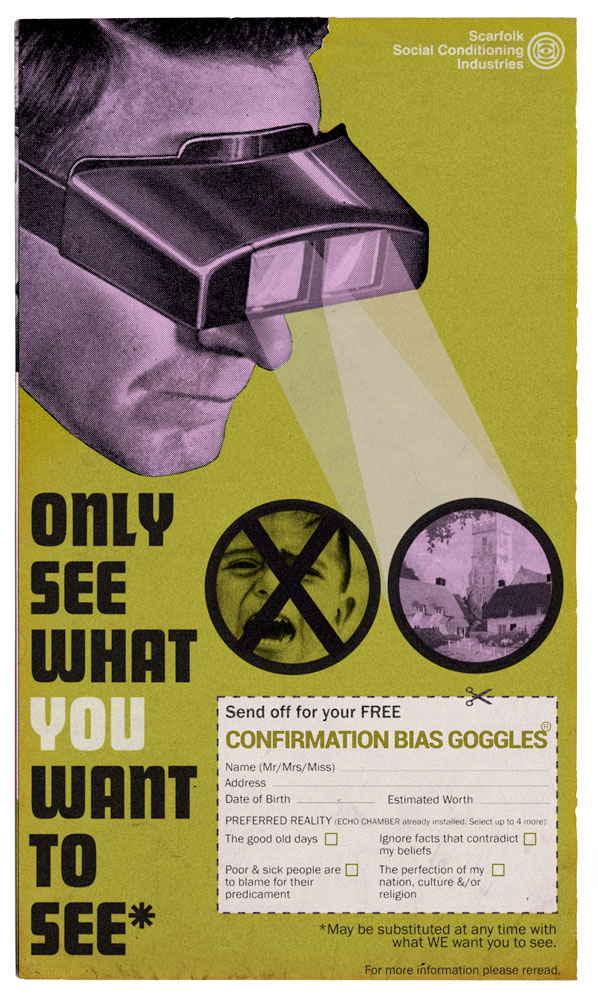
Confirmation Bias Goggles were the first wearable technology to be wired directly into the brain. In addition to the pinhead-sized speaker which perpetually broadcast the statement 'Of course you're right!' into the auditory cortex, the goggles' sensors could also switch off those parts of the brain that deal with troublesome emotions and feelings such as empathy, decency and healthy scepticism.

By tapping into the wearer's biases, the goggles literally deleted undesirable objects from the wearer's field of vision. Sights that were too dominant to be erased completely were visually falsified to validate the wearer's preconceptions.

By 1971, the state had adapted the goggles for use in schools. Children were told precisely what to think and what their personal opinions as adults would be.  Unsurprisingly, everybody who tried the goggles, without exception, thought that they were a great idea.


See also: De-education classes, Rub-on transfer newspapers, Mindborstal drug, The Fact Ban, and Children & Hallucinogens: The Future of Discipline.

Friday, 31 March 2017

Scarfolk Mail Rub-On-Transfer News


In the early 1970s, local newspapers changed their publishing strategies. They stopped thinking of readers as interested parties keen to learn the latest news from objective sources. Instead, they thought of them as clients who consumed news to suit their lifestyles and, consequently, their unwavering ideologies.

Censoring and slanting facts soon degraded into outright fabrication and readers became conditioned to see only information that pandered to and confirmed their negative biases, so much so that newspapers such as the Scarfolk Mail realised that they no longer needed to provide actual content: Readers only saw what they wanted to see and comprehended what they wanted to comprehend.

Consequently, in 1972, the Scarfolk Mail started publishing editions with little or no content. Instead, it provided sheets of rub-on-transfers should the reader want to fill in the columns with their own jaundiced content. The Scarfolk Mail went on to win a prize for best reportage of the year, as voted by readers.

Thursday, 16 June 2016

Voting in the 1970s


Research into confirmation bias at Scarfolk University in 1973 showed that 87% of people will not deviate from their beliefs, no matter how much counter evidence is presented to them. However, the study found that the figure drops considerably if torture is used, with more than 50% of subjects losing all their beliefs, largely because their brains stop functioning during the study.

These findings demonstrated to the government that informing citizens and giving them a choice is futile because they've already made up their minds, often basing their decisions on irrelevant, whimsical criteria such as whether a politcian's eyes are too close together, his choice of football team, or if he took an active part in the unwarranted decimation and exploitation of a foreign nation for personal financial gain.

By the mid-1970s the government had vastly overspent on citizen persecution and "physical coercion" and no longer had the resources to enforce the election and referendum outcomes it desired. It felt that the only way forward was simply to "remove those limiting aspects of the democratic process which give citizens a say in the running of the country". Consequently, a referendum was set for early 1975 and the public was politely encouraged to ban the right to vote and give itself over to iron-handed totalitarian rule.