Saturday, 18 June 2022

Bad Kingdom (1972)

In 1972, the government drew up plans to construct a deportation facility off the coast of Ireland that could house as many as 70 million people - the entire population of the UK, if need be. The intention was to make it an exact replica of the United Kingdom and call it Bad Kingdom. Nobody, it seemed, fulfilled the increasingly stringent criteria of what it meant to be truly British. 

Experts estimated that, by 2050, the United Kingdom's only remaining residents would be members of the Cabinet, the Royal family, and bald-headed perpetually enraged men with a poor command of the English language whose idea of patriotism was to attack with deckchairs anyone who so much as spoke with a foreign accent. 

In all likelihood, without enough people to maintain a working infrastructure, these UK residents would have to sneak into Bad Kingdom in order to stock up on supplies and to have a shower, although doing so would be illegal and carry a sentence of deportation back to the United Kingdom where they risked being deported to Bad Kingdom, leaving the UK empty.

Thursday, 2 June 2022

The Silver Jubilee Ghost (1977)

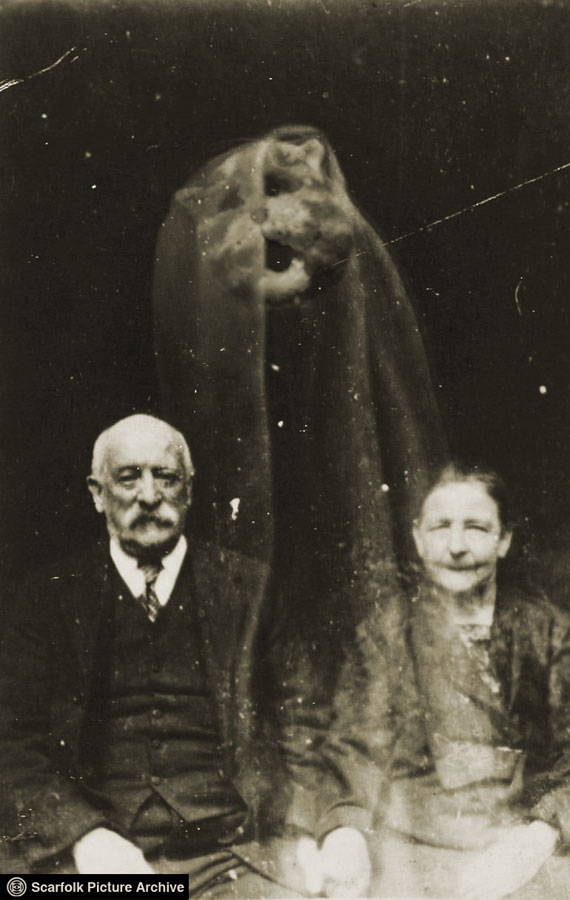
During the Queen's Silver Jubilee in 1977 a ghostly figure was spotted by alarmed viewers in a BBC broadcast. The spectre appeared to be sitting beside the Queen in her carriage. The apparition's identity remains unknown, though some claim it is Scarfolk resident Herbert Empire. 

Empire, a proud slaughterhouse owner and staunch monarchist, died after trying to tattoo a likeness of the royal family on his own brain using the pin on the back of a royal souvenir badge that depicted the young Prince Andrew meticulously checking the gender of a Corgi with his nose. A post mortem also revealed that Empire had swallowed substantial quantities of red, white and blue paint, later found to contain toxins, to ensure that everything he discharged was patriotic. 

The Queen was encouraged to publicly acknowledge Empire's loyal actions on his birthday, which annoyed her because it would mean missing her favourite radio programme called I Know God Doesn't Exist But I'm Not Saying Anything Because the Peasants Still Think Royals Are Divinely Chosen.

An example of the souvenir badge used by Herbert Empire.

Tuesday, 24 May 2022

The Children's Guide To Séances & Cuddly Demons (Scarfolk Books, 1973)

 "Are you amongst us, spirit? Wake up, be bright, be golden and light. Bagpuss, oh hear what I sing..."

From page 37 of the Children's Guide To Séances & Cuddly Demons (Scarfolk Books, 1973). The book encouraged children to contact the apparitions of children's deceased television stars. It was banned briefly, however, in 1975 when Noddy and Big Ears, deranged by their time in the spirit world, broke through to the earthly realm and wreaked havoc in a branch of Marks & Spencer, causing thousands of pounds worth of damage. Additionally, a priest had to be called to perform an exorcism over the shop's entire stock of varicose vein support tights.


Saturday, 11 December 2021

"Plan C" (1979)

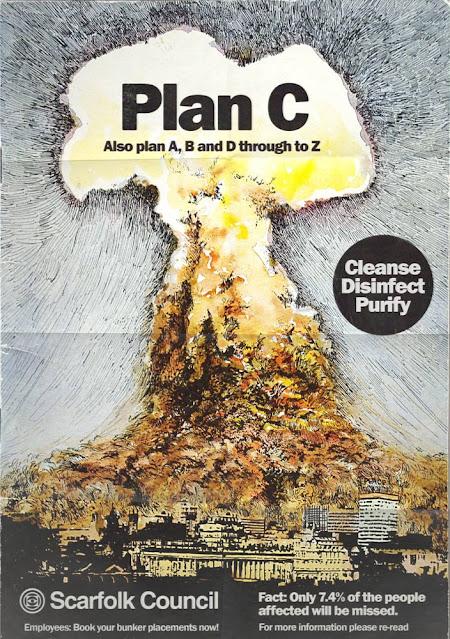
This internal council document was only recently unearthed in our archives. It refers to a secret governmental emergency plan to "purify" the town following some kind of "infestation or plague," the details of which have now been lost. 

Although we can now no longer be entirely sure what Plan C consisted of, the image of a nuclear mushroom cloud offers us a clear indication of the council's intention. Our archivists have postulated that the council might have thought it simpler and more cost effective to remove all living things than to target specific vermin and/or undesirable microscopic pathogens. 

What also seems clear is that an unidentified but enthusiastic council employee took it upon themselves to extend Plan C to almost every eventuality, in effect making the nuclear Plan C simply the only plan.

The notion that the council planned to employ a nuclear option is further supported by a minor story in a local newspaper from the time. In October 1979, seven-year-old schoolboy Nigel Johnson, mixed up his family's contribution to his school's annual harvest festival. Instead of the intended box containing four cans of oxtail soup and spaghetti hoops in tomato sauce, he took a quarter tonne of enriched uranium and other weapons-grade nuclear materials.

The boy's father, a local councillor, when questioned how his son could have found such materials at home, claimed ignorance. "Boys are always picking up things like this in the playground," he said and added "it's the fault of liberal teachers and communist dinner ladies and I firmly believe they should be among the first to be cleansed."

Sunday, 18 July 2021

Government Self-Support Scheme Posters (1971-)

The government's self-support scheme launched in 1971. It's not known when the scheme finished because nobody could ever reach the government by telephone. Letters were returned with 'Not known at this address' written across them. Even when people turned up in London to complain in person, they discovered that many government buildings were just facades of the kind one might find on a film set. The Houses of Commons and Lords were in partial ruin, seemingly vacated years before, and had become home to goats, chickens and other livestock. This fact had only gone undetected for so long because the bleating and clucking of the animals coming from within the chambers was indistinguishable from those of their political predecessors.

Thursday, 5 November 2020

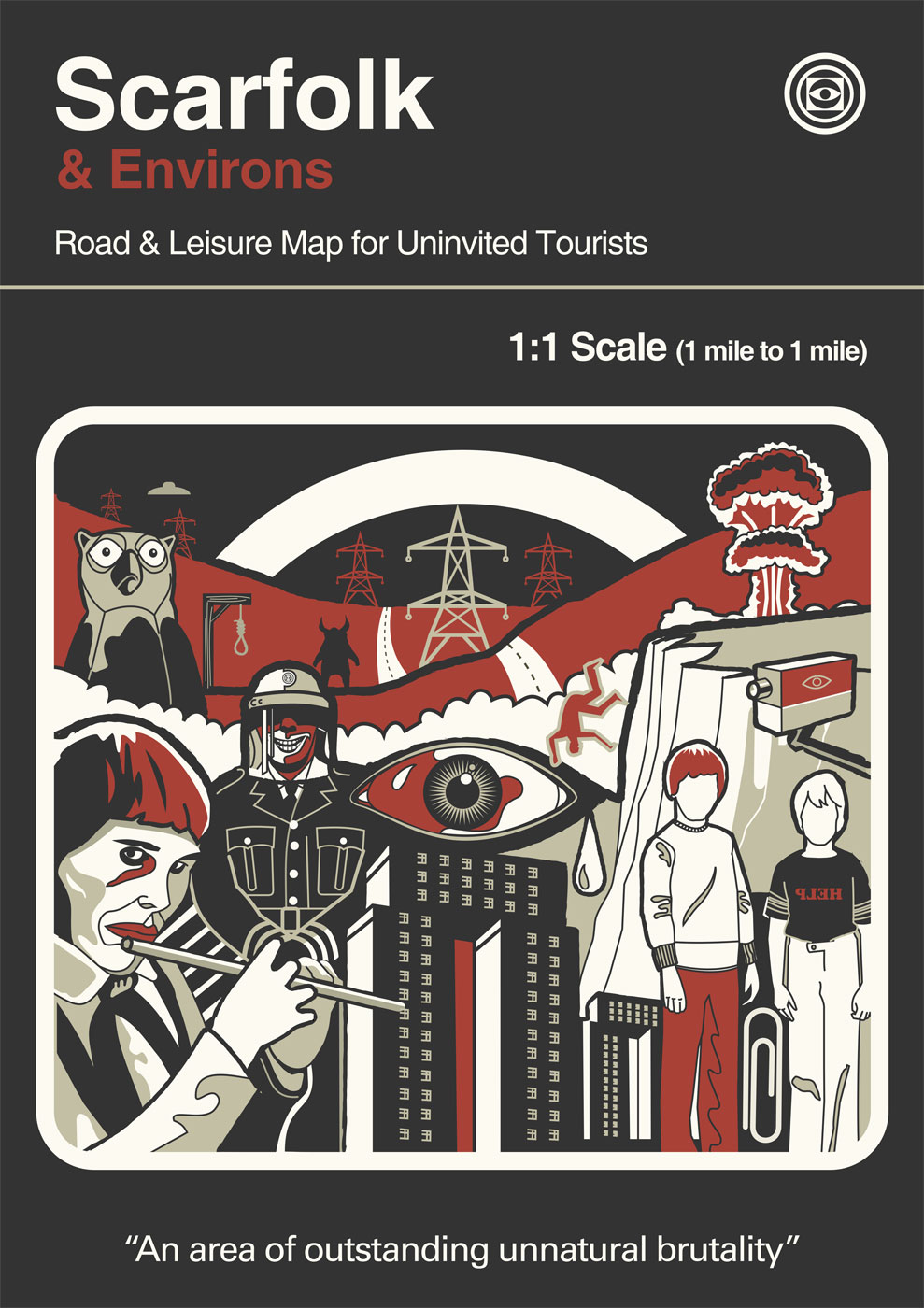
Scarfolk & Environs: Road & Leisure Map for Uninvited Tourists


AVAILABLE NOW

A large format map that comes in a bespoke folder, 
with a Scarfolk visa and souvenir postcard.
 A limited-edition (1st 1000 orders only), web-exclusive version also 
includes a Scarfolk bookmark made of genuine imitation leather. 
(Available from Herb Lester Assoc.WaterstonesFoyles

Friday, 24 July 2020

The Infamous Class 3 School Illustration (1976-1979)


On 10 September, 1976, dozens of children, including every single pupil from class 3, Scarfolk High School, vanished on their way to school. A police operation was launched but no clues were ever found. The children were pronounced dead the following Monday, a mere three days later.

Every year thereafter, the police commissioned their sketch artist to draw, in the style of a school photograph, how the missing children might have looked (albeit with their faces removed) had they not disappeared in mysterious circumstances. This was sent to the bereaved parents of class 3 at an exorbitant cost of £31.25.

In the 1979 class sketch, one parent noticed a small label on one of the faceless figure's clothes that contained a code word only their child could have known. 

Under mounting pressure from parents, the police eventually raided their artist's studio and found 347 children in his cellar where many had been held captive for several years. The police immediately seized and confined the children as evidence in a crime investigation, which, after much dithering, ultimately never went to court leaving the families no choice but to pursue a private prosecution against the kidnapper. 

As the children had already been pronounced dead and the cost of amending the relevant paperwork was high, they were given away as prizes in the Scarfolk police raffle, which helped pay the legal fees of their sketch artist, who, it turns out, was the son of Scarfolk's police commissioner.

Sunday, 28 June 2020

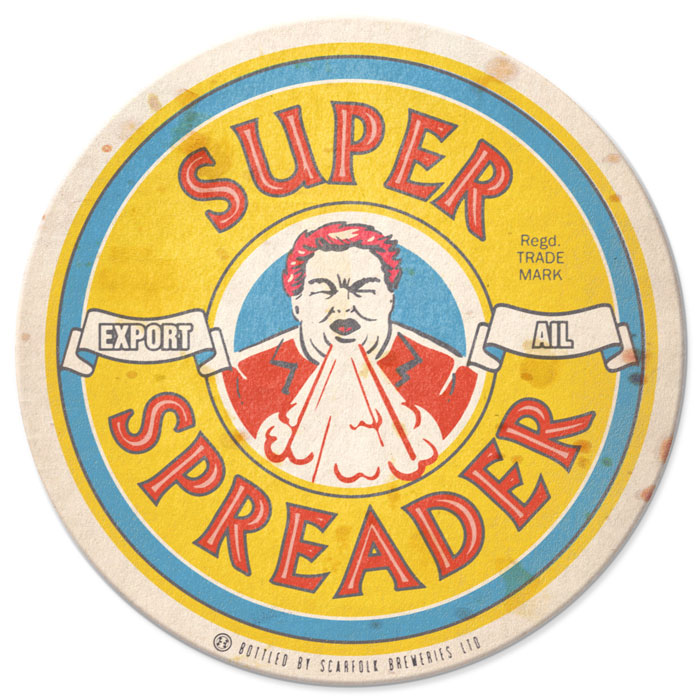
Beer Mats of the 1970s


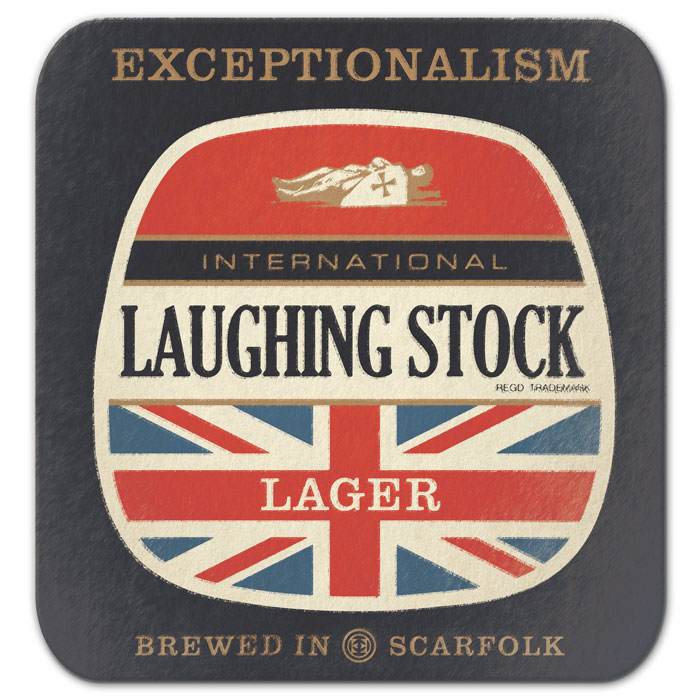
The pubs have reopened. Here is a selection of 1970s beer mats from the Scarfolk council archives. Collect them all!


NOW AVAILABLE to buy from Saatchi Gallery!

Includes:
8 x Different beer mats
1 x printed insert
1 x presentation box


Saturday, 20 June 2020

The Solstice Incident (1978)

Below is an artist's impression, and recently unearthed Polaroids, of the 1978 Solstice Incident during which an occult ritual went awry at Scarfolk Henge resulting in the transformation of the sacrificial martyr into an enormous space hopper.

When neither druid nor doctor could reverse the process, the victim became a town mascot, offering rides to children. Records show, however, that he was also secretly employed by the state to violently intimidate seditious citizens and prying outsiders. He was known among council staff as 'The Bouncer'.

The as-yet unsolved Steamroller Murders of Spring 1979, when dozens of people were discovered crushed flat with every bone in their bodies broken, were almost certainly a result of The Bouncer's handiwork.

Add caption

Tuesday, 9 June 2020

Unknown Poster Campaign (1970s)


No one is entirely sure what the purpose of this public information poster was. All we know is that when a council worker accidentally posted it on billboards around Scarfolk, the poster below was quickly pasted over it. 


Records show that the errant, anonymous worker was soon sold to another council where his job was either to feed the council pets or be fed to the council pets. Documents don't clarify which.  

Thursday, 30 January 2020

NHS Face Removals (1977- )


While some children were born without faces simply because they didn't deserve them (see the Scarfolk Annual 197X), the government became increasingly concerned about citizens who did have them. They found that people with faces are more likely to have personal desires, hopes and dreams, in short: a will and ideas of their own. 

Such idiosyncrasies were not only thought of as needlessly self-indulgent, they were also deemed inconsistent with the smooth running of a successful society. Scarfolk's was the first council benevolent enough to offer face removals on the NHS.

In 1976, the council trialled face removals on stray foreigners, prisoners, children nobody wanted, unsuspecting people who were picked up leisurely walking in a park after sundown and volunteers (see leaflet above). 

When the full scheme was rolled out in 1977, the council soon lost track of which faceless citizen was which. By 1978 a new law was passed which dictated that all faceless people were required to have a tattoo of their old face over their lost one to make identification easier.

Tuesday, 3 December 2019

Election Posters of the 1970s

Of all the 304 general elections that were held in the UK during the 1970s, these three election posters for the Conservative party are among the few campaign materials that are still extant. This is largely due to the fact that campaign slogans were more often compulsorily tattooed onto ailing citizens who collected welfare benefits.*

All promotional literature was designed and printed by the Scarfolk Advertising Agency, who, it was later revealed to the surprise of all clients concerned, had been working not only for the Conservative, but also the Labour and Liberal Parties.

Furthermore, the agency cleverly maximised its profits by selling exactly the same poster designs to all clients. Only the party name was changed. This made it difficult for voters to decide who to vote for, but it also confused politicians who became unsure which party they belonged to.


*See also: ‘Trampvertising’.

Further reading: 'Watch Out! There's a Politician About' (1975), 'Voting isn't Working' election poster, 'Democracy Rationing', 'Put Old People Down at Birth' election pamphlet.