Wednesday, 31 May 2017

Police Interrogation Safewords


Almost everybody endured police interrogations at some point during the 1970s. They were so frequent that most families had a packed bag by the front door (people were expected to bring a spare change of underwear and their own first-aid supplies).

If by chance all members of a family were summoned together, they might make a day of it, have a picnic in the prison facility's Garden of Incorruptibility and watch the interrogation of their loved ones on big monitors. Laugh tracks were included to minimise distress.

While the security services were openly proud of their slogans such as "we promise to raise a glass to those who don't confess", if a detainee did suffer irreversible psychological or physical damage as a result of their interrogation, the family was awarded a £5 book token and a potted cactus as compensation.

More about Scarfolk Security Services.

Thursday, 18 May 2017

"Children: The Cause of All Crime"


In 1970 the Scarfolk Crime Commission embarked on the largest study into crime to date. After two years of intense investigation it found a startling correlation between the types of people who commit crime and their early life experiences.

The findings were unequivocal: 100% of criminals had also once been children.

The council immediately put into effect acts intended to reduce, if not entirely eradicate this insidious cause of crime. Thousands of children were rounded up in camps. Toys were burnt in massive pyres. Adults were sterilised. Anyone who had been in regular contact with children, or had ever been a child, was quarantined in vast bunkers specially built several storeys below the council building.

Though Scarfolk was reduced to a ghost town, the scheme proved a success. During the first month that these stringent measures had been implemented not one crime had been committed. Consequently, at the 1972 Conference of Sham Utopias, a local conservative MP predicted that the most successful towns, and even countries, of the future will be those that eradicate all citizens who have any connection to, or dealings with, children or the adults they grow into.

For more about bad children, see: Brood parasites, Serious Infant Dental Assault, the Never Go with Strange Children campaign and the Infant Liberation Front terror group.

Wednesday, 10 May 2017

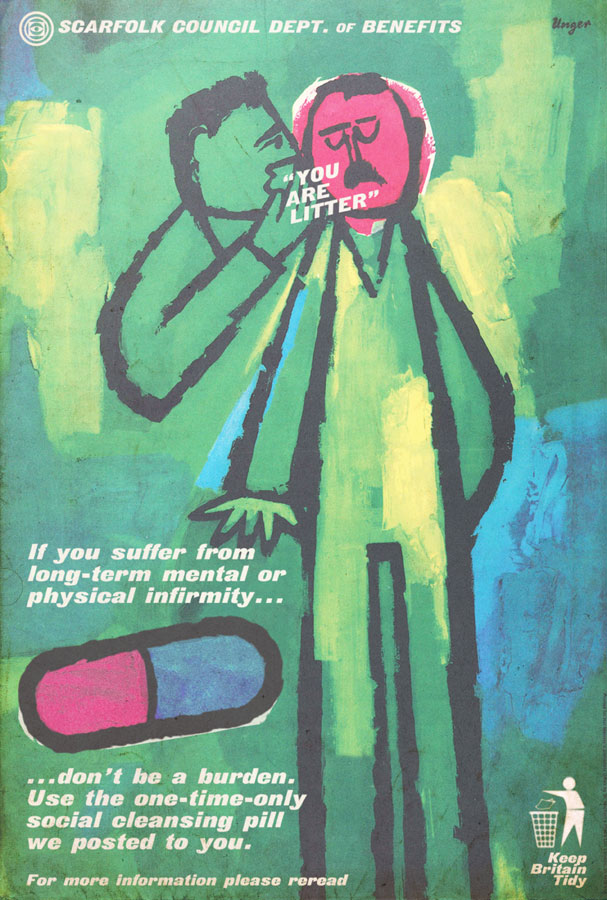
Benefits Assessment Bouncers (1972)


In 1972 the council outsourced its sick and disability benefits assessment service to a team of nightclub bouncers. The bouncers broke into the homes of claimants in the dead of night, shone lights in their faces and screamed threats at them.

Claimants who were identified as frauds were thrown down their own stairs, often repeatedly, to ensure that their physical and mental conditions matched their claims.

Genuine claimants were offered a menu of euthanasia options of varying price and bullied into choosing the most expensive, the so-called 'Kill Pill', which also contained a mild explosive (see poster above). However, claimants did have the choice to nominate another family member who could commit suicide in their place.

People who refused to take their own lives were officially recategorised as "potentially hazardous biological litter"; they were consequently charged with self-fly-tipping and taken away in vast fleets of skips on the first Monday of every month.

Monday, 1 May 2017

The Annual Maypylon Dance


Only children whose parents had lost either their jobs or their lives were selected to take part in the annual Scarfolk Maypylon Dance. On the face of it, the tradition welcomed in Spring, but it was really just an exercise in cutting unnecessary welfare expenditure. Funds were rerouted to more important undertakings such as supporting the arms industry, which sold weapons to volatile nations that regularly threatened Britain with war.

Super-conductive copper ribbons were used during the dance because it was believed that their combination with 400,000 volts and expendable children opened a vortex to an alternate dimension where household items were always on sale and could be purchased for a fraction of the price. Items that were brought back through the vortex, however, risked corruption by dark forces, as witnessed on May 1st 1971 when Scarfolk was overrun by a vast horde of malevolent, sentient food blenders.

For more May Day celebrations, see the Scarfolk Wicker Man.

Friday, 21 April 2017

Election Campaign Poster (1974)


Gerry Mander (see above) was the Scarfolk Party candidate in the 1974 election. Though much of his nationalistic campaign consisted of subliminal brainwashing techniques, complicated satanic invocations, and simply lying and punching liberals in the face, he did also proffer tangible promises.

For example, he wanted Britain to be the first western nation to construct an underground sewage system designed specifically to transport its disabled and sick to landfill sites. He also insisted that women finally be recognised as the most valuable resource in their husband's or father's livestock.

Most of all, he strongly promoted British exports such as conker wine and badger cheese and demanded that the UK be acknowledged as the clear trade leader out of all the world’s authoritarian third world nations.

Thursday, 13 April 2017

Real Easter Egg (1971)


Back in the 1970s, many people complained that the word “Easter” had been dropped from the packaging of chocolate eggs. They also claimed it was only a matter of time before other Christian Easter imagery, such as anthropomorphised cartoon chicks playing with bashful ducks or dungaree-wearing bunny rabbits, received the same treatment.

The Scarfolk Confectionery Company was only too happy to remind consumers of the true biblical events surrounding Easter: Gruesome acts of mutilation and torture, filicide/suicide, crude carpentry and auto-exhumation were all necessary to atone for the original sin that most people agree is historically unfounded, though still blame on one woman’s innocent desire for a healthy snack.

The Scarfolk Confectionery Company ensured that the word “Easter” was not omitted from its products (see above, from a 1971 brochure), in fact it was printed on the packaging over 100 times with corrosive ink that burned the word into the skin of the consumer. Anyone not bearing the burn scars was deemed by the government to be "unBritish".

Happy Easter from Scarfolk!
For more Easter-related artefacts, see also Rabies Easter Eggs, Jellied Babies and Confectionery Branded Cigarettes.

Thursday, 6 April 2017

"Diseases are cool!"


In the 1970s, the Notional Health Service envied those public sectors that received more funding from the government. The NHS was particularly resentful of the Department of Education & Indoctrination and in 1977 it set out to entice children away from schools and state-run brainwashing covens into hospitals so that it could justify larger budget requests.

The NHS initially launched a major campaign aimed at children and teens, which promoted the health benefits of serious medical diseases and conditions, especially those which required substantial financial resources. In addition to adverts in magazines such as Look-In (see above), it also produced collectable bubble-gum cards (see below), badges, T-shirts and cuddly toys that resembled bacterial cells and viruses.

While the idea of being dangerously sick did become very popular among the nation's school children (indeed, the Staphylococcus aureus flesh-eating disease playset was the biggest seller of Christmas 1978), it still wasn't enough to attract the desired funding to the health sector and in 1978 the NHS took the inevitable step of directly infecting its merchandise with actual diseases to ensure success.


Friday, 31 March 2017

Scarfolk Mail Rub-On-Transfer News


In the early 1970s, local newspapers changed their publishing strategies. They stopped thinking of readers as interested parties keen to learn the latest news from objective sources. Instead, they thought of them as clients who consumed news to suit their lifestyles and, consequently, their unwavering ideologies.

Censoring and slanting facts soon degraded into outright fabrication and readers became conditioned to see only information that pandered to and confirmed their negative biases, so much so that newspapers such as the Scarfolk Mail realised that they no longer needed to provide actual content: Readers only saw what they wanted to see and comprehended what they wanted to comprehend.

Consequently, in 1972, the Scarfolk Mail started publishing editions with little or no content. Instead, it provided sheets of rub-on-transfers should the reader want to fill in the columns with their own jaundiced content. The Scarfolk Mail went on to win a prize for best reportage of the year, as voted by readers.

Tuesday, 21 March 2017

Identified Flying Objects (& Esoteric Truth)

In the 1970s, the distinction between fact and fiction completely broke down as a result of years of government fabrications, corporate deceit, media falsehoods and systematic educational disinformation.

Objective truth gained an esoteric, almost occult status along with subjects such as ghosts, bigfoot, the Loch Ness Monster, pagan paediatrics and other unexplained phenomena. Many didn't believe that objective truth even existed.


The dwindling numbers of people who insisted that real facts were 'out there' were pushed to the fringes of society and labelled conspiracy theorists. They saw it as their duty to promote even the most rudimentary facts and reintroduce them into the public arena.


One area of so-called "arcane knowledge" concerned IFOs (Identified Flying Objects), which eventually caught the public imagination, or rather the lack of it. Sensationalised books and magazines about the topic flooded newsagents and bookshops (see pages above and below from The IFO Phenomenon (Corgi, 1977) and a pull-poster from IFO Monthly magazine). By the end of the decade, many people claimed to have had a "close encounter" with an IFO. Some even reported that they had been taken aboard such craft.


(click to enlarge)

For more information about the suppression of facts in public discourse, see the Truth Reform Act of 1976 and mandatory de-education classes.

Monday, 6 March 2017

"Life is Easier With Guilt" Public Information Campaign

This is part 2 of our look at crime in Scarfolk (see last week’s post about 'Real British Crime').

In 1972, Scarfolk Council decided that the "presumption of innocence before being proven guilty" was a bit too presumptuous.


A council spokesperson said that "such legal bureaucracy completely ignores the rights of guilty people who want to be legally recognised as guilty but have either committed a crime that has unfortunately gone undetected, or are, through no fault of their own, awaiting trials which could take many months, even years to rightfully establish their guilt.


The spokesman also pointed out that people may be guilty of actions that are not yet considered crimes and underlined the importance of recognising these people’s culpability to ensure peace of mind.

In the spring of 1973, the government's propaganda department launched a campaign that promoted guilt as a desirable attribute. It was so successful that many people feared they might not be guilty enough and committed horrific crimes to nurture in themselves feelings of self-worth and wellbeing.

The campaign featured a policeman whose nickname was "PC Fang". Allegedly, he had the ability to instil a deep sense of guilt in even the most innocent citizens. Some say he achieved this by using supernatural powers; others say he used a hammer.

A frame from a lost public information film that played at cinemas during the advertisements. 

A T-shirt compulsorily worn by children.


Thursday, 23 February 2017

The Campaign for Real British Crime (CRBC)


When immigrants began moving to Scarfolk in the mid-1970s, many local criminals worried that foreign offenders would threaten their livelihoods. They formed an organisation called the Campaign for Real British Crime (CRBC), which fought for the rights of UK born criminals. The CRBC demanded that the police prioritise investigations in favour of offences committed by British lawbreakers, for whom they also tried to ensure more convictions and longer prison terms.

Campaigners for Real British Crime also attempted to reintroduce and encourage traditional, archaic crimes, some of which had not been committed in Britain for many years; for example, conspiring with a neighbour's goose while intoxicated, handling rhubarb and voles in suspicious circumstances, invoking demons while wearing a toupee, and committing crimes abroad when they can be carried out just as successfully at home.

Tuesday, 14 February 2017

1970s Valentine's Day Greetings Card


Love is the air like doves and butterflies and pulmonary tuberculosis. Happy Valentine's Day from Scarfolk.

Friday, 10 February 2017

"Fun Fag Facts" (1974)


This info-tisement appeared in children's weekly magazines and on the walls of schools as part of the 1974 "Cigaretiquette campaign". It was funded in part by the SCRG (Scarfolk Cancer Research Group) who, having accidentally hired too many employees and purchased expensive premises, desperately needed a sharp increase in the numbers of cancer patients to attract the funding they required to maintain their organisation.

See also: confectionery-branded cigarettes of the 1970s.

Thursday, 2 February 2017

Play & Learn Drowning Game (late 1970s)

This is part 2 of our feature on water-based toys (see last week's Action Man waterboarding accessories).

In the late 1970s, the government predicted that by the time the decade's children were grown up, suicides would be commonplace, perhaps even fashionable. This would be due to the "inevitable effects of living in a declining society in which the government has abandoned the welfare of its citizens in favour of fun hobbies it finds less boring", but mostly because "it will make suicide a compulsory part of national cutbacks".


The minister for welfare proposed that "suicide clubs" be established (they even launched a slogan: "Let's all say Felo-de-se!"), and that suicide methods be taught in schools and job centres by alternative-career advisors.

The government also funded several toy manufacturers who created products which cast suicide in a positive light. One such toy was the Play & Learn Drowning Game, which was also adapted into a console game in 1978.


Friday, 27 January 2017

Action Man Waterboarding Accessories (early 1970s)

The image below shows the instruction booklet that came with an Action Man accessory kit. Like many boys' toys, such as tractors, diggers and trains, the Action Man waterboarding kit was designed to help young boys develop a sense of what they might like to be when they grow up.

A survey conducted in 1978 found that the jobs boys most wanted when they were older included astronaut, engine driver and chief torturer for a totalitarian regime which uses its cover as a civilised democracy to commit national and international atrocities with impunity.

(click to enlarge)

Friday, 20 January 2017

The De-evolution of Mankind (Pelican Books, 1975).


Many people are unaware that a young Donald Trump appeared on the cover of a book called The De-evolution of Mankind, published in Scarfolk by Pelican Books in 1975.

From the introduction:
"Scientists predict that, at some point in the early 21st century, humans will stop evolving and will start the process of de-evolution. Several signs will herald this decline:
i. People will stop reading books. It's estimated that the length of an average book will be eighteen words, including the title and copyright page.
ii. Increasingly, people will only vote for leaders who can communicate using an abbreviated, primitive dialect, a sort of "Dunce Patois" in which whole sentences will be reduced to single words: "True!", "Bad!", "Shame!", etc.
iii. The distinction between the real and the imaginary will be lost and fictional characters will ascend to the highest posts of office.
iv. Human hands will shrink through inactivity and will become little more than tiny, feeble scoops [...]

[...] The mighty space stations we once imagined in our future will drift unpopulated because the knowledge required to reach them will have been either outlawed or carelessly forgotten. The threadbare remnants of mankind will scrabble around a dying earth, daubing themselves with orange mud to avoid being burned due to the global overheating they said would never happen. We will return to this development in Chapter 4, which is entitled 'Consummate Dickheads'."

Friday, 13 January 2017

Minor Meat Cuts Poster (1973)


An excerpt from a 1973 speech by Scarfolk's Minister for Family Welfare and Catering:

"In times of economic crisis, cuts are inevitable. We feel, however, that the citizens of Scarfolk should be directly involved in the process of how these cuts are implemented and that is why every household will soon receive a booklet describing all the cuts we currently recommend..."

Two weeks after the speech, thousands of poor families received Charcuterie for Beginners, which contained several pull-out posters, one of which is presented above.

More food-related austerity solutions from 1973 see HERE and HERE.

Thursday, 5 January 2017

Real British Living Cement


Scarfolk's elite lived in hillside enclaves on both sides of the town. In 1971, these rich, wealthy and powerful residents decided that they wanted to travel freely between each other without having to pass through town where they might "contract a disease such as rabies or poverty from one of the underdeveloped proles".

They resolved to build a vast bridge over the town but soon learned that the costs would be exorbitant. Collaborating with the council and building contractors, they invented a new, cheaper cement aggregate that was not only "freely available and completely natural" but it also helped to reduce spending in other areas, mainly social welfare.

For weeks after the opening of the bridge, the muffled cries and groans that could be heard coming from within the structure were ascribed to high winds. It was only when limbs and other body parts began poking through the time-worn concrete years later that the bridge acquired its nickname "the big bridge in which all the worthless missing townspeople are buried".

Local business leaders were outraged that the truth had not come to light much earlier, especially because they had missed out on years of exploiting the bridge as a tourist destination.

More cement-related artefacts HERE.

Friday, 23 December 2016

Radio Times Christmas Issue

Everyone at Scarfolk Council wishes you a very merry final Christmas before the inevitable apocalypse.

Here's your festive double issue of the Radio Times, which covers Christmas to the new year (or the end of time, whichever comes first.)


Learn more about the jolly apocalypse HERE.

Thursday, 15 December 2016

Disposable Children Bags


Discarded children were a serious problem in 1970s Scarfolk. Adults who had decided against parenthood, whether for reasons of finance or boredom, would dump their offspring in sacks by roadsides or in laybys.

Hungry children who had not been given the required sedative dosages often chewed their way out of the sacks and wandered into speeding traffic. Not only did these unwanted children cause hours of unnecessary delays to motorists, but a study showed that discarded children were responsible for close to a million pounds worth of damage to car bonnets, bumpers and windscreens in 1974 alone.

From January 1975, any 'Bag Baby' (as they came to be known) involved in a road accident that incurred costs to motorists, risked a fine of up to £125.

Thursday, 8 December 2016

BBC Sound Effects Records (early 1970s)

In the early 1970s, the BBC produced numerous sound effects records. Though many were created for educational purposes, such as 'Squeaky Eyeballs' (1973), the public were encouraged to utilise the more practical releases in their daily lives.
Expressing emotion or personal thoughts in both private and public had long been outlawed. Records such as 'British Tutting' (1970) allowed the disgruntled listener to listen to a variety of legally sanctioned tuts as a sort of surrogate expression of displeasure. Equally, 'Inconsolable Weeping in Libraries' was a soothing, lawful substitute for the act itself.
As familial contentment was also prohibited in the 1970s (apart from at Christmas when it was compulsory. See HERE), some families, frightened that their satisfaction might be discovered and reported, opted for albums such as those from the BBC's Divorce Series, which they would play at elevated volumes for the ears of prying neighbours or passing government agents.

Not all deceptions were successful. If a family was arrested they would be taken to their local police station where, while waiting to be interrogated by specialised officers, they might be played an album such as 'Uncomfortable Silences'.


Thursday, 1 December 2016

Council Advent Cards

In 1970s Scarfolk, the council sent out personalised advent cards to all its citizens.

Not only did the cards hint cryptically at policies due to be introduced in the new year, but they were also frequently accompanied by updated citizen expiration details (see HERE).


The more observant among you may have spotted Charlie Barn on the roof.
More on advent HERE.

http://scarfolk.blogspot.de/p/cyclops-cats.html

Wednesday, 23 November 2016

1970s Pornography

Even an archive as respectable as Scarfolk's contains artefacts that some might deem offensive. In 1970s Britain, many aspects of life became increasingly sexualised, though sex was rarely one of them.

As you look at these pornographic magazines, which were aimed at lovers of Brutalism, please remember that the 1970s were a very different time with its own mores and values.

Click on the brown paper bag to access the magazines. You must be over the age of 18* (SFW).

http://scarfolk.blogspot.com/p/pornography.html 

 *with a City & Guilds qualification in town planning.

Thursday, 17 November 2016

Mandatory De-education Classes


Post-Truthism is nothing new. Following the Truth Reform Act of 1976, it became every citizen's civic duty to attend de-education classes. The state instinctively felt that knowledge and the educated people who wield it destablize governmental plans, especially those that routinely and deliberately disregard verifiable facts.

According to one de-education textbook: "A good or 'Schrödinger' fact is simultaneously true and untrue until such a time that someone in authority tells you which, though they may change their mind or substitute the fact entirely for another piece of information, fabricated or otherwise, that suits their personal or political needs."

It could take many years for a citizen to unlearn everything, particularly because they first had to learn the complex method of how to unlearn. (Also see the How to Burn Books book).

Additionally, because de-education classes were compulsory (and expensive), some people opted instead for lobotomies by backstreet barber-surgeons, who, it was later revealed, received government funding. These unregistered practitioners would lay their patients' heads on the bottom step of a staircase, then release a Slinky attached to a sledgehammer from the top step. If this procedure was unsuccessful, they would force the patients to binge-watch ITV talent shows such as Opportunity Knocks or the BBC's Come Dancing programme.

Thursday, 10 November 2016

The "Easy as 1-2-3" Campaign


From the launch of the 'Easy as 1-2-3' campaign:

"We live in worrying times. Many residents require help but feel that they are unable to discuss with the council the social issues that affect them.

While it is true that a) we adhere to a strict policy of not answering our public helpline telephones and b) our offices cannot be approached without the aid of a mine detector, we would like to alleviate any concerns you may have.

In the coming weeks you will see posters [see above] placed in public areas around the town. Read them thoroughly. They contain all the details you need to go about your daily life. You do not require any additional information from the council. Further solicitations for help or support, even in alleged emergencies, could incur a fine of up to £500."

Monday, 31 October 2016

Halloween Masks

(Page taken from the weekly children's hobby magazine 'Which Craft?')

In 1970s Scarfolk, children liked to make Halloween masks out of everyday household items such old curtains, ritually-sacrificed livestock and executed criminals.

The latter were so sought-after that mischievous children planted evidence of crimes that ensured the arrest and capital punishment of relatives in the hope of inheriting a head with which to make a mask.

Happy Halloween/Samhain from everyone at Scarfolk Council!

Thursday, 20 October 2016

The Economy & Currency Fly-Tipping (1970s)


When the pound's value suddenly plummeted in 1972 to its lowest in 170 years and became virtually worthless, people started throwing out all their money. Piles of discarded coins and banknotes littered the streets. Scarfolk's binmen were so overwhelmed that they went on strike, demanding a £4 pay rise.

Despite campaigns to stop currency fly-tipping (see above and below), the government, unable to cope with the mountains of useless sterling, created an ingenious scheme: It advised citizens to hold on to their money and use it instead to trade for basic items such as food and shelter. It even suggested that interim emergency values be attributed to the useless cash. The recommended value for a five pence piece, for example, was five pence.

The only way Britons could earn real money was by making tea and biscuits which were rushed in mass flotillas of little ships to the continent - evoking the evacuation of Dunkirk - where they were sold to Europeans on their tea breaks.


Thursday, 13 October 2016

Points-Based Citizenship (1972-)


While politicians debated a points-based system for immigrants in the early 1970s, Scarfolk went a step further and introduced a similar system for existing citizens.

The council didn't see why it should be burdened with unimportant, objectionable people.

Surprisingly, many citizens had never even entertained the idea that their country of birth was purely accidental and that their value to society might be lower than that of a pack of disposable nappies or a plate of tripe*, never mind better educated, more civilised foreigners.

Between 1972 and 1976 thousands of British citizens were deported to an immense raft which floated five miles off the coast of Blackpool. Realising that they were now the foreigners they had previously denigrated, the deportees hurled racist abuse at themselves and each other and frequently got into fights.

* see Citizen Values for further details.

Thursday, 6 October 2016

Foreigner Identification Badges (1974)


From 1974, all foreigners (as well as citizens friendly to foreigners) were required by law to wear identification badges. The image above is just one page from a hefty, six volume guide distributed to local councils and border officials. The glossy guide and badges were so expensive to produce that they were manufactured abroad because the dwindling UK print industry no longer had adequate resources.

Additionally, the first print run of the guide had to be recalled after a typo was discovered: A foreign typesetter had accidently rendered every instance of the word 'British' as 'Brutish'.

Thursday, 29 September 2016

Accidents in the Workplace (1971)


In the first half of the 1970s, accidents in the workplace increased one-hundred fold, largely because work equipment and machinery were poorly maintained by employers. In fact, health and safety guidelines were so frequently overlooked by corporations that the government could see no reason why employees shouldn't be able to accurately foresee and schedule the life-changing accidents that would befall them; especially because every major company was obliged to provide its workers, as per union regulations, with the services of a clairvoyant or witch.

In January 1971 the scheduling of accidents became policy. The state would only pay disability benefits and/or sick pay if the time and nature of an employee's workplace accident had been approved in advance by his employer.

Employees who had unplanned accidents as a result of their employer's negligence were accused of unprofessionalism and many were fired for damaging company resources and impeding productivity.

Some enterprises, however, turned the nuisance of careless workers to their advantage: One company that manufactured metal warning and safety signs for Scarfolk Council saw its employees mutilated by volatile machinery so many times that it stopped sign-making and moved into the far more lucrative decorative finger business.

Saturday, 24 September 2016

"Positive Outlook? Look Out!" (1976)


In the hot summer of 1976, people were enjoying the rare sunshine and the opportunity to socialise, sometimes even with foreigners. Scarfolk Council became concerned that its citizens were developing something akin to happiness, which it considered a destabilising threat to its authority.

Government operatives illicitly carried out false-flag acts of terror in an attempt to discourage positivity and regain control, but Scarfolk citizens were undeterred.

Fearing that this pandemic of cheerfulness was a prelude to social breakdown, perhaps even leading to revolution, the government quickly passed a health bill to formally recategorise "psychological states such as contentment, gratification and satisfaction" as mental illnesses "as dangerous in their effects as diseases such as rabies".

The above poster, which played on deep-seated personal doubts, appeared on the walls of cafes and restaurants, leisure centres and in other locations where people might be at risk of enjoying themselves or becoming contaminated by peace-of-mind

Friday, 16 September 2016

Death is Like a Happy Balloon (1973)


Death is Like a Happy Balloon by Dr Cassandra Henge was one in series of books published by Bullyrag Books who specialised in introducing children to alarming topics without alleviating any of their readers' fears. Other books in the series included Totalitarianism is Like a Merry Smile, Slaughterhouses are Like a Paddling Pool and Organ Failure is Like Fudge.


Death is Like a Happy Balloon contained a subliminal trigger word, as is used in hypnosis and psychological conditioning. The idea was that if there were any future social problems - overpopulation, revolution, widespead idiocy, a disproportionate number of old people - the government could use the trigger word and cull a whole generation by activating overwhelming suicidal thoughts.


The state carefully chose the word (a neologism, unrepeatable here for legal reasons), so that it would not trigger an unintended suicide epidemic.

In 1975, however, a UN human rights inspector was sent to the UK to interview alleged victims of state brutality. His foreign name by chance matched the trigger word and thousands took their lives following a television broadcast about his visit.
It was later revealed that the government had specifically requested the inspector by name. Additionally, it had total control over the broadcast's contents and when it was aired to ensure that it reached the maximum number of viewers.